Introduction
Maritime Vessel Management Software helps shipping companies manage fleets, monitor vessel operations, ensure regulatory compliance, and optimize maritime logistics from a centralized platform. It replaces manual processes with automation, improving efficiency, safety, and operational visibility.
Modern vessel management platforms go beyond basic fleet tracking. They now include AI-driven route optimization, predictive maintenance, identity management, cybersecurity protections, Zero Trust access, and role-based permissions, ensuring both operational efficiency and secure handling of maritime data.
Common use cases:
- Fleet and vessel monitoring
- Maintenance scheduling and asset management
- Voyage planning and optimization
- Compliance with maritime regulations
- Crew and safety management
Key evaluation criteria:
- Fleet management and tracking capabilities
- Maintenance and asset management
- Integration with navigation and logistics systems
- Ease of deployment and usability
- Security features like encryption and RBAC
- Real-time analytics and reporting
- Scalability across fleets
- Pricing and value
Best for: Shipping companies, logistics providers, maritime operators, and offshore industries.
Not ideal for: Small operators with very limited fleets or basic tracking needs.
Key Trends in Maritime Vessel Management Software
- AI-based route optimization and fuel efficiency
- Integration with IoT and onboard sensors
- Real-time fleet monitoring and analytics
- Cloud-based maritime platforms
- Predictive maintenance using data analytics
- Compliance automation for maritime regulations
- Integration with port and logistics systems
- Focus on cybersecurity and data protection
- Support for autonomous and smart vessels
- SaaS-based subscription pricing models
How We Evaluated Maritime Vessel Management Software (Methodology)
- Market adoption and industry usage
- Feature completeness across vessel workflows
- Reliability and operational performance
- Security posture including data protection
- Integration ecosystem with maritime systems
- Ease of use and onboarding
- Scalability across fleet sizes
- Support quality and documentation
- Overall value and ROI
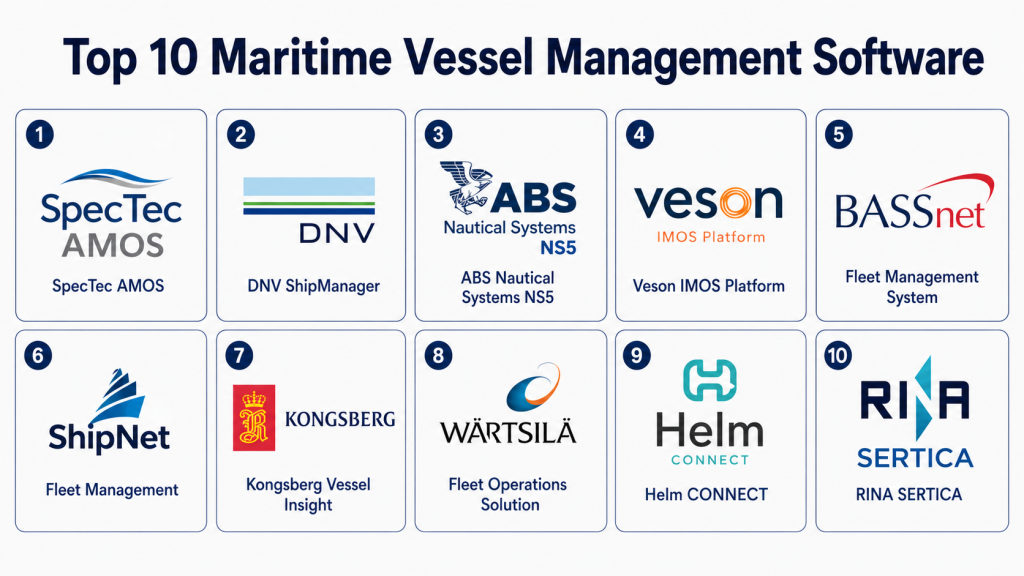
Top 10 Maritime Vessel Management Software
#1 — ABS Nautical Systems (NS5)
Short description:
ABS Nautical Systems NS5 is a comprehensive vessel management platform designed for maritime operations. It offers maintenance, compliance, and fleet management tools. The platform supports real-time monitoring and reporting. It is suitable for large fleets. It enhances efficiency and compliance.
Key Features
- Maintenance management
- Compliance tracking
- Fleet monitoring
- Reporting
- Integration support
Pros
- Industry-leading solution
- Scalable
Cons
- Complex setup
- Cost
Platforms / Deployment
Web / Cloud / Hybrid
Security & Compliance
Encryption, RBAC. Compliance: Not publicly stated
Integrations & Ecosystem
- Maritime systems
- APIs
Support & Community
Enterprise support with strong documentation
#2 — DNV ShipManager
Short description:
DNV ShipManager is a vessel management solution for fleet operations and compliance. It provides maintenance, procurement, and reporting tools. The platform integrates with maritime systems. It is suitable for large shipping companies. It improves operational efficiency.
Key Features
- Fleet management
- Maintenance
- Compliance
- Procurement
- Reporting
Pros
- Comprehensive features
- Reliable
Cons
- Complex implementation
- Cost
Platforms / Deployment
Web / Cloud
Security & Compliance
Encryption. Compliance: Not publicly stated
Integrations & Ecosystem
- Maritime systems
- APIs
Support & Community
Enterprise support
#3 — Kongsberg Vessel Insight
Short description:
Kongsberg Vessel Insight is a digital platform for vessel data and fleet management. It provides real-time monitoring and analytics. The platform integrates with onboard systems. It is suitable for modern fleets. It enhances decision-making and efficiency.
Key Features
- Real-time monitoring
- Data analytics
- Fleet management
- Integration support
- Alerts
Pros
- Advanced analytics
- Modern platform
Cons
- Cost
- Learning curve
Platforms / Deployment
Web / Cloud
Security & Compliance
Encryption. Compliance: Not publicly stated
Integrations & Ecosystem
- IoT systems
- APIs
Support & Community
Good support
#4 — Wärtsilä Fleet Operations Solution
Short description:
Wärtsilä Fleet Operations Solution is a maritime management platform for fleet optimization and monitoring. It offers real-time analytics and route optimization tools. The platform integrates with navigation systems. It is suitable for large fleets. It enhances efficiency.
Key Features
- Fleet monitoring
- Route optimization
- Analytics
- Integration support
- Alerts
Pros
- Strong optimization
- Scalable
Cons
- Cost
- Complex setup
Platforms / Deployment
Web / Cloud
Security & Compliance
Encryption. Compliance: Not publicly stated
Integrations & Ecosystem
- Navigation systems
- APIs
Support & Community
Enterprise support
#5 — ShipNet Fleet Management
Short description:
ShipNet Fleet Management is a solution for managing vessel operations and logistics. It offers maintenance, procurement, and reporting tools. The platform integrates with maritime systems. It is suitable for shipping companies. It enhances operational efficiency.
Key Features
- Fleet management
- Maintenance
- Procurement
- Reporting
- Integration support
Pros
- Flexible
- Scalable
Cons
- UI complexity
- Cost
Platforms / Deployment
Web / Cloud
Security & Compliance
Encryption. Compliance: Not publicly stated
Integrations & Ecosystem
- Maritime systems
- APIs
Support & Community
Good support
#6 — MarineCFO
Short description:
MarineCFO is a vessel management platform designed for maritime operations. It provides fleet management, maintenance, and reporting tools. The platform integrates with maritime systems. It is suitable for SMBs and enterprises. It improves efficiency.
Key Features
- Fleet management
- Maintenance
- Reporting
- Integration support
- Alerts
Pros
- Easy to use
- Flexible
Cons
- Limited advanced features
- Pricing varies
Platforms / Deployment
Web / Cloud
Security & Compliance
Not publicly stated
Integrations & Ecosystem
- Maritime systems
Support & Community
Standard support
#7 — BASSnet
Short description:
BASSnet is a vessel management solution for fleet operations and compliance. It offers maintenance, safety, and reporting tools. The platform integrates with maritime systems. It is suitable for large fleets. It enhances operational efficiency.
Key Features
- Fleet management
- Maintenance
- Safety management
- Reporting
- Integration support
Pros
- Comprehensive features
- Scalable
Cons
- Complex setup
- Cost
Platforms / Deployment
Web / Cloud
Security & Compliance
Encryption. Compliance: Not publicly stated
Integrations & Ecosystem
- Maritime systems
- APIs
Support & Community
Enterprise support
#8 — Veson IMOS Platform
Short description:
Veson IMOS Platform is a maritime operations system for fleet and logistics management. It offers scheduling, analytics, and reporting tools. The platform integrates with shipping systems. It is suitable for shipping companies. It enhances operational efficiency.
Key Features
- Fleet scheduling
- Analytics
- Reporting
- Integration support
- Alerts
Pros
- Strong analytics
- Flexible
Cons
- Learning curve
- Cost
Platforms / Deployment
Web / Cloud
Security & Compliance
Encryption. Compliance: Not publicly stated
Integrations & Ecosystem
- Shipping systems
- APIs
Support & Community
Good support
#9 — SpecTec AMOS
Short description:
SpecTec AMOS is a vessel management system for maintenance and operations. It offers fleet management, compliance, and reporting tools. The platform integrates with maritime systems. It is suitable for large fleets. It enhances efficiency.
Key Features
- Maintenance management
- Fleet tracking
- Compliance
- Reporting
- Integration support
Pros
- Reliable
- Scalable
Cons
- Complex UI
- Cost
Platforms / Deployment
Web / Cloud
Security & Compliance
Encryption. Compliance: Not publicly stated
Integrations & Ecosystem
- Maritime systems
Support & Community
Enterprise support
#10 — Helm CONNECT
Short description:
Helm CONNECT is a maritime software platform for vessel operations and maintenance. It offers fleet tracking, maintenance, and reporting tools. The platform integrates with maritime systems. It is suitable for SMBs and enterprises. It enhances efficiency.
Key Features
- Fleet management
- Maintenance
- Reporting
- Integration support
- Alerts
Pros
- Easy to use
- Flexible
Cons
- Limited advanced features
- Pricing varies
Platforms / Deployment
Web / Cloud
Security & Compliance
Encryption. Compliance: Not publicly stated
Integrations & Ecosystem
- Maritime systems
- APIs
Support & Community
Good support
Comparison Table (Top 10)
| Tool Name | Best For | Platform(s) Supported | Deployment | Standout Feature | Public Rating |
|---|---|---|---|---|---|
| ABS NS5 | Enterprise fleets | Web | Hybrid | Compliance | N/A |
| DNV ShipManager | Large fleets | Web | Cloud | Procurement | N/A |
| Kongsberg | Modern fleets | Web | Cloud | Analytics | N/A |
| Wärtsilä | Enterprise | Web | Cloud | Optimization | N/A |
| ShipNet | Shipping companies | Web | Cloud | Flexibility | N/A |
| MarineCFO | SMB | Web | Cloud | Simplicity | N/A |
| BASSnet | Large fleets | Web | Cloud | Safety mgmt | N/A |
| Veson IMOS | Logistics | Web | Cloud | Scheduling | N/A |
| SpecTec AMOS | Enterprise | Web | Cloud | Maintenance | N/A |
| Helm CONNECT | SMB/Enterprise | Web | Cloud | Ease of use | N/A |
Evaluation & Scoring of Maritime Vessel Management Software
| Tool Name | Core | Ease | Integrations | Security | Performance | Support | Value | Weighted Total |
|---|---|---|---|---|---|---|---|---|
| ABS NS5 | 9 | 6 | 9 | 8 | 9 | 9 | 7 | 8.3 |
| DNV | 9 | 6 | 9 | 8 | 9 | 9 | 7 | 8.3 |
| Kongsberg | 8 | 8 | 8 | 7 | 8 | 8 | 7 | 7.8 |
| Wärtsilä | 9 | 6 | 9 | 8 | 9 | 9 | 7 | 8.3 |
| ShipNet | 8 | 7 | 8 | 7 | 8 | 8 | 7 | 7.7 |
| MarineCFO | 7 | 9 | 7 | 6 | 7 | 7 | 8 | 7.4 |
| BASSnet | 9 | 6 | 9 | 8 | 9 | 9 | 7 | 8.3 |
| Veson IMOS | 8 | 7 | 8 | 7 | 8 | 8 | 7 | 7.7 |
| AMOS | 9 | 6 | 9 | 8 | 9 | 9 | 7 | 8.3 |
| Helm | 7 | 9 | 7 | 7 | 7 | 7 | 8 | 7.6 |
Which Maritime Vessel Management Software Is Right for You?
Solo / Small Operators
Basic tools may be sufficient.
SMB
MarineCFO and Helm CONNECT offer simplicity.
Mid-Market
ShipNet and Veson IMOS provide scalability.
Enterprise
ABS NS5, DNV, and Wärtsilä offer advanced capabilities.
Budget vs Premium
Budget tools focus on ease of use. Premium tools offer advanced analytics.
Feature Depth vs Ease of Use
Advanced tools require training.
Integrations & Scalability
Choose tools with maritime integrations.
Security & Compliance Needs
Look for encryption and compliance support.
Frequently Asked QuestionsFrequently Asked Questions
1. What is maritime vessel management software?
Maritime vessel management software is used to manage fleet operations, maintenance, and compliance from a centralized system. It helps shipping companies monitor vessels in real time. It improves operational efficiency and safety. It also ensures compliance with maritime regulations. This makes fleet management more streamlined and effective.
2. How much does maritime software cost?
Pricing depends on fleet size, features, and deployment model. Enterprise solutions are usually more expensive due to advanced capabilities. Smaller tools offer affordable pricing for limited fleets. Additional costs may include integrations and support. Businesses should evaluate ROI before choosing a solution.
3. Is maritime vessel management software secure?
Most platforms provide security features like encryption and role-based access control. Some also support advanced authentication methods. Security levels vary by vendor. Protecting operational and vessel data is critical. Always review security features before selecting a tool.
4. Can it integrate with other maritime systems?
Yes, most tools integrate with navigation systems, logistics platforms, and onboard sensors. These integrations improve operational efficiency and data accuracy. APIs allow customization and flexibility. Integration capabilities vary across platforms. It is important to verify compatibility before implementation.
5. How long does implementation take?
Implementation time depends on the complexity of the system and fleet size. Small setups may take a few weeks. Large enterprise deployments can take several months. Proper planning and configuration are required. Training staff is also essential for successful adoption.
6. Can small shipping companies use these tools?
Yes, many platforms are designed for small and mid-sized operators. They offer scalable features and flexible pricing. These tools help improve efficiency and reduce manual work. They also support business growth. Smaller companies can expand usage as their fleet grows.
7. What are common mistakes when choosing a tool?
Common mistakes include choosing based only on price and ignoring integration needs. Some businesses overlook scalability and usability. Poor planning can lead to implementation issues. Not testing the platform is another risk. Always align the tool with operational requirements.
8. How does AI help in maritime software?
AI helps optimize routes and reduce fuel consumption. It predicts maintenance needs and prevents downtime. AI improves decision-making with data insights. It also enhances operational efficiency. This leads to cost savings and better fleet performance.
9. Can these platforms scale with fleet growth?
Yes, most vessel management platforms are designed to scale. They support multiple vessels and complex operations. Enterprise tools handle global fleets. SMB tools can expand with additional features. Choosing a scalable solution ensures long-term value.
10. Can you switch vessel management software later?
Yes, switching is possible but requires proper planning. Data migration and system integration updates are needed. Staff training is also required. Some downtime may occur during transition. Choosing a flexible platform initially can reduce switching challenges.
Conclusion
Maritime Vessel Management Software plays a critical role in modernizing fleet operations, improving efficiency, and ensuring compliance with maritime regulations. These platforms enable shipping companies to manage vessels, optimize routes, and streamline maintenance processes, ultimately reducing operational costs and enhancing safety. With the integration of AI, real-time analytics, and cloud-based solutions, maritime software is evolving to support smarter and more connected fleets.
The best solution depends on fleet size and operational complexity. Enterprise tools like ABS Nautical Systems NS5, DNV ShipManager, and Wärtsilä Fleet Operations provide advanced capabilities for large fleets, while solutions like MarineCFO and Helm CONNECT offer simpler and more affordable options for smaller operators. Key considerations include scalability, integration capabilities, and ease of use.
To make the right choice, shortlist a few platforms, evaluate their features, and test their performance in real-world scenarios. Focus on long-term efficiency, compliance, and ROI. With the right vessel management software, organizations can improve operations, enhance safety, and drive sustainable growth in maritime operations.
