Introduction
Airline Reservation Systems are software platforms that manage flight bookings, ticketing, inventory, and passenger data for airlines. These systems are the backbone of airline operations, enabling real-time seat availability, pricing, and booking management across global distribution channels.
With increasing demand for digital travel and seamless booking experiences, modern airline reservation systems have evolved to include dynamic pricing, AI-driven demand forecasting, and integration with global distribution systems. They help airlines optimize revenue, improve customer experience, and streamline operations.
Common use cases:
- Managing flight bookings and ticketing
- Tracking seat inventory and availability
- Handling passenger data and profiles
- Integrating with travel agencies and platforms
- Automating pricing and revenue management
What buyers should evaluate:
- Booking and ticketing capabilities
- Integration with global distribution systems
- Pricing and revenue management features
- Scalability for airline operations
- Performance and reliability
- Security and data protection
- Ease of use and system flexibility
- Support and implementation services
Best for: Airlines, travel companies, and aviation service providers managing booking operations.
Not ideal for: Small businesses without airline or travel booking needs.
Key Trends in Airline Reservation Systems
- AI-driven pricing and demand forecasting
- Integration with global distribution systems
- Cloud-based reservation platforms
- Real-time booking and inventory updates
- Enhanced customer experience features
- Mobile-first booking interfaces
- Automation of ticketing and workflows
- Data-driven analytics and reporting
How We Evaluate Airline Reservation Systems (Methodology)
- Market adoption and industry presence
- Feature completeness and flexibility
- Integration ecosystem
- Performance and reliability
- Security capabilities
- Scalability across airline operations
- Ease of implementation
- Customer support quality
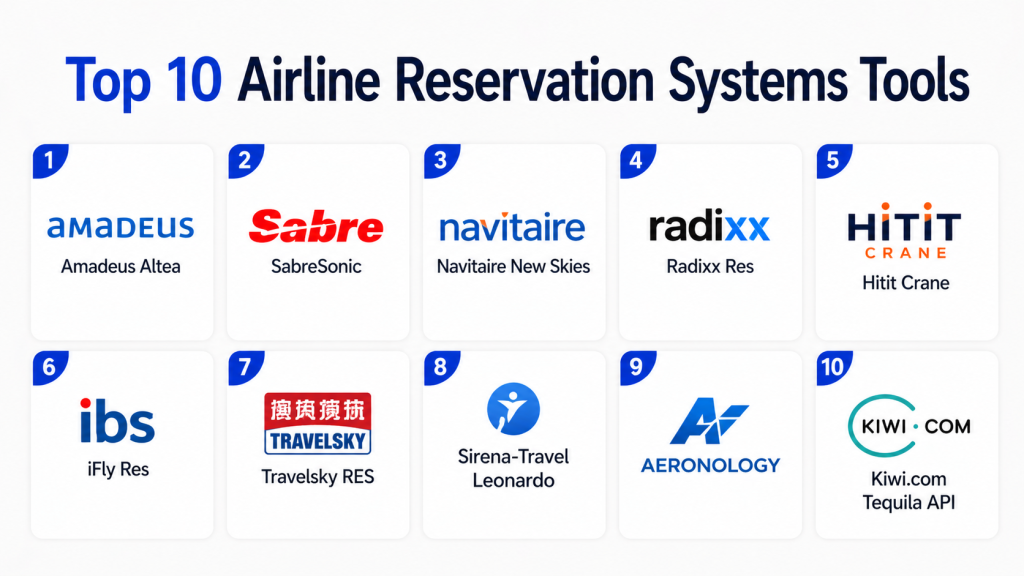
Top 10 Airline Reservation Systems
#1 — Amadeus Altea
Short description:
Amadeus Altea is a leading airline reservation system used by major airlines globally. It provides booking, inventory, and departure control features. The platform supports large-scale operations. It improves efficiency and customer experience.
Key Features
- Reservation management
- Inventory control
- Departure control
- Revenue management
Pros
- Industry leader
- Highly scalable
Cons
- Complex implementation
- High cost
Platforms / Deployment
Web / Cloud
Security & Compliance
Not publicly stated
Integrations & Ecosystem
Integrates with global distribution systems.
- Travel agencies
- Airline systems
Support & Community
Enterprise support.
#2 — SabreSonic
Short description:
SabreSonic is a comprehensive airline reservation platform providing booking and revenue management features. It supports global airline operations. The platform is suitable for large airlines. It enhances efficiency.
Key Features
- Booking management
- Pricing
- Inventory control
- Analytics
Pros
- Strong features
- Global reach
Cons
- Expensive
- Complex setup
Platforms / Deployment
Web / Cloud
Security & Compliance
Not publicly stated
Integrations & Ecosystem
Integrates with airline systems.
- GDS platforms
- Travel tools
Support & Community
Enterprise support.
#3 — Navitaire New Skies
Short description:
Navitaire New Skies is a reservation system designed for low-cost carriers. It provides booking and revenue management features. The platform is scalable. It is suitable for growing airlines.
Key Features
- Reservation management
- Revenue management
- Inventory control
- Reporting
Pros
- Cost-effective
- Scalable
Cons
- Limited advanced features
- Customization challenges
Platforms / Deployment
Web / Cloud
Security & Compliance
Not publicly stated
Integrations & Ecosystem
Supports integrations with airline tools.
- Travel platforms
Support & Community
Good support.
#4 — Radixx Res
Short description:
Radixx Res is a cloud-based airline reservation system offering booking and ticketing features. It is suitable for mid-sized airlines. It provides flexibility and efficiency.
Key Features
- Booking management
- Ticketing
- Inventory control
- Reporting
Pros
- Flexible
- Cloud-based
Cons
- Limited enterprise features
- Pricing varies
Platforms / Deployment
Web / Cloud
Security & Compliance
Not publicly stated
Integrations & Ecosystem
Integrates with airline systems.
- Travel platforms
Support & Community
Reliable support.
#5 — Hitit Crane
Short description:
Hitit Crane is an airline reservation system offering booking and operational features. It supports airlines with integrated solutions. The platform is scalable. It improves efficiency.
Key Features
- Reservation management
- Inventory control
- Revenue management
- Reporting
Pros
- Integrated solution
- Scalable
Cons
- Limited global adoption
- Complex setup
Platforms / Deployment
Web / Cloud
Security & Compliance
Not publicly stated
Integrations & Ecosystem
Supports integrations with airline systems.
- GDS platforms
Support & Community
Reliable support.
#6 — IBS iFly Res
Short description:
IBS iFly Res is a reservation system designed for airlines and travel companies. It offers booking, inventory, and customer management features. It is suitable for enterprises. It improves operations.
Key Features
- Booking management
- Inventory control
- Customer management
- Reporting
Pros
- Enterprise-ready
- Flexible
Cons
- Complex implementation
- Pricing varies
Platforms / Deployment
Web / Cloud
Security & Compliance
Not publicly stated
Integrations & Ecosystem
Integrates with airline tools.
- Travel platforms
Support & Community
Enterprise support.
#7 — Travelsky RES
Short description:
Travelsky RES is a reservation system widely used in specific regions. It provides booking and inventory management features. It supports airline operations. It is suitable for regional airlines.
Key Features
- Reservation management
- Inventory control
- Ticketing
- Reporting
Pros
- Regional strength
- Reliable
Cons
- Limited global reach
- Customization limitations
Platforms / Deployment
Web / Cloud
Security & Compliance
Not publicly stated
Integrations & Ecosystem
Supports integrations with airline systems.
- Travel platforms
Support & Community
Reliable support.
#8 — Sirena-Travel Leonardo
Short description:
Sirena-Travel Leonardo is a reservation system offering booking and ticketing features. It supports airline operations. It is suitable for regional carriers. It provides reliability.
Key Features
- Booking management
- Ticketing
- Inventory control
- Reporting
Pros
- Reliable
- Regional focus
Cons
- Limited features
- Smaller ecosystem
Platforms / Deployment
Web / Cloud
Security & Compliance
Not publicly stated
Integrations & Ecosystem
Supports integrations with airline systems.
- Travel tools
Support & Community
Moderate support.
#9 — Aeronology
Short description:
Aeronology is a reservation system designed for airlines and travel companies. It offers booking and ticketing features. The platform is flexible. It is suitable for growing airlines.
Key Features
- Booking management
- Ticketing
- Inventory control
- Reporting
Pros
- Flexible
- Easy to use
Cons
- Limited advanced features
- Smaller ecosystem
Platforms / Deployment
Web / Cloud
Security & Compliance
Not publicly stated
Integrations & Ecosystem
Supports integrations with airline tools.
- Travel platforms
Support & Community
Good support.
#10 — Kiwi.com Tequila API
Short description:
Kiwi.com Tequila API is a booking platform that enables flight search and reservations. It is suitable for developers and travel platforms. It provides flexibility and integration capabilities.
Key Features
- Flight search
- Booking integration
- API access
- Data aggregation
Pros
- Developer-friendly
- Flexible
Cons
- Requires technical setup
- Limited direct airline features
Platforms / Deployment
Web / Cloud
Security & Compliance
Not publicly stated
Integrations & Ecosystem
Integrates with travel platforms.
- APIs
- Booking systems
Support & Community
Moderate support.
Comparison Table
| Tool Name | Best For | Platform(s) | Deployment | Standout Feature | Public Rating |
|---|---|---|---|---|---|
| Amadeus Altea | Enterprise | Web | Cloud | Scalability | N/A |
| SabreSonic | Enterprise | Web | Cloud | Global reach | N/A |
| Navitaire | LCC | Web | Cloud | Cost efficiency | N/A |
| Radixx | Mid-market | Web | Cloud | Flexibility | N/A |
| Hitit Crane | Growing airlines | Web | Cloud | Integration | N/A |
| IBS iFly | Enterprise | Web | Cloud | Flexibility | N/A |
| Travelsky | Regional | Web | Cloud | Reliability | N/A |
| Sirena | Regional | Web | Cloud | Stability | N/A |
| Aeronology | SMB airlines | Web | Cloud | Ease of use | N/A |
| Kiwi API | Developers | Web | Cloud | API access | N/A |
Evaluation & Scoring Table
| Tool | Core | Ease | Integrations | Security | Performance | Support | Value | Total |
|---|---|---|---|---|---|---|---|---|
| Amadeus | 10 | 7 | 9 | 8 | 10 | 9 | 7 | 8.8 |
| Sabre | 10 | 7 | 9 | 8 | 10 | 9 | 7 | 8.8 |
| Navitaire | 9 | 8 | 8 | 7 | 9 | 8 | 8 | 8.3 |
| Radixx | 8 | 8 | 7 | 7 | 8 | 7 | 8 | 7.8 |
| Hitit | 8 | 7 | 7 | 7 | 8 | 7 | 8 | 7.7 |
| IBS | 9 | 7 | 8 | 7 | 9 | 8 | 7 | 8.0 |
| Travelsky | 8 | 7 | 7 | 7 | 8 | 7 | 8 | 7.6 |
| Sirena | 7 | 7 | 6 | 6 | 7 | 6 | 8 | 7.0 |
| Aeronology | 7 | 8 | 6 | 6 | 7 | 7 | 8 | 7.2 |
| Kiwi API | 8 | 6 | 9 | 6 | 8 | 7 | 8 | 7.7 |
Which Airline Reservation System Is Right for You?
Small / Regional Airlines
If you are a regional or small airline, platforms like Aeronology or Sirena-Travel Leonardo are suitable. These tools provide essential booking and ticketing features without high complexity. They are easier to implement and manage. They support basic operations efficiently. For smaller carriers, affordability and simplicity are key.
Low-Cost Carriers
Low-cost airlines should consider solutions like Navitaire New Skies. These platforms are designed for high-volume bookings and cost efficiency. They provide revenue management and inventory control features. They help optimize operations and pricing. These tools are ideal for budget-focused airlines.
Mid-Market Airlines
Mid-sized airlines can benefit from platforms like Radixx Res or Hitit Crane. These systems offer a balance of flexibility and advanced features. They support booking, inventory, and reporting. They also provide integration capabilities. These tools are suitable for growing airlines.
Enterprise / Global Airlines
Large airlines should choose platforms like Amadeus Altea or SabreSonic. These systems offer enterprise-grade capabilities and scalability. They support complex operations and global distribution. They provide advanced analytics and automation. These platforms are industry leaders.
Budget vs Premium
Budget systems provide essential booking and inventory features at lower cost. Premium systems offer advanced analytics, automation, and integrations. If your operations are simple, budget tools are sufficient. For global operations, premium platforms are better. Choose based on your scale.
Feature Depth vs Ease of Use
Some systems offer advanced features but require training and implementation effort. Others are simple but limited in functionality. Smaller airlines should prioritize ease of use. Larger airlines benefit from feature-rich platforms. The right balance depends on your needs.
Integrations & Scalability
Airline systems must integrate with global distribution systems and travel platforms. This ensures seamless booking and operations. Scalability is critical for growth. Choose platforms that can handle increasing demand. Integration capability is essential.
Security & Compliance Needs
Airline systems handle sensitive passenger data, so security is critical. Choose platforms with strong data protection and compliance features. Enterprises should prioritize secure systems. Protecting customer data ensures trust and reliability. Security should always be evaluated.
Frequently Asked Questions (FAQs)
1. What is an airline reservation system?
An airline reservation system is software used to manage flight bookings and ticketing. It tracks seat availability and passenger data. It also handles pricing and inventory. These systems are essential for airline operations. They improve efficiency and accuracy.
2. Who uses airline reservation systems?
Airlines, travel agencies, and booking platforms use these systems. They help manage bookings and customer data. They are used for both domestic and international travel. These tools support large-scale operations. They are essential in the aviation industry.
3. Can small airlines use these systems?
Yes, many systems are designed for small and regional airlines. They offer basic features and lower cost options. These tools help manage bookings efficiently. They are scalable for growth. Small airlines can benefit from them.
4. Do these systems integrate with travel platforms?
Yes, most systems integrate with global distribution systems and travel platforms. This allows seamless booking across channels. Integration improves efficiency and reach. Compatibility is important. Always check integration options.
5. How do airline systems handle pricing?
These systems use dynamic pricing models. Prices change based on demand, availability, and other factors. This helps maximize revenue. Pricing automation is a key feature. It improves profitability.
6. Are airline reservation systems secure?
Security depends on the platform. Many systems offer secure data handling and access control. Some include compliance features. Airlines must evaluate security carefully. Protecting passenger data is critical.
7. What features should I look for?
Look for booking management, inventory control, and pricing features. Integration with travel platforms is important. Ease of use should also be considered. Choose features based on your needs. Scalability is key.
8. Can these systems handle large operations?
Yes, enterprise systems are designed for large-scale operations. They can handle high booking volumes and complex workflows. They support global operations. Performance and scalability are important. These systems are highly reliable.
9. What are common challenges with these systems?
Common challenges include high cost and complex implementation. Integration issues may also occur. Training may be required for staff. These challenges depend on the platform. Proper planning helps overcome them.
10. What are alternatives to airline reservation systems?
Alternatives include manual booking or basic software. These are less efficient and error-prone. Reservation systems provide automation and accuracy. They improve operations and customer experience. They are essential for modern airlines.Conclusion
Airline Reservation Systems are critical for managing bookings, inventory, and customer data in the aviation industry. They enable airlines to operate efficiently, optimize revenue, and provide seamless booking experiences to customers.
Choosing the right system depends on airline size, operational complexity, and integration needs. Large airlines require enterprise-grade solutions, while smaller carriers can benefit from flexible and cost-effective platforms.
Start by evaluating your operational requirements, testing available systems, and ensuring compatibility with existing tools. The right airline reservation system will improve efficiency, scalability, and customer satisfaction.
