Introduction
Reservation Management Software helps businesses manage bookings, reservations, and customer scheduling efficiently. These platforms are widely used in industries like hospitality, restaurants, travel, and events to streamline operations and improve customer experience.
In a digital-first world, customers expect real-time booking and instant confirmation. Reservation software enables businesses to automate bookings, manage availability, reduce errors, and optimize capacity. Modern tools also provide analytics, integrations, and automation to enhance efficiency and revenue.
Common use cases:
- Managing hotel and restaurant reservations
- Handling event and ticket bookings
- Scheduling customer appointments
- Managing availability and capacity
- Automating confirmations and reminders
What buyers should evaluate:
- Ease of use and interface
- Booking and scheduling features
- Integration with payment and CRM systems
- Automation and notifications
- Scalability across locations
- Reporting and analytics
- Security and data protection
- Support and onboarding
Best for: Restaurants, hotels, event organizers, travel companies, and service providers.
Not ideal for: Small businesses with minimal booking needs or manual processes.
Key Trends in Reservation Management Software
- Real-time booking and availability updates
- Mobile-first reservation systems
- Integration with payment gateways
- AI-driven demand forecasting
- Customer experience personalization
- Cloud-based deployment
- Automated notifications and reminders
- Integration with CRM and POS systems
How We Evaluate Reservation Management Software (Methodology)
- Market adoption and popularity
- Feature completeness and flexibility
- Ease of use and onboarding
- Integration ecosystem
- Performance and reliability
- Security capabilities
- Scalability across businesses
- Customer support quality
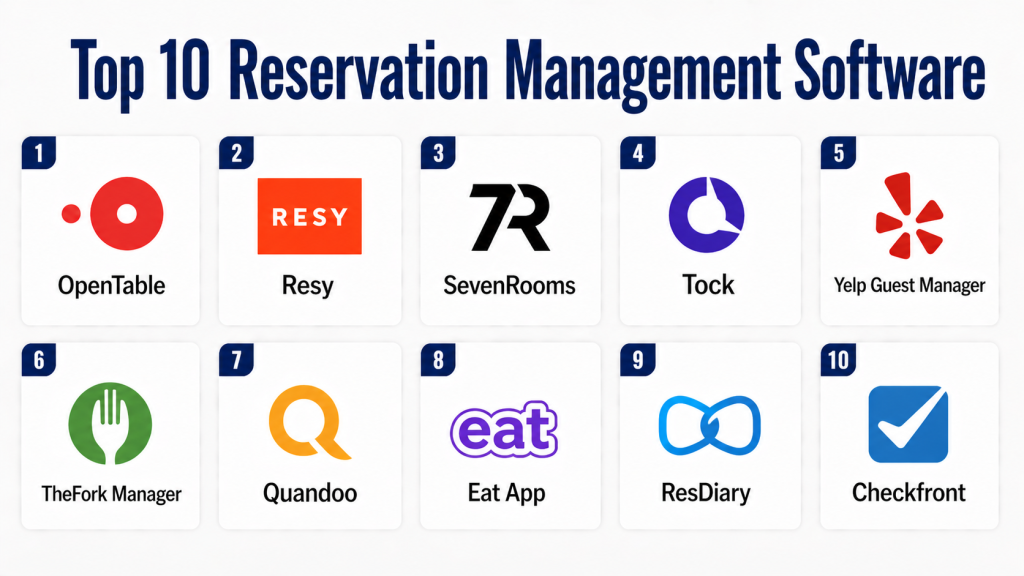
Top 10 Reservation Management Software
#1 — OpenTable
Short description:
OpenTable is a leading restaurant reservation platform used globally. It allows customers to book tables online and helps restaurants manage reservations. The platform provides analytics and customer insights. It improves efficiency and guest experience.
Key Features
- Online reservations
- Table management
- Customer insights
- Notifications
Pros
- Widely adopted
- Easy to use
Cons
- Subscription cost
- Restaurant-focused
Platforms / Deployment
Web, Mobile / Cloud
Security & Compliance
Not publicly stated
Integrations & Ecosystem
Integrates with restaurant systems.
- POS systems
- CRM tools
Support & Community
Strong support.
#2 — Resy
Short description:
Resy is a modern restaurant reservation platform focused on customer experience. It offers booking, waitlist management, and analytics. The platform is suitable for restaurants. It enhances guest engagement.
Key Features
- Reservation management
- Waitlist
- Customer insights
- Notifications
Pros
- Good user experience
- Strong analytics
Cons
- Limited to restaurants
- Pricing varies
Platforms / Deployment
Web, Mobile / Cloud
Security & Compliance
Not publicly stated
Integrations & Ecosystem
Supports integrations with restaurant tools.
- POS systems
Support & Community
Reliable support.
#3 — SevenRooms
Short description:
SevenRooms is a reservation and guest management platform for hospitality businesses. It provides booking, CRM, and analytics features. The platform is suitable for restaurants and hotels. It improves customer experience.
Key Features
- Reservation management
- CRM
- Analytics
- Automation
Pros
- Strong analytics
- Customer insights
Cons
- Higher pricing
- Complex setup
Platforms / Deployment
Web / Cloud
Security & Compliance
Not publicly stated
Integrations & Ecosystem
Integrates with hospitality systems.
- POS tools
- CRM systems
Support & Community
Enterprise support.
#4 — Bookatable
Short description:
Bookatable is a restaurant reservation system that helps manage bookings and customer flow. It provides online reservations and analytics. The platform is suitable for restaurants. It improves operational efficiency.
Key Features
- Online booking
- Table management
- Analytics
- Notifications
Pros
- Easy to use
- Reliable
Cons
- Limited features
- Smaller ecosystem
Platforms / Deployment
Web / Cloud
Security & Compliance
Not publicly stated
Integrations & Ecosystem
Supports integrations with restaurant systems.
- POS tools
Support & Community
Good support.
#5 — Tock
Short description:
Tock is a reservation platform for restaurants and events. It supports prepaid reservations and ticketing. The platform is suitable for hospitality businesses. It improves revenue management.
Key Features
- Reservation management
- Prepaid booking
- Event management
- Analytics
Pros
- Revenue optimization
- Flexible
Cons
- Complex setup
- Pricing varies
Platforms / Deployment
Web / Cloud
Security & Compliance
Not publicly stated
Integrations & Ecosystem
Integrates with hospitality tools.
- Payment systems
- POS tools
Support & Community
Good support.
#6 — Resova
Short description:
Resova is a reservation management platform for tours and activities. It provides booking, scheduling, and customer management features. The platform is suitable for travel businesses. It improves efficiency.
Key Features
- Booking management
- Scheduling
- Customer management
- Notifications
Pros
- Industry-specific
- Easy to use
Cons
- Limited customization
- Smaller ecosystem
Platforms / Deployment
Web / Cloud
Security & Compliance
Not publicly stated
Integrations & Ecosystem
Supports integrations with travel tools.
- Booking platforms
Support & Community
Reliable support.
#7 — Checkfront
Short description:
Checkfront is a reservation system for tours, rentals, and activities. It provides booking and payment features. The platform is suitable for service businesses. It improves customer experience.
Key Features
- Booking management
- Payment integration
- Scheduling
- Reporting
Pros
- Flexible
- Scalable
Cons
- Learning curve
- Pricing varies
Platforms / Deployment
Web / Cloud
Security & Compliance
Not publicly stated
Integrations & Ecosystem
Integrates with business tools.
- Payment systems
- CRM tools
Support & Community
Good support.
#8 — FareHarbor
Short description:
FareHarbor is a booking platform for tours and activities. It provides reservation management and payment features. The platform is suitable for travel businesses. It improves efficiency.
Key Features
- Booking management
- Payments
- Scheduling
- Reporting
Pros
- Industry-focused
- Reliable
Cons
- Limited customization
- Pricing varies
Platforms / Deployment
Web / Cloud
Security & Compliance
Not publicly stated
Integrations & Ecosystem
Supports integrations with travel tools.
- Booking platforms
Support & Community
Reliable support.
#9 — Peek Pro
Short description:
Peek Pro is a reservation management platform for tours and experiences. It offers booking, scheduling, and marketing tools. The platform is suitable for businesses. It enhances customer engagement.
Key Features
- Booking management
- Scheduling
- Marketing tools
- Reporting
Pros
- Feature-rich
- Good support
Cons
- Higher pricing
- Complex setup
Platforms / Deployment
Web / Cloud
Security & Compliance
Not publicly stated
Integrations & Ecosystem
Integrates with business tools.
- CRM tools
- Marketing platforms
Support & Community
Strong support.
#10 — SimplyBook.me
Short description:
SimplyBook.me is a flexible booking platform for service businesses. It provides reservation, payment, and scheduling features. The platform is suitable for various industries. It improves efficiency.
Key Features
- Booking management
- Payment integration
- Scheduling
- Notifications
Pros
- Flexible
- Easy to use
Cons
- Learning curve
- Pricing varies
Platforms / Deployment
Web / Cloud
Security & Compliance
Not publicly stated
Integrations & Ecosystem
Supports integrations with business tools.
- Payment systems
- CRM tools
Support & Community
Reliable support.
Comparison Table
| Tool Name | Best For | Platform(s) | Deployment | Standout Feature | Public Rating |
|---|---|---|---|---|---|
| OpenTable | Restaurants | Web/Mobile | Cloud | Popularity | N/A |
| Resy | Restaurants | Web/Mobile | Cloud | UX | N/A |
| SevenRooms | Hospitality | Web | Cloud | CRM | N/A |
| Bookatable | Restaurants | Web | Cloud | Simplicity | N/A |
| Tock | Events | Web | Cloud | Prepaid | N/A |
| Resova | Tours | Web | Cloud | Industry focus | N/A |
| Checkfront | Rentals | Web | Cloud | Flexibility | N/A |
| FareHarbor | Travel | Web | Cloud | Reliability | N/A |
| Peek Pro | Experiences | Web | Cloud | Marketing | N/A |
| SimplyBook | Services | Web | Cloud | Flexibility | N/A |
Evaluation & Scoring Table
| Tool | Core | Ease | Integrations | Security | Performance | Support | Value | Total |
|---|---|---|---|---|---|---|---|---|
| OpenTable | 9 | 9 | 8 | 7 | 9 | 9 | 8 | 8.6 |
| Resy | 8 | 9 | 7 | 7 | 8 | 8 | 8 | 8.1 |
| SevenRooms | 9 | 7 | 8 | 7 | 9 | 8 | 7 | 8.1 |
| Bookatable | 7 | 9 | 6 | 6 | 7 | 7 | 8 | 7.4 |
| Tock | 9 | 7 | 8 | 7 | 9 | 8 | 7 | 8.1 |
| Resova | 8 | 8 | 7 | 6 | 8 | 7 | 8 | 7.7 |
| Checkfront | 8 | 8 | 8 | 6 | 8 | 7 | 8 | 7.9 |
| FareHarbor | 8 | 8 | 7 | 6 | 8 | 7 | 8 | 7.7 |
| Peek Pro | 9 | 7 | 8 | 7 | 9 | 8 | 7 | 8.1 |
| SimplyBook | 8 | 8 | 7 | 6 | 8 | 7 | 8 | 7.7 |
Which Reservation Management Software Is Right for You?
Solo / Small Businesses
If you run a small restaurant, service, or local business, tools like SimplyBook.me or Resova are ideal. These platforms are easy to use and quick to set up. They provide essential features like booking, scheduling, and notifications. You don’t need complex integrations at this stage. For small operations, simplicity and affordability are key factors.
SMB / Growing Businesses
Small to mid-sized businesses should consider tools like OpenTable or Checkfront. These platforms offer better booking management, customer tracking, and payment integration. They help streamline operations and improve customer experience. They are suitable for restaurants, rentals, and service businesses. These tools provide a strong balance of features and usability.
Mid-Market / Multi-Location Operations
Businesses managing multiple locations can benefit from tools like SevenRooms or Tock. These platforms offer advanced features like CRM, analytics, and centralized control. They help manage high booking volumes efficiently. They also provide insights into customer behavior. These tools are ideal for scaling operations.
Enterprise / Large-Scale Businesses
Large enterprises should choose platforms like Peek Pro or enterprise-grade reservation systems. These tools offer automation, integrations, and scalability. They support complex workflows and large customer volumes. They also provide reporting and analytics features. These platforms are designed for high-performance environments.
Budget vs Premium
Budget tools provide basic booking and scheduling features at a lower cost. Premium tools offer advanced analytics, integrations, and automation. If your needs are simple, budget tools are sufficient. For larger operations and better customer insights, premium tools are better. Choose based on your business goals.
Feature Depth vs Ease of Use
Some tools offer advanced capabilities but require setup and training. Others are simple but limited in functionality. Beginners should prioritize ease of use. Advanced users can benefit from feature-rich platforms. The right choice depends on your operational needs.
Integrations & Scalability
Reservation software should integrate with payment systems, CRM, and POS tools. This improves workflow efficiency and automation. Scalability is important for growing businesses. Choose platforms that can handle increased demand. Integration capability ensures long-term success.
Security & Compliance Needs
Reservation systems handle customer data, so security is critical. Choose platforms with secure data handling and access control. Businesses should review privacy policies carefully. Enterprise users should prioritize compliance features. Protecting customer data is essential.
Frequently Asked Questions (FAQs)
1. What is reservation management software?
Reservation management software is a digital tool used to manage bookings and customer reservations. It helps businesses track availability and schedule bookings. It replaces manual systems with automated processes. It improves efficiency and reduces errors. It is widely used in hospitality and service industries.
2. Can reservation software improve customer experience?
Yes, it allows customers to book easily and receive instant confirmation. It reduces waiting time and improves convenience. Automated notifications keep customers informed. This leads to better satisfaction. It enhances overall service quality.
3. Is reservation software suitable for small businesses?
Yes, small businesses can benefit from basic reservation tools. These platforms are easy to use and affordable. They help organize bookings and reduce manual work. Even small operations can improve efficiency. It depends on business needs.
4. Can these tools integrate with other systems?
Yes, many platforms integrate with CRM, POS, and payment systems. Integration improves workflow and data accuracy. It allows better management of operations. Compatibility is important. Always check integration options.
5. Do reservation systems support online payments?
Many tools support payment integration. Customers can pay while booking reservations. This improves convenience and reduces cancellations. Payment features depend on the platform. It is useful for service businesses.
6. Are reservation management tools secure?
Security depends on the provider. Many tools offer secure data handling and access control. Some include compliance features. Businesses should evaluate security before choosing. Protecting customer data is important.
7. Can reservation software handle multiple locations?
Yes, many tools support multi-location management. This is useful for growing businesses. It allows centralized control of bookings. It improves efficiency across locations. Enterprise tools are best for this.
8. What features should I look for?
Look for booking management, notifications, and reporting features. Integration with other systems is important. Ease of use should also be considered. Choose features based on your needs. Scalability is key.
9. What are common mistakes when choosing software?
Choosing overly complex tools is a common mistake. Ignoring integration needs can cause issues. Not considering scalability can limit growth. Overpaying for unused features is another issue. Proper evaluation is important.
10. What are alternatives to reservation management software?
Alternatives include manual booking systems or spreadsheets. These are less efficient and prone to errors. Software solutions provide automation and insights. They improve efficiency and customer experience. They are better for modern businesses.
Conclusion
Reservation Management Software has become essential for businesses that rely on bookings and customer scheduling. It replaces manual processes with automated systems that improve efficiency, reduce errors, and enhance the overall customer experience. With features like real-time availability, notifications, and analytics, these tools help businesses operate more effectively and deliver better service.
Choosing the right solution depends on your business size, industry, and operational complexity. Small businesses can benefit from simple and cost-effective tools, while larger organizations require advanced platforms with integrations, analytics, and scalability. Evaluating ease of use, feature depth, and integration capabilities is critical to making the right decision.
To get started, shortlist a few platforms that align with your needs and test their functionality. Ensure compatibility with your existing systems and review security features before implementation. The right reservation management software will not only streamline operations but also improve customer satisfaction and support long-term business growth.
