Introduction
Shipping Rate Management Tools are specialized solutions that help businesses calculate, compare, and optimize shipping costs across carriers and delivery options. In plain terms, they remove guesswork and manual rate lookups so that online sellers, warehouses, and logistics teams can offer accurate shipping rates at checkout, automate carrier selection, and minimize shipping spend. In a world where customer expectations for fast, affordable delivery continue to rise, shipping rate management is no longer a luxury — it’s a competitive necessity.
These tools are especially relevant in as more businesses adopt omnichannel selling, dynamic pricing, and marketplace‑driven logistics. Fluctuating carrier costs, international delivery complexity, and demand for same‑day or next‑day delivery mean sellers must be agile and data‑driven. Shipping rate management sits at the intersection of operations, customer experience, and profitability.
Use cases include:
- E‑commerce stores showing real‑time carrier rates at checkout
- 3PLs (third‑party logistics) optimizing parcel spend across FedEx, UPS, DHL, and regional carriers
- Marketplaces aggregating multiple sellers with diverse shipping cost structures
- Enterprises managing high‑volume domestic and cross‑border logistics
- Automated ERP and WMS systems sending orders to carriers with the best cost‑to‑service match
When evaluating shipping rate management tools, buyers should consider:
- Carrier coverage (regional, international, postal, freight)
- Real‑time rate accuracy and update frequency
- Rate rules and markup flexibility
- Packaging optimization and dimensional pricing support
- Checkout integration experience
- API accessibility and extensibility
- Reporting and analytics granularity
- Security and compliance standards
- Usability for operations teams
- Cost / pricing transparency
Best for: E‑commerce operations managers, logistics planners, CTOs of retail and marketplace businesses, shipping and fulfillment teams at SMB to enterprise scale.
Not ideal for: Small sellers with minimal shipping volume who can rely on carrier rate cards manually; stores with very simple, flat‑rate shipping needs where advanced management tools add complexity without clear ROI.
Key Trends in Shipping Rate Management Tools
- AI‑powered rate prediction and carrier selection, reducing cost while maintaining service levels
- Dynamic rate adjustments based on demand, inventory location, and delivery windows
- APIs for seamless integration with checkout platforms, marketplaces, ERPs, and warehouse systems
- Dimensional weight and cubic optimization to lower freight spend
- Multi‑carrier support beyond parcel — LTL, FTL, and postal‑regional mixes
- Cloud‑native platforms with web dashboards and mobile capabilities
- Automated shipping rules and conditional pricing markup strategies
- Enhanced reporting with cost segmentation by SKU, region, or customer cohort
- Omnichannel fulfillment logic tied to rate decisions
- Security focus with enterprise access control, audit logs, and compliance for global operations
How We Selected These Tools (Methodology)
- Reviewed market adoption and mindshare across SMB and enterprise shipping environments
- Assessed feature completeness (real‑time rates, rules engine, carrier breadth)
- Examined reliability and performance signals (uptime, latency, data accuracy)
- Evaluated security posture (encryption, SSO, MFA, audit trails) where publicly stated
- Measured integration strength (APIs, native e‑commerce checkout extensions)
- Considered support and documentation quality
- Looked at pricing and total value delivered for typical users
- Balanced fit for different company sizes and delivery complexity
- Prioritized tools with forward‑looking capabilities (AI/automation, analytics)
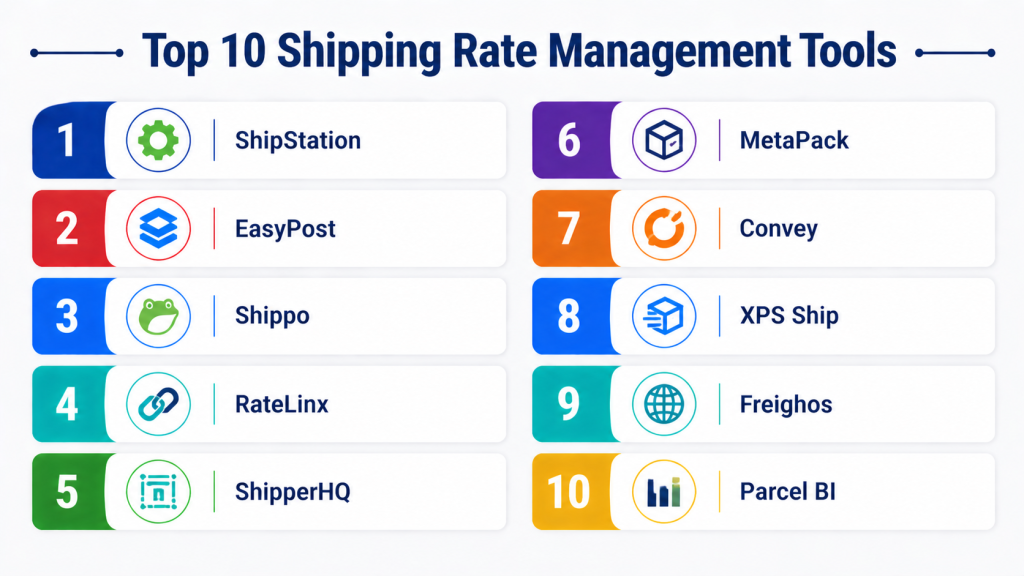
Top 10 Shipping Rate Management Tools
#1 — ShipStation
Short description: ShipStation is a cloud‑based shipping management platform widely adopted by e‑commerce sellers for rate comparison, order fulfillment automation, and multi‑carrier support. It’s suitable for SMBs and mid‑market brands seeking to streamline shipping operations with flexible carrier contracts and real‑time quoting.
Key Features
- Real‑time carrier rate comparison
- Automation rules and batch processing
- Multi‑channel order import
- Custom packing slips and branding
- Reporting and cost analytics
- Carrier options for domestic and international delivery
- Discounted negotiated rates
Pros
- Easy onboarding and intuitive UI
- Strong automation capabilities for order workflows
- Good carrier coverage for parcel services
Cons
- Premium features can be expensive for high volume shippers
- Less suited for LTL/FTL freight use cases
Platforms / Deployment
- Web / Cloud
Security & Compliance
- Not publicly stated specific certifications
- Standard web security controls assumed
Integrations & Ecosystem
ShipStation integrates broadly with online marketplaces and shopping carts:
- E‑commerce platforms (major carts)
- Marketplaces (big marketplaces)
- Shipping carriers
- ERP/Warehouse systems via API
Support & Community
Documentation, email and chat support; active user community forums.
#2 — EasyPost
Short description: EasyPost is a developer‑friendly shipping API that enables real‑time rate shopping across carriers and customizable shipping workflows. It’s tailored for businesses with technical resources wanting full API control without a standalone UI focus.
Key Features
- Unified RESTful API for carriers
- Rate shopping across domestic and international carriers
- Tracking and label generation
- Address validation
- Webhooks for event notifications
- Support for parcel and freight services
Pros
- Highly flexible and programmable
- Broad carrier coverage via API
Cons
- Requires development resources for integration
- Not a plug‑and‑play dashboard for non‑technical teams
Platforms / Deployment
- Web API / Cloud
Security & Compliance
- Encryption standard practices
- Data security managed by provider
Integrations & Ecosystem
Extensible via API:
- Custom checkout systems
- Warehouse and ERP systems
- Shipping label providers
- Internal fulfillment logic
Support & Community
API documentation and developer support; community forums.
#3 — Shippo
Short description: Shippo is a scalable shipping API and dashboard that offers rate management, multi‑carrier label purchasing, and fulfillment workflows suitable for SMBs and marketplace sellers.
Key Features
- Live rate comparison
- Multi‑carrier label generation
- Batch shipping and automation
- Tracking and notifications
- Easy returns management
- Shipping cost analytics
Pros
- Simple onboarding with web UI
- Affordable for small to medium shippers
Cons
- Fewer enterprise‑grade analytics than some peers
- Support tiers vary by plan
Platforms / Deployment
- Web / Cloud
Security & Compliance
- Not publicly stated specifics
- Standard cloud provider security
Integrations & Ecosystem
- E‑commerce platforms
- Marketplaces
- Carrier services
- API access for custom integrations
Support & Community
Email support and help center resources; knowledge base.
#4 — RateLinx
Short description: RateLinx is an enterprise rate management tool focusing on large shippers that need carrier contract analysis, multi‑modal rate shopping, and transportation spend optimization.
Key Features
- Contract rate management
- Intelligent carrier selection logic
- Multi‑modal support (parcel, LTL/FTL)
- Cost benchmarking and analytics
- Carrier performance insights
- Automation of rate rules
Pros
- Strong for large, complex shipping portfolios
- Detailed cost analytics
Cons
- Higher complexity and cost
- Suitability skews toward enterprise
Platforms / Deployment
- Web / Cloud
Security & Compliance
- Not publicly stated; enterprise controls assumed
Integrations & Ecosystem
- ERP and TMS systems
- Carrier feeds
- BI and analytics platforms
Support & Community
Dedicated account support for enterprise customers; documentation provided.
#5 — ShipperHQ
Short description: ShipperHQ helps online retailers control shipping rate logic at checkout with advanced rate rules, carrier options, and multi‑origin support. It’s ideal for complex e‑commerce environments.
Key Features
- Advanced shipping rules engine
- Real‑time carrier rate management
- Delivery options and service level choices
- Dimensional weight handling
- Multi‑origin support
- Storefront rate customization
Pros
- Granular control over rate logic
- Works well for complex catalogs and international shipping
Cons
- Requires technical setup for full customization
- Pricing complexity for high volumes
Platforms / Deployment
- Web / Cloud
Security & Compliance
- Not publicly stated specifics
Integrations & Ecosystem
- Major e‑commerce platforms
- Marketplaces
- Carrier services
- API for custom workflows
Support & Community
Documentation and guided onboarding; premium support tiers.
#6 — MetaPack
Short description: MetaPack is a shipping rate and logistics management platform favored by mid‑market and enterprise retailers, providing global carrier access and dynamic rate optimization.
Key Features
- Global carrier connectivity
- Rate sourcing and optimization
- Delivery options personalization
- Returns and exchanges management
- Analytics on delivery performance
- Multi‑channel distribution
Pros
- Scales globally
- Strong focus on customer delivery experience
Cons
- Enterprise pricing
- Onboarding complexity
Platforms / Deployment
- Web / Cloud
Security & Compliance
- Not publicly stated certifications; enterprise‑grade controls expected
Integrations & Ecosystem
- E‑commerce and OMS systems
- Carrier networks
- Returns platforms
- BI and analytics integrations
Support & Community
Dedicated enterprise support; onboarding teams and docs.
#7 — Convey
Short description: Convey focuses on shipping visibility and exception management, including optimized carrier selection based on historical performance and rate logic, useful for mid to large shippers.
Key Features
- Delivery visibility and tracking
- Carrier performance benchmarking
- Exception resolution workflows
- Intelligent routing suggestions
- Analytics on delivery cost vs performance
- Integration with shipment systems
Pros
- Excellent visibility tools
- Helps reduce exceptions and costs
Cons
- Not purely a rate calculator
- Value tied to visibility layers
Platforms / Deployment
- Web / Cloud
Security & Compliance
- Not publicly stated
Integrations & Ecosystem
- TMS and WMS systems
- ERP integrations
- Carrier networks
Support & Community
Enterprise support teams; documentation.
#8 — XPS Ship
Short description: XPS Ship is a multi‑carrier shipping rate and fulfillment solution focused on parcel carrier selection, discounted rates, and automation workflows, suitable for SMBs and mid‑market operations.
Key Features
- Live rate shopping across carriers
- Carrier discounts and negotiated pricing
- Automation rule set
- Label printing
- Tracking and compliance documentation
- Reporting dashboards
Pros
- Strong discount negotiation access
- Easy for volume shippers
Cons
- Fewer advanced analytics than enterprise peers
- Mobile tools limited
Platforms / Deployment
- Web / Cloud
Security & Compliance
- Not publicly stated
Integrations & Ecosystem
- E‑commerce platforms
- Marketplaces
- ERP/WMS via API
Support & Community
Help desk support; setup resources.
#9 — Freighos
Short description: Freighos centers on international freight rate management and multimodal logistics, helping businesses get transparent freight costs and documentation support for cross‑border shipping.
Key Features
- International freight rate marketplace
- Multimodal service options
- Customs and compliance assist
- Freight documentation automation
- Cost comparison tools
- Carrier network access
Pros
- Simplifies complex freight rate discovery
- Good for global shippers
Cons
- More freight than parcel focus
- Interface not as polished
Platforms / Deployment
- Web / Cloud
Security & Compliance
- Not publicly stated
Integrations & Ecosystem
- Freight carriers
- Forwarders
- Export compliance tools
Support & Community
Dedicated freight support; resource guides.
#10 — Parcel BI
Short description: Parcel BI is a reporting and analytics platform for parcel spend and carrier performance, offering rate insights and benchmarking across carriers.
Key Features
- Cost and service reporting
- Carrier performance benchmarking
- Rate trend analysis
- Dashboard reporting
- Custom KPIs
- Data export tools
Pros
- Deep insight into spend patterns
- Helps identify cost saving opportunities
Cons
- Not a live rate feed tool
- Requires integration with shipment data sources
Platforms / Deployment
- Web / Cloud
Security & Compliance
- Not publicly stated
Integrations & Ecosystem
- ERP and TMS data feeds
- Carrier billing systems
- BI tools
Support & Community
Documentation and analytics support.
Comparison Table (Top 10)
| Tool Name | Best For | Platform(s) Supported | Deployment | Standout Feature | Public Rating |
|---|---|---|---|---|---|
| ShipStation | SMB to mid‑market | Web | Cloud | Automation rules | N/A |
| EasyPost | Developer‑centric | API | Cloud | Unified carrier API | N/A |
| Shippo | SMB | Web | Cloud | Affordable multi‑carrier | N/A |
| RateLinx | Enterprise | Web | Cloud | Contract rate analysis | N/A |
| ShipperHQ | Complex checkout logic | Web | Cloud | Advanced rule engine | N/A |
| MetaPack | Enterprise global | Web | Cloud | Global carrier optimization | N/A |
| Convey | Visibility & routing | Web | Cloud | Performance benchmarking | N/A |
| XPS Ship | Volume shippers | Web | Cloud | Carrier discounts | N/A |
| Freighos | International freight | Web | Cloud | Freight rate marketplace | N/A |
| Parcel BI | Analytics/reporting | Web | Cloud | Spend insights | N/A |
Evaluation & Scoring of Shipping Rate Management Tools
| Tool Name | Core (25%) | Ease (15%) | Integrations (15%) | Security (10%) | Performance (10%) | Support (10%) | Value (15%) | Weighted Total (0–10) |
|---|---|---|---|---|---|---|---|---|
| ShipStation | 8 | 9 | 8 | 7 | 8 | 8 | 8 | 8.1 |
| EasyPost | 9 | 7 | 9 | 8 | 9 | 7 | 8 | 8.4 |
| Shippo | 7 | 8 | 7 | 7 | 7 | 7 | 8 | 7.7 |
| RateLinx | 8 | 6 | 8 | 7 | 8 | 7 | 7 | 7.6 |
| ShipperHQ | 8 | 7 | 8 | 7 | 8 | 7 | 7 | 7.7 |
| MetaPack | 9 | 6 | 9 | 8 | 8 | 7 | 6 | 7.6 |
| Convey | 7 | 7 | 7 | 7 | 8 | 7 | 6 | 7.2 |
| XPS Ship | 7 | 8 | 7 | 7 | 7 | 7 | 8 | 7.5 |
| Freighos | 7 | 6 | 7 | 7 | 7 | 6 | 6 | 6.7 |
| Parcel BI | 6 | 7 | 7 | 7 | 7 | 7 | 7 | 7.2 |
How to interpret these scores:
Scores are relative within this set of top tools. Higher weighted totals indicate stronger overall balance across core capabilities, integrations, security, performance, support, and value. Tools with strong developer APIs (e.g., EasyPost) score highly for flexibility but may be less intuitive for non‑technical users. Analytics‑focused tools like Parcel BI score well for insight but low for live rate generation.
Which Shipping Rate Management Tools Is Right for You?
Solo / Freelancer
For individual sellers or very small operations, Shippo or XPS Ship provide straightforward rate comparison and label generation without complex rules. They’re affordable and easy to adopt with limited shipping volume.
SMB
Small and medium‑sized merchants should consider ShipStation or ShipperHQ for automated rate rules and broader carrier choices integrated with e‑commerce platforms. These tools help streamline operations as order volume grows.
Mid‑Market
Mid‑market businesses with multiple sales channels benefit from EasyPost for developer flexibility or RateLinx for advanced contract rate management, especially where carrier negotiations and performance tracking matter.
Enterprise
Large enterprises with global delivery networks and complex rate structures are best served by MetaPack, RateLinx, and Convey. These tools handle scale, analytics, multi‑modal options, and visibility across carriers.
Budget vs Premium
If budget is a priority and needs are straightforward, Shippo and XPS Ship offer strong basic functionality. For premium features — automated analytics, deep rule logic, and global coverage — MetaPack and RateLinx are justified investments.
Feature Depth vs Ease of Use
Tools like EasyPost and RateLinx offer feature depth and flexibility — ideal for teams with technical resources. ShipStation and Shippo prioritize usability, lowering the barrier to operational improvements.
Integrations & Scalability
If integrations with ERP, OMS, or proprietary systems are required, EasyPost and ShipperHQ provide robust APIs. For future growth, platforms that support expanding carrier networks and analytics (Parcel BI, MetaPack) help maintain scalability.
Security & Compliance Needs
For enterprises handling sensitive logistics data, tools with strong enterprise controls and access management — even if not publicly detailed — should be validated during evaluation. Always confirm audit trails, encryption standards, and access control capabilities with providers.
Frequently Asked Questions (FAQs)
What pricing models do shipping rate management tools use?
Shipping rate management solutions typically use tiered subscription pricing based on feature sets, order volume, or carrier connections. Some API services charge by usage, while enterprise platforms often require custom quotes based on scale and integrations.
How do these tools integrate with e‑commerce platforms?
Most tools offer plugins or built‑in connectors for popular carts. API‑first platforms allow custom integration into checkout systems, while dashboard‑centric tools import orders from carts and marketplaces for rate comparison and fulfillment management.
Can I use multiple carriers with a single tool?
Yes. Multi‑carrier support is a core value proposition. Tools usually connect to major parcel carriers and, in some cases, freight carriers. Check carrier coverage for your regions of operation.
Are these tools suitable for international shipping?
Many tools support international rate shopping and documentation. Tools like MetaPack and Freighos are stronger in global logistics, while others focus mainly on domestic markets.
Will these tools handle dimensional weight pricing?
Yes. Most modern shipping rate tools account for dimensional (DIM) weight pricing and help optimize packaging to reduce costs.
How long does implementation take?
Implementation time varies. Out‑of‑the‑box dashboard solutions can be ready within days, while API‑centric setups with custom workflows may take weeks depending on integration complexity.
Can I automate carrier selection?
Yes. Automation rules and intelligent carriers selection based on cost, delivery time, or service level are standard features in many tools.
Do these tools provide analytics?
Yes. Analytics ranges from basic spend summaries to advanced benchmarking and performance dashboards. Tools like Parcel BI specialize in deep analytics.
Is developer support necessary?
Not for all tools. Dashboard‑first tools are usable without coding, but API‑centric platforms like EasyPost require development resources for custom integrations.
How do shipping rate tools improve customer experience?
By providing accurate, transparent shipping costs, delivery options, and estimated delivery times at checkout, these tools help reduce cart abandonment and build trust with buyers.
Conclusion
Shipping Rate Management Tools play a critical role in modern commerce by enabling accurate, real‑time carrier rate calculations, automated logistics workflows, and lower shipping costs. As customer expectations rise, businesses that leverage intelligent rate management gain both operational efficiency and competitive advantage. Understanding carrier coverage, rate logic, and integration needs is key to selecting the right solution.
Different tools serve different business scales and challenges. Smaller sellers may prioritize ease of use and basic automation, while mid‑market and enterprise companies require deep APIs, advanced analytics, and global carrier access. Evaluating the balance between feature depth and usability — along with security and integration fit — ensures that the tool chosen aligns with both current requirements and future growth.
To get started, shortlist 2–3 tools that match your business profile, run small pilot tests, and validate core requirements such as carrier support, rate accuracy, and integration pathways. This approach mitigates risk and empowers your logistics and operations teams to deliver better shipping outcomes with confidence.
