Introduction
Customer Experience (CX) Platforms are software solutions that help organizations manage, analyze, and improve interactions across the entire customer journey. These platforms unify data from multiple touchpoints—such as websites, mobile apps, support channels, and marketing campaigns—to deliver personalized and consistent experiences.
In today’s digital-first environment, CX platforms have become central to business strategy. They now integrate with CRM systems, identity management frameworks, cybersecurity controls, zero trust architectures, and access control systems to ensure secure, compliant, and seamless customer interactions. With rising customer expectations and competition, delivering exceptional experiences is no longer optional—it is a core differentiator.
Common use cases include:
- Mapping and optimizing customer journeys
- Personalizing customer interactions across channels
- Collecting and analyzing customer feedback
- Managing omnichannel communication
- Improving customer retention and loyalty
Key evaluation criteria:
- Customer journey orchestration
- Analytics and reporting capabilities
- Omnichannel support
- Integration with CRM and marketing tools
- Security and data privacy controls
- Ease of use and customization
- Scalability and performance
- Pricing and value
Best for: Enterprises, marketing teams, customer success teams, digital businesses, and organizations focused on customer engagement.
Not ideal for: Businesses with limited customer interaction channels or simple service workflows.
Key Trends in Customer Experience (CX) Platforms
- AI-driven personalization: Real-time recommendations and adaptive experiences
- Omnichannel engagement: Unified experience across web, mobile, chat, and social
- Customer data platforms (CDP) integration: Single customer view
- Zero Trust and identity integration: Secure customer interactions
- Real-time analytics: Immediate insights into customer behavior
- Automation of customer journeys: Reduced manual intervention
- Privacy-first design: Compliance with global data regulations
- Low-code customization: Faster deployment and flexibility
- Experience orchestration: Coordinating interactions across systems
How We Evaluated Customer Experience Platforms (Methodology)
- Assessed market adoption and platform maturity
- Evaluated feature completeness (journeys, analytics, engagement)
- Reviewed security posture (data protection, access control)
- Measured integration ecosystem strength
- Considered ease of use and onboarding
- Analyzed performance and scalability
- Compared AI and automation capabilities
- Evaluated pricing flexibility and value
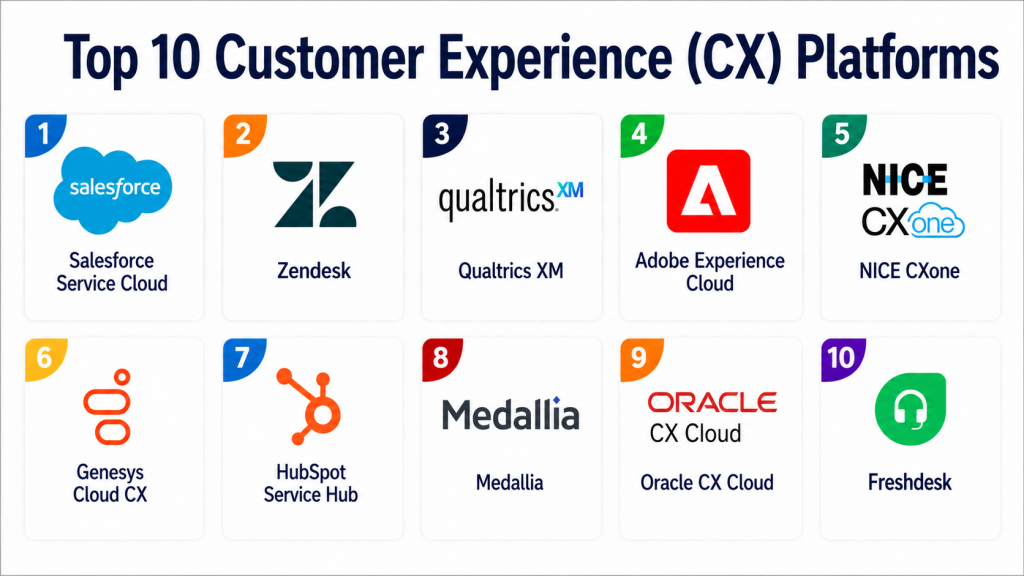
Top 10 Customer Experience (CX) Platforms
#1 — Salesforce Customer 360
Short description: Salesforce Customer 360 is a comprehensive CX platform that unifies customer data across sales, service, and marketing. It provides a single view of the customer. The platform supports personalization, analytics, and automation. It integrates with Salesforce ecosystem. It is highly scalable and customizable. It is best suited for large enterprises. It requires setup and administration.
Key Features
- Unified customer data platform
- AI-driven insights
- Omnichannel engagement
- Workflow automation
- Analytics dashboards
- Integration ecosystem
Pros
- Highly scalable and customizable
- Strong ecosystem
Cons
- Complex implementation
- High cost
Platforms / Deployment
Web / iOS / Android
Cloud
Security & Compliance
SSO, MFA, RBAC, encryption
Supports GDPR, enterprise compliance standards
Integrations & Ecosystem
Extensive ecosystem with enterprise integrations.
- CRM tools
- Marketing platforms
- APIs
Support & Community
Strong enterprise support and large community.
#2 — Adobe Experience Cloud
Short description: Adobe Experience Cloud is a leading CX platform focused on digital experiences and marketing. It provides tools for analytics, content management, and personalization. It is widely used by enterprises. It offers deep insights into customer behavior. It integrates with Adobe ecosystem. It is powerful but complex.
Key Features
- Experience management
- Analytics
- Personalization
- Content management
- Customer journey orchestration
Pros
- Strong analytics
- Advanced personalization
Cons
- Complex setup
- Premium pricing
Platforms / Deployment
Web
Cloud
Security & Compliance
Encryption, access control
Supports enterprise compliance
Integrations & Ecosystem
Strong Adobe ecosystem integration.
- Marketing tools
- Analytics platforms
- APIs
Support & Community
Enterprise-level support.
#3 — SAP Customer Experience (SAP CX)
Short description: SAP CX provides a suite of tools for commerce, marketing, and customer engagement. It integrates with SAP ERP systems. It supports large enterprises. It offers analytics and personalization. It is suitable for complex environments. It requires implementation effort.
Key Features
- Commerce platform
- Marketing automation
- Customer data management
- Analytics
- Personalization
Pros
- Strong enterprise integration
- Scalable
Cons
- Complex deployment
- High cost
Platforms / Deployment
Web
Cloud
Security & Compliance
SSO, encryption
Supports enterprise compliance
Integrations & Ecosystem
SAP ecosystem integration.
- ERP
- APIs
Support & Community
Enterprise support.
#4 — Oracle CX Cloud
Short description: Oracle CX Cloud is a comprehensive platform for managing customer interactions. It includes sales, service, and marketing modules. It provides analytics and automation. It is designed for enterprises. It integrates with Oracle ecosystem. It is powerful but complex.
Key Features
- Customer engagement tools
- Analytics
- Workflow automation
- Omnichannel support
- Data management
Pros
- Strong enterprise capabilities
- Scalable
Cons
- Complex implementation
- Expensive
Platforms / Deployment
Web
Cloud
Security & Compliance
SSO, encryption
Supports enterprise standards
Integrations & Ecosystem
Oracle ecosystem integration.
- ERP
- APIs
Support & Community
Enterprise support.
#5 — Zendesk CX Suite
Short description: Zendesk CX Suite focuses on customer support and service experience. It provides ticketing, chat, and analytics. It is easy to use and deploy. It is suitable for SMBs and mid-market organizations. It offers scalability and integration.
Key Features
- Ticketing system
- Live chat
- Analytics
- Automation
- Knowledge base
Pros
- Easy to use
- Strong support features
Cons
- Limited advanced customization
- Costs increase with scale
Platforms / Deployment
Web / iOS / Android
Cloud
Security & Compliance
MFA, encryption
Supports compliance standards
Integrations & Ecosystem
Integrates with many tools.
- CRM
- Messaging platforms
- APIs
Support & Community
Strong support and community.
#6 — HubSpot Service Hub
Short description: HubSpot Service Hub is part of HubSpot’s CRM ecosystem. It focuses on customer service and experience. It provides ticketing, automation, and feedback tools. It is easy to use. It is ideal for SMBs. It integrates with HubSpot CRM.
Key Features
- Ticketing
- Customer feedback
- Automation
- Reporting
- Knowledge base
Pros
- Easy to use
- Strong integration with CRM
Cons
- Limited enterprise features
- Advanced features require upgrades
Platforms / Deployment
Web / iOS / Android
Cloud
Security & Compliance
MFA, encryption
GDPR compliant
Integrations & Ecosystem
HubSpot ecosystem integration.
- CRM
- Marketing tools
- APIs
Support & Community
Good support and documentation.
#7 — Genesys Cloud CX
Short description: Genesys Cloud CX is a cloud-based platform for customer engagement and contact centers. It provides omnichannel communication. It supports AI-driven interactions. It is suitable for enterprises and large contact centers. It is scalable and reliable.
Key Features
- Omnichannel communication
- AI-driven interactions
- Contact center tools
- Analytics
- Automation
Pros
- Strong contact center features
- Scalable
Cons
- Complex setup
- Pricing varies
Platforms / Deployment
Web
Cloud
Security & Compliance
SSO, MFA, encryption
Supports compliance standards
Integrations & Ecosystem
Integrates with enterprise tools.
- CRM
- APIs
Support & Community
Enterprise support.
#8 — Freshdesk (Freshworks CX)
Short description: Freshdesk is a customer support platform with CX capabilities. It provides ticketing, automation, and analytics. It is suitable for SMBs and mid-market teams. It is easy to deploy. It offers good value.
Key Features
- Ticketing
- Automation
- Analytics
- Collaboration
- Knowledge base
Pros
- Affordable
- Easy to use
Cons
- Limited enterprise features
- Basic customization
Platforms / Deployment
Web / iOS / Android
Cloud
Security & Compliance
MFA, encryption
Supports compliance standards
Integrations & Ecosystem
Supports integrations.
- CRM
- APIs
Support & Community
Good support for SMBs.
#9 — Medallia
Short description: Medallia is a customer experience management platform focused on feedback and analytics. It collects and analyzes customer data. It helps improve experiences. It is used by enterprises. It provides insights and reporting.
Key Features
- Feedback collection
- Analytics
- Reporting
- Experience management
- Insights
Pros
- Strong analytics
- Enterprise capabilities
Cons
- Complex setup
- Premium pricing
Platforms / Deployment
Web
Cloud
Security & Compliance
Encryption
Supports compliance standards
Integrations & Ecosystem
Integrates with enterprise tools.
- APIs
Support & Community
Enterprise support.
#10 — Qualtrics XM
Short description: Qualtrics XM is an experience management platform that includes CX capabilities. It focuses on feedback and analytics. It helps organizations understand customer sentiment. It provides dashboards and reporting. It is suitable for enterprises.
Key Features
- Experience management
- Feedback collection
- Analytics
- Reporting
- Dashboards
Pros
- Strong insights
- Enterprise-grade
Cons
- Expensive
- Complex setup
Platforms / Deployment
Web
Cloud
Security & Compliance
Encryption, access control
Supports compliance standards
Integrations & Ecosystem
Supports integrations.
- CRM
- APIs
Support & Community
Enterprise-level support.
Comparison Table
| Tool Name | Best For | Platform(s) Supported | Deployment | Standout Feature | Public Rating |
|---|---|---|---|---|---|
| Salesforce CX | Enterprise | Web, Mobile | Cloud | Unified data | N/A |
| Adobe Experience | Enterprise | Web | Cloud | Personalization | N/A |
| SAP CX | Enterprise | Web | Cloud | ERP integration | N/A |
| Oracle CX | Enterprise | Web | Cloud | Scalability | N/A |
| Zendesk | SMB | Web, Mobile | Cloud | Support tools | N/A |
| HubSpot | SMB | Web, Mobile | Cloud | Ease of use | N/A |
| Genesys | Enterprise | Web | Cloud | Contact center | N/A |
| Freshdesk | SMB | Web, Mobile | Cloud | Affordability | N/A |
| Medallia | Enterprise | Web | Cloud | Analytics | N/A |
| Qualtrics | Enterprise | Web | Cloud | Experience mgmt | N/A |
Evaluation & Scoring of Customer Experience Platforms
| Tool | Core | Ease | Integrations | Security | Performance | Support | Value | Total |
|---|---|---|---|---|---|---|---|---|
| Salesforce | 10 | 7 | 10 | 9 | 9 | 9 | 7 | 8.9 |
| Adobe | 9 | 7 | 9 | 9 | 9 | 8 | 6 | 8.4 |
| SAP | 9 | 6 | 9 | 9 | 9 | 8 | 6 | 8.3 |
| Oracle | 9 | 6 | 9 | 9 | 9 | 8 | 6 | 8.3 |
| Zendesk | 8 | 9 | 8 | 8 | 8 | 8 | 8 | 8.2 |
| HubSpot | 8 | 9 | 8 | 8 | 8 | 8 | 9 | 8.4 |
| Genesys | 9 | 7 | 8 | 9 | 9 | 8 | 7 | 8.3 |
| Freshdesk | 7 | 9 | 7 | 7 | 8 | 7 | 9 | 7.9 |
| Medallia | 9 | 7 | 7 | 8 | 8 | 8 | 6 | 8.0 |
| Qualtrics | 9 | 7 | 7 | 8 | 8 | 8 | 6 | 8.0 |
Scores are comparative and based on weighted evaluation across features, usability, integrations, security, and value.
Which Customer Experience Platform Is Right for You?
Solo / Freelancer
Use simple tools like HubSpot or Freshdesk.
SMB
Zendesk and HubSpot are strong options.
Mid-Market
Freshdesk and Genesys offer scalability.
Enterprise
Salesforce, Adobe, SAP, Oracle are best choices.
Budget vs Premium
Budget: Freshdesk, HubSpot
Premium: Salesforce, Adobe
Feature Depth vs Ease of Use
Depth: Salesforce, Adobe
Ease: HubSpot, Zendesk
Integrations & Scalability
Best: Salesforce, Adobe
Moderate: HubSpot, Freshdesk
Security & Compliance Needs
High: Salesforce, Oracle
Basic: HubSpot, Freshdesk
Frequently Asked Questions (FAQs)
1. What is a Customer Experience platform?
A CX platform helps manage and improve customer interactions. It centralizes data and workflows. It enhances engagement. It provides analytics. It improves customer satisfaction.
2. Why are CX platforms important?
They improve customer satisfaction and retention. They provide insights into behavior. They enable personalization. They support business growth. They enhance decision-making.
3. Are CX platforms secure?
Most platforms include encryption and access controls. Enterprise tools offer advanced security. Security depends on configuration. Organizations should evaluate vendors.
4. How long does implementation take?
Implementation varies by complexity. Simple tools are quick to deploy. Enterprise tools require planning. Training is needed. Setup depends on requirements.
5. Can CX platforms integrate with CRM?
Yes, most integrate with CRM systems. This improves data flow. It enhances customer insights. APIs are common. Integration is critical.
6. Who uses CX platforms?
Marketing teams, customer success teams, and enterprises use them. They manage customer interactions. They improve engagement. They support analytics.
7. What industries use CX platforms?
Retail, finance, healthcare, and technology use them. Any customer-focused business benefits. They improve experience. They enhance loyalty.
8. What are common mistakes?
Choosing based only on cost is a mistake. Ignoring scalability can cause issues. Lack of training reduces adoption. Overlooking integrations limits value. Security should be considered.
9. Are CX platforms scalable?
Yes, most platforms scale well. Enterprise tools handle large volumes. SMB tools may have limits. Choosing the right tool is important. Scalability ensures growth.
10. How to switch CX platforms?
Switching involves data migration and training. Planning is essential. Testing should be done first. Gradual rollout reduces risks. Vendors often provide support.
Conclusion
Customer Experience Platforms have become a cornerstone of modern business strategy, enabling organizations to deliver personalized, consistent, and secure interactions across the customer journey. As expectations rise and competition intensifies, these platforms provide the tools needed to understand customer behavior, automate engagement, and improve satisfaction. Enterprise solutions like Salesforce Customer 360 and Adobe Experience Cloud lead in scalability and depth, while tools like Zendesk and HubSpot offer accessible and effective solutions for smaller teams.
The right CX platform depends on your organization’s size, customer interaction complexity, and integration requirements. Instead of focusing solely on features, businesses should evaluate usability, scalability, and security alignment. A practical next step is to shortlist a few platforms, run pilot implementations, and validate how well they integrate with existing systems. This ensures long-term success and improved customer experiences.
