Introduction
Route Optimization Tools help businesses plan the most efficient routes for deliveries, field service operations, and logistics. These tools use algorithms, real-time data, and automation to reduce travel time, fuel costs, and operational inefficiencies.
In modern logistics and service industries, route optimization has become essential due to rising delivery expectations, fuel costs, and operational complexity. Advanced tools now incorporate AI, real-time traffic data, and predictive analytics to improve decision-making and delivery performance.
Common use cases include:
- Planning delivery routes for logistics and eCommerce
- Managing field service technician schedules
- Reducing fuel consumption and travel time
- Improving last-mile delivery efficiency
- Optimizing fleet operations
Key evaluation criteria:
- Route optimization algorithms
- Real-time tracking and updates
- Multi-stop route planning
- Integration with logistics and ERP systems
- Ease of use and onboarding
- Scalability and performance
- Security and access control
- Reporting and analytics
Best for: Logistics companies, delivery services, field service teams, retailers, and enterprises managing fleet operations.
Not ideal for: Businesses with minimal routing needs or those operating with very small delivery volumes.
Key Trends in Route Optimization Tools
- AI-driven route optimization and predictive planning
- Real-time traffic and weather data integration
- Cloud-based and mobile-first platforms
- Automation of scheduling and dispatching
- Integration with TMS, OMS, and GPS systems
- Multi-vehicle and fleet optimization
- Sustainability tracking and fuel efficiency metrics
- API-first and headless integration models
- Enhanced security with RBAC and authentication
- Subscription-based pricing models
How We Evaluated Route Optimization Tools
- Market adoption across logistics and field service industries
- Feature depth for routing and scheduling
- Performance, scalability, and reliability
- Security features and compliance readiness
- Integration ecosystem with logistics platforms
- Ease of use and onboarding experience
- Vendor support and documentation quality
- Suitability for SMB, mid-market, and enterprise
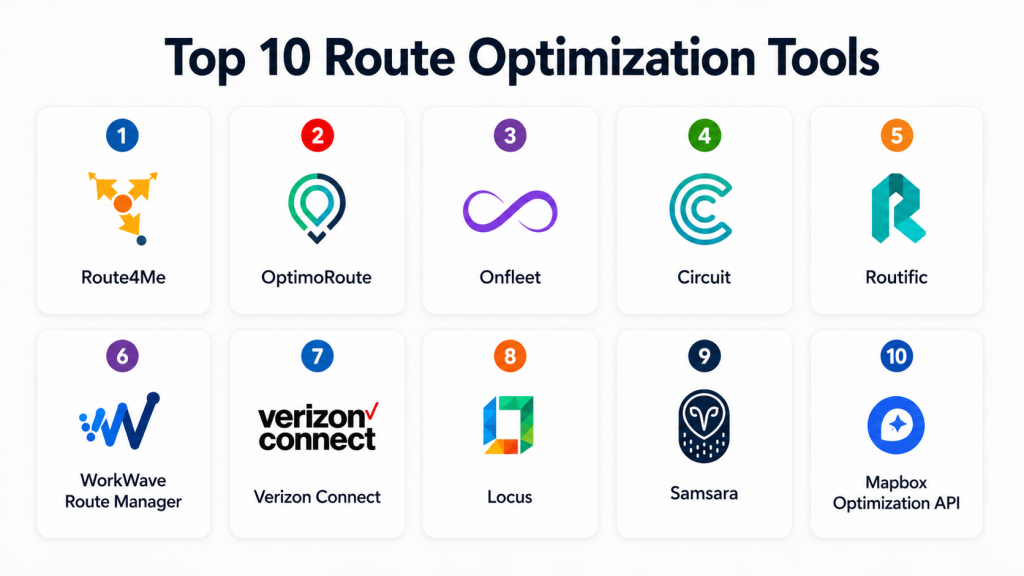
Top 10 Route Optimization Tools
#1 — Route4Me
Short description :
Route4Me is a widely used route optimization platform designed for logistics and delivery businesses. It provides advanced routing algorithms and real-time route planning. The platform supports multi-stop routing and fleet management. It is ideal for businesses of all sizes. Route4Me helps reduce fuel costs and improve efficiency. It offers scalable solutions for growing operations.
Key Features
- Multi-stop route planning
- Real-time tracking
- Fleet management
- Route analytics
- Mobile app support
Pros
- Easy to use
- Scalable
Cons
- Pricing can increase with scale
- Limited customization
Platforms / Deployment
Web / iOS / Android / Cloud
Security & Compliance
RBAC, encryption
Integrations & Ecosystem
- GPS systems
- Logistics platforms
- APIs
Support & Community
Strong support and documentation
#2 — OptimoRoute
Short description :
OptimoRoute is a route optimization tool designed for delivery and field service operations. It offers advanced scheduling and routing capabilities. The platform provides real-time updates and tracking. It is ideal for SMBs and mid-sized businesses. OptimoRoute focuses on efficiency and ease of use. It helps improve delivery performance.
Key Features
- Route optimization
- Scheduling
- Real-time tracking
- Analytics
- Multi-vehicle support
Pros
- User-friendly
- Strong scheduling features
Cons
- Limited enterprise features
- Fewer integrations
Platforms / Deployment
Web / Cloud
Security & Compliance
Encryption
Integrations & Ecosystem
- CRM tools
- Logistics platforms
Support & Community
Reliable support
#3 — Onfleet
Short description :
Onfleet is a modern route optimization platform focused on last-mile delivery. It provides real-time tracking and analytics. The platform offers driver management and customer notifications. It is ideal for delivery businesses. Onfleet is easy to use and scalable. It helps improve customer experience.
Key Features
- Last-mile optimization
- Real-time tracking
- Driver management
- Notifications
- Analytics
Pros
- Modern interface
- Strong customer experience features
Cons
- Limited advanced routing
- Pricing can be high
Platforms / Deployment
Web / Mobile / Cloud
Security & Compliance
Encryption
Integrations & Ecosystem
- CRM tools
- Delivery platforms
Support & Community
Good support
#4 — Circuit
Short description :
Circuit is a simple route optimization tool for small delivery teams. It provides easy route planning and navigation. The platform is designed for ease of use. It is ideal for small businesses. Circuit offers mobile-first features. It helps improve delivery efficiency.
Key Features
- Route planning
- Navigation
- Mobile app
- Delivery tracking
- Scheduling
Pros
- Simple interface
- Affordable
Cons
- Limited features
- Not for large fleets
Platforms / Deployment
Mobile / Cloud
Security & Compliance
Encryption
Integrations & Ecosystem
- Navigation tools
- Mobile apps
Support & Community
Good SMB support
#5 — Routific
Short description :
Routific is a route optimization tool designed for delivery businesses. It provides fast route planning and scheduling. The platform supports multi-stop deliveries. It is ideal for SMBs. Routific focuses on ease of use. It helps reduce delivery time and costs.
Key Features
- Route optimization
- Scheduling
- Multi-stop routing
- Reporting
- Delivery tracking
Pros
- Easy to use
- Affordable
Cons
- Limited advanced features
- Not ideal for enterprises
Platforms / Deployment
Web / Cloud
Security & Compliance
Encryption
Integrations & Ecosystem
- eCommerce tools
- Logistics platforms
Support & Community
Reliable support
#6 — WorkWave Route Manager
Short description :
WorkWave Route Manager is designed for field service and logistics operations. It offers route planning, scheduling, and analytics. The platform supports fleet optimization. It is ideal for mid-market businesses. WorkWave provides automation features. It helps improve operational efficiency.
Key Features
- Route planning
- Scheduling
- Fleet optimization
- Analytics
- Automation
Pros
- Strong scheduling
- Scalable
Cons
- Learning curve
- Setup required
Platforms / Deployment
Web / Cloud
Security & Compliance
RBAC, encryption
Integrations & Ecosystem
- CRM tools
- Field service systems
Support & Community
Good support
#7 — Verizon Connect
Short description :
Verizon Connect is a fleet and route optimization platform. It provides GPS tracking and route planning. The platform supports real-time tracking and analytics. It is ideal for fleet operations. Verizon Connect offers scalability. It helps improve efficiency.
Key Features
- GPS tracking
- Route optimization
- Fleet management
- Analytics
- Reporting
Pros
- Strong tracking features
- Scalable
Cons
- Expensive
- Complex
Platforms / Deployment
Web / Mobile / Cloud
Security & Compliance
Encryption
Integrations & Ecosystem
- GPS devices
- Fleet systems
Support & Community
Enterprise support
#8 — Locus
Short description :
Locus is an AI-driven route optimization platform designed for logistics companies. It provides real-time tracking and analytics. The platform supports automation and optimization. It is ideal for enterprises. Locus focuses on efficiency and scalability. It integrates with logistics systems.
Key Features
- AI optimization
- Real-time tracking
- Analytics
- Automation
- Multi-vehicle routing
Pros
- Advanced AI
- Scalable
Cons
- Premium pricing
- Requires integration
Platforms / Deployment
Cloud
Security & Compliance
Encryption
Integrations & Ecosystem
- Logistics platforms
- ERP systems
Support & Community
Enterprise support
#9 — Samsara
Short description :
Samsara is a fleet management and route optimization platform. It provides real-time tracking and analytics. The platform integrates with IoT devices. It is ideal for fleet-heavy businesses. Samsara offers scalability. It helps improve operational efficiency.
Key Features
- Fleet tracking
- Route optimization
- IoT integration
- Analytics
- Reporting
Pros
- Strong IoT integration
- Scalable
Cons
- Expensive
- Complex
Platforms / Deployment
Cloud
Security & Compliance
Encryption
Integrations & Ecosystem
- IoT devices
- Fleet systems
Support & Community
Good support
#10 — Mapbox Optimization API
Short description :
Mapbox Optimization API is a developer-focused route optimization solution. It provides APIs for custom routing solutions. The platform supports advanced optimization algorithms. It is ideal for developers and tech companies. Mapbox offers flexibility and scalability. It enables custom implementations.
Key Features
- Routing APIs
- Optimization algorithms
- Custom integration
- Scalability
- Developer tools
Pros
- Highly flexible
- Developer-friendly
Cons
- Requires technical expertise
- Not plug-and-play
Platforms / Deployment
Web / API / Cloud
Security & Compliance
Varies / N/A
Integrations & Ecosystem
- Developer tools
- APIs
Support & Community
Developer community support
Comparison Table (Top 10)
| Tool Name | Best For | Platform(s) | Deployment | Standout Feature | Rating |
|---|---|---|---|---|---|
| Route4Me | All sizes | Web/Mobile | Cloud | Scalability | N/A |
| OptimoRoute | SMB | Web | Cloud | Scheduling | N/A |
| Onfleet | Delivery | Web/Mobile | Cloud | Last-mile focus | N/A |
| Circuit | Small teams | Mobile | Cloud | Simplicity | N/A |
| Routific | SMB | Web | Cloud | Affordability | N/A |
| WorkWave | Mid-market | Web | Cloud | Automation | N/A |
| Verizon | Fleet | Web/Mobile | Cloud | GPS tracking | N/A |
| Locus | Enterprise | Web | Cloud | AI optimization | N/A |
| Samsara | Fleet | Web | Cloud | IoT integration | N/A |
| Mapbox | Developers | API | Cloud | Custom routing | N/A |
Evaluation & Scoring of Route Optimization Tools
| Tool | Core | Ease | Integrations | Security | Performance | Support | Value | Total |
|---|---|---|---|---|---|---|---|---|
| Route4Me | 8 | 8 | 8 | 7 | 8 | 8 | 8 | 8.0 |
| OptimoRoute | 7 | 9 | 7 | 7 | 7 | 7 | 8 | 7.6 |
| Onfleet | 7 | 8 | 8 | 7 | 7 | 7 | 7 | 7.4 |
| Circuit | 6 | 9 | 6 | 7 | 7 | 7 | 9 | 7.3 |
| Routific | 7 | 8 | 7 | 7 | 7 | 7 | 8 | 7.5 |
| WorkWave | 8 | 7 | 8 | 7 | 8 | 7 | 7 | 7.6 |
| Verizon | 8 | 6 | 8 | 8 | 8 | 8 | 6 | 7.7 |
| Locus | 9 | 7 | 8 | 8 | 9 | 8 | 6 | 8.1 |
| Samsara | 8 | 7 | 8 | 8 | 8 | 8 | 6 | 7.9 |
| Mapbox | 9 | 5 | 9 | 7 | 9 | 7 | 7 | 7.9 |
How to interpret scores:
These scores provide a comparative overview across features, usability, and value. Enterprise tools score higher in performance and scalability, while SMB tools excel in ease of use and affordability. Use these scores as a guideline based on your needs.
Which Route Optimization Tool Is Right for You?
Solo / Freelancer
Circuit or Routific is sufficient.
SMB
OptimoRoute, Routific, and Route4Me are ideal.
Mid-Market
WorkWave and Onfleet provide balanced features.
Enterprise
Locus, Verizon Connect, and Samsara are best.
Budget vs Premium
Budget: Circuit, Routific
Premium: Locus, Samsara
Feature Depth vs Ease of Use
Deep: Locus, Mapbox
Easy: Circuit, OptimoRoute
Integrations & Scalability
Strong: Mapbox, Locus
Scalable: Route4Me, Samsara
Security & Compliance Needs
High: Verizon, Samsara
Moderate: Circuit, Routific
Frequently Asked Questions (FAQs)
1. What are route optimization tools?
Route optimization tools help businesses plan the most efficient routes for deliveries or services. They reduce travel time and fuel costs. These tools use algorithms and real-time data. They improve operational efficiency. They are widely used in logistics and field services.
2. How much do route optimization tools cost?
Pricing varies depending on features and scale. Cloud tools usually offer subscription plans. SMB tools are more affordable. Enterprise tools are expensive. Additional costs may include integrations.
3. Are route optimization tools necessary?
They are not required for very small operations. However, as delivery volume increases, they become essential. They reduce costs and improve efficiency. They also enhance customer satisfaction. Growing businesses benefit most.
4. How long does implementation take?
Cloud tools can be deployed quickly. Enterprise systems take longer. Integration affects timelines. Proper planning helps. Testing is important before full use.
5. What integrations are important?
Important integrations include TMS, GPS, ERP, and CRM systems. APIs provide flexibility. Integration improves efficiency. It reduces manual work. Businesses should check compatibility.
6. Can route optimization reduce fuel costs?
Yes, optimized routes reduce distance and idle time. This lowers fuel consumption. It also improves delivery efficiency. Automation helps in planning. Businesses save costs.
7. What security features should these tools have?
Tools should include RBAC and encryption. Authentication is important. Data protection matters. Compliance is required for enterprises. Secure tools ensure safe operations.
8. Can these tools manage multiple vehicles?
Yes, most tools support multi-vehicle routing. They optimize routes for entire fleets. This improves efficiency. It reduces operational complexity. It is essential for logistics businesses.
9. Can you switch tools later?
Switching is possible but requires effort. Data migration is needed. Integration changes may occur. Costs can be high. Plan carefully before choosing.
10. What are alternatives to route optimization tools?
Alternatives include manual planning or spreadsheets. These lack automation. They are inefficient for large operations. Route tools provide better results. They are more scalable.
Conclusion
Route Optimization Tools have become essential for businesses managing deliveries and field operations in today’s fast-paced environment. From enterprise solutions like Locus and Samsara to SMB-friendly tools like Circuit and Routific, there are options available for every scale. These tools help reduce operational costs, improve delivery efficiency, and enhance customer satisfaction through optimized routing.
Choosing the right tool depends on your business size, routing complexity, and integration needs. Instead of selecting based only on features, evaluate ease of use, scalability, and compatibility with your existing systems. A practical approach is to shortlist a few tools, test them in real-world scenarios, and validate performance before making a decision. This ensures long-term efficiency and operational success.
