Introduction
Quality Management Systems (QMS) are software platforms that help organizations manage, monitor, and improve quality processes across products, services, and operations. These systems standardize workflows for compliance, audits, corrective actions, and continuous improvement, ensuring consistent quality outcomes.
In today’s regulated and competitive environment, QMS tools are essential across industries like manufacturing, healthcare, pharmaceuticals, aerospace, and IT services. With digital transformation, modern QMS platforms now include automation, analytics, cloud deployment, and AI-driven insights. They also integrate with Identity Management, Cybersecurity frameworks, Zero Trust architectures, and Access Control systems to ensure secure and compliant operations.
Real-world use cases include:
- Quality audits and compliance tracking
- Document control and standard operating procedures
- Non-conformance and corrective action management
- Supplier quality management
- Risk assessment and mitigation
What buyers should evaluate:
- Compliance and regulatory support
- Document and workflow management
- Audit and reporting capabilities
- Integration with ERP and other systems
- Scalability and deployment options
- Security and compliance features
- Ease of use and customization
- Vendor support and ecosystem
Best for: Quality managers, compliance teams, manufacturers, healthcare organizations, and enterprises managing regulated processes.
Not ideal for: Small businesses with minimal compliance or quality requirements.
Key Trends in QMS Tools
- Cloud-based QMS platforms replacing legacy systems
- AI-driven quality analytics and insights
- Integration with ERP, MES, and supply chain systems
- Real-time compliance monitoring and reporting
- Mobile access for audits and inspections
- Automated workflows and document management
- Risk-based quality management approaches
- Enhanced cybersecurity for compliance systems
- Low-code customization for workflows
- Global compliance support across regulations
How We QMS Tools (Methodology)
We evaluated tools based on:
- Quality management features and compliance support
- Workflow automation and document control
- Integration capabilities with enterprise systems
- Performance and scalability
- Security and compliance readiness
- Ease of use and customization
- Vendor reputation and adoption
- Support and ecosystem strength
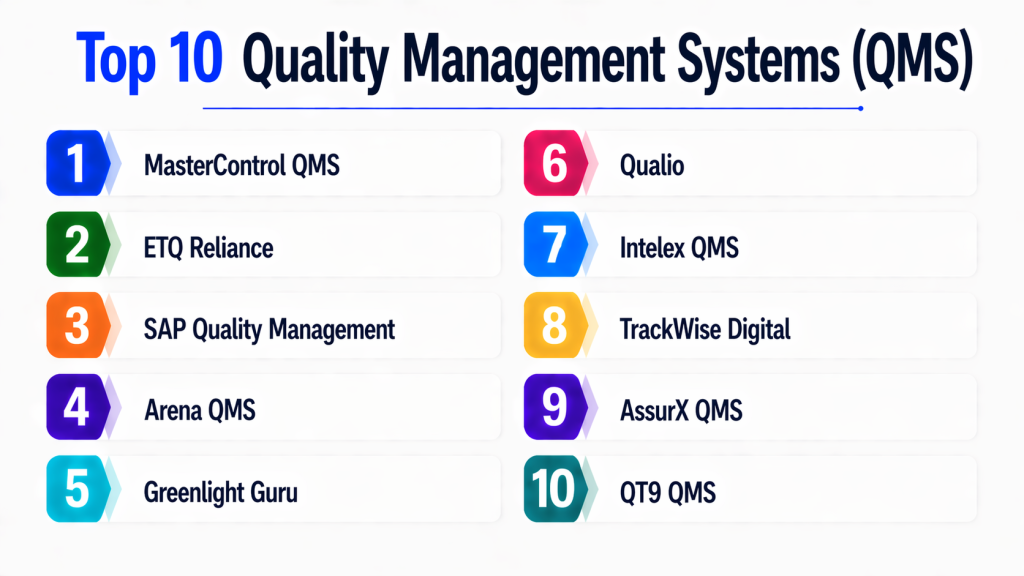
Top 10 Quality Management Systems (QMS)
#1 — MasterControl QMS
Short description :
MasterControl QMS is a leading enterprise-grade quality management platform. It is widely used in regulated industries like healthcare and pharmaceuticals. Provides comprehensive tools for compliance, document management, and audits. Supports automation and real-time reporting. Ideal for large organizations with strict regulatory requirements.
Key Features
- Document control
- Audit management
- Compliance tracking
- Workflow automation
- Reporting tools
Pros
- Strong compliance support
- Enterprise-ready
Cons
- Expensive
- Complex setup
Platforms / Deployment
Cloud / On-premise
Security & Compliance
Enterprise controls
Compliance: Varies
Integrations & Ecosystem
- ERP systems
- Compliance tools
Support & Community
Strong enterprise support.
#2 — ETQ Reliance
Short description :
ETQ Reliance is a flexible QMS platform designed for quality and compliance management. It offers configurable workflows and analytics. Suitable for mid to large enterprises. Supports industry standards.
Key Features
- Workflow automation
- Compliance management
- Analytics
Pros
- Flexible
- Scalable
Cons
- Learning curve
- Cost
Platforms / Deployment
Cloud / On-premise
Security & Compliance
Enterprise controls
Integrations & Ecosystem
- ERP systems
Support & Community
Strong support.
#3 — SAP Quality Management
Short description :
SAP Quality Management is part of SAP’s enterprise suite. It integrates quality processes with business operations. Ideal for large organizations using SAP systems.
Key Features
- Integrated quality management
- Analytics
- Compliance tools
Pros
- Strong integration
- Enterprise-grade
Cons
- Complex
- Expensive
Platforms / Deployment
Cloud / On-premise
Security & Compliance
Enterprise controls
Integrations & Ecosystem
- SAP ecosystem
Support & Community
Global support.
#4 — Arena QMS
Short description :
Arena QMS is a cloud-based quality management platform. It is widely used in product-centric industries. Provides document control and compliance features.
Key Features
- Document management
- Compliance tools
- Workflow automation
Pros
- Easy to use
- Cloud-based
Cons
- Limited customization
- Cost
Platforms / Deployment
Cloud
Security & Compliance
Varies
Integrations & Ecosystem
- PLM systems
Support & Community
Good support.
#5 — Greenlight Guru
Short description :
Greenlight Guru is a QMS platform designed for medical device companies. It supports compliance with regulatory standards. Provides audit and risk management tools.
Key Features
- Risk management
- Compliance tracking
- Audit tools
Pros
- Industry-specific
- Easy to use
Cons
- Niche use
- Limited scalability
Platforms / Deployment
Cloud
Security & Compliance
Compliance-focused
Integrations & Ecosystem
- Medical systems
Support & Community
Strong niche support.
#6 — Qualio
Short description
Qualio is a cloud-based QMS platform for life sciences companies. It simplifies compliance and document management. Suitable for startups and growing businesses.
Key Features
- Document control
- Compliance management
- Workflow automation
Pros
- Easy to implement
- Scalable
Cons
- Limited enterprise features
- Cost
Platforms / Deployment
Cloud
Security & Compliance
Compliance-focused
Integrations & Ecosystem
- Life sciences tools
Support & Community
Growing support.
#7 — Intelex QMS
Short description :
Intelex provides a QMS platform focused on environmental, health, and safety compliance. It offers analytics and workflow automation. Suitable for enterprises.
Key Features
- Compliance tracking
- Analytics
- Workflow tools
Pros
- Comprehensive
- Scalable
Cons
- Complex
- Cost
Platforms / Deployment
Cloud
Security & Compliance
Enterprise controls
Integrations & Ecosystem
- EHS systems
Support & Community
Enterprise support.
#8 — TrackWise Digital
Short description :
TrackWise Digital is a cloud-based QMS platform for regulated industries. It supports quality and compliance workflows. Ideal for large enterprises.
Key Features
- Quality workflows
- Compliance tools
- Reporting
Pros
- Enterprise-grade
- Reliable
Cons
- Expensive
- Complex
Platforms / Deployment
Cloud
Security & Compliance
Enterprise controls
Integrations & Ecosystem
- Compliance systems
Support & Community
Strong support.
#9 — AssurX QMS
Short description :
AssurX is a configurable QMS platform supporting quality and compliance management. It offers flexibility and scalability. Suitable for various industries.
Key Features
- Workflow management
- Compliance tracking
- Document control
Pros
- Flexible
- Customizable
Cons
- Learning curve
- Limited UI
Platforms / Deployment
Cloud / On-premise
Security & Compliance
Varies
Integrations & Ecosystem
- ERP systems
Support & Community
Moderate support.
#10 — QT9 QMS
Short description :
QT9 QMS is a cloud-based platform for quality and compliance management. It offers features for audits, risk, and document control. Suitable for SMBs.
Key Features
- Audit management
- Risk tracking
- Document control
Pros
- Affordable
- Easy to use
Cons
- Limited advanced features
- Smaller ecosystem
Platforms / Deployment
Cloud
Security & Compliance
Varies
Integrations & Ecosystem
- Business tools
Support & Community
Growing support.
Comparison Table (Top 10)
| Tool Name | Best For | Platform(s) | Deployment | Standout Feature | Public Rating |
|---|---|---|---|---|---|
| MasterControl | Enterprise | Multi | Hybrid | Compliance | N/A |
| ETQ Reliance | Enterprise | Multi | Hybrid | Flexibility | N/A |
| SAP QM | Enterprise | Multi | Hybrid | Integration | N/A |
| Arena | SMB | Cloud | Cloud | Ease | N/A |
| Greenlight | Medical | Cloud | Cloud | Niche | N/A |
| Qualio | SMB | Cloud | Cloud | Simplicity | N/A |
| Intelex | Enterprise | Cloud | Cloud | Analytics | N/A |
| TrackWise | Enterprise | Cloud | Cloud | Reliability | N/A |
| AssurX | Flexible | Multi | Hybrid | Customization | N/A |
| QT9 | SMB | Cloud | Cloud | Cost | N/A |
Evaluation & Scoring of QMS Tools
| Tool | Core | Ease | Integration | Security | Performance | Support | Value | Total |
|---|---|---|---|---|---|---|---|---|
| MasterControl | 10 | 7 | 10 | 9 | 9 | 10 | 7 | 9.0 |
| ETQ | 9 | 8 | 9 | 9 | 9 | 9 | 8 | 8.8 |
| SAP QM | 9 | 7 | 10 | 9 | 9 | 9 | 7 | 8.6 |
| Arena | 8 | 9 | 8 | 8 | 8 | 8 | 8 | 8.1 |
| Greenlight | 8 | 9 | 7 | 9 | 8 | 8 | 8 | 8.1 |
| Qualio | 8 | 9 | 7 | 8 | 8 | 8 | 8 | 8.0 |
| Intelex | 9 | 7 | 9 | 9 | 9 | 9 | 7 | 8.5 |
| TrackWise | 9 | 7 | 9 | 9 | 9 | 9 | 7 | 8.5 |
| AssurX | 8 | 7 | 8 | 8 | 8 | 7 | 8 | 7.7 |
| QT9 | 7 | 9 | 7 | 7 | 7 | 7 | 9 | 7.6 |
Which QMS Tool Is Right for You?
Solo / Small Business
Use QT9, Qualio
SMB
Use Arena, ETQ
Mid-Market
Use AssurX, Intelex
Enterprise
Use MasterControl, SAP QM, TrackWise
Budget vs Premium
Budget: QT9
Premium: MasterControl
Feature Depth vs Ease
Depth: SAP QM
Ease: Arena
Security & Compliance
Best: MasterControl, ETQ
Frequently Asked Questions (FAQs)
1. What is a QMS system?
A Quality Management System (QMS) is a software platform used to manage and standardize quality processes across an organization. It helps ensure products and services meet defined quality standards. QMS tools also support documentation, audits, and compliance tracking. They are widely used in regulated industries. Overall, they improve consistency and operational efficiency.
2. Why is QMS important?
QMS is important because it helps organizations maintain high-quality standards and meet regulatory requirements. It reduces errors, improves process efficiency, and enhances customer satisfaction. By automating workflows, it minimizes manual work and inconsistencies. It also provides better visibility into quality metrics. This leads to continuous improvement across operations.
3. Are QMS tools scalable
Yes, modern QMS tools are designed to scale from small businesses to large enterprises. Cloud-based platforms make it easier to expand without heavy infrastructure. Scalability depends on the tool’s architecture and features. Enterprise solutions can handle complex, multi-location operations. Proper implementation ensures smooth growth.
4. Are QMS tools secure?
Security depends on the vendor and deployment model used. Most enterprise QMS tools offer encryption, role-based access control, and audit logs. These features help protect sensitive quality and compliance data. Organizations must follow best practices for configuration and access management. Compliance support varies across industries and tools.
5. Which QMS tool is best for beginners?
Tools like QT9 QMS and Qualio are often recommended for beginners due to their simple interfaces and ease of use. They provide essential features without overwhelming complexity. These tools are suitable for small teams and startups. Beginners can gradually adopt more advanced platforms. Choosing the right tool depends on business needs.
6. Can QMS tools integrate with ERP systems?
Yes, most QMS tools integrate with ERP systems to provide a unified view of operations. This integration helps streamline workflows across departments. It improves data consistency and reduces duplication. Many tools also support API-based integrations. This makes it easier to connect with other business systems.
7. Are QMS tools expensive?
The cost of QMS tools varies depending on features, scale, and deployment model. Some cloud-based tools offer affordable subscription plans. Enterprise-grade solutions are generally more expensive due to advanced capabilities. Organizations should evaluate total cost based on long-term value. Selecting the right tool can optimize ROI.
8. What industries use QMS tools?
QMS tools are widely used in industries such as manufacturing, healthcare, pharmaceuticals, aerospace, and food processing. These industries require strict quality and compliance standards. QMS helps ensure consistency and regulatory adherence. Adoption is growing across all sectors. It is essential for quality-driven organizations.
9. What are the limitations of QMS tools?
QMS tools can be complex to implement and may require training for effective use. Some platforms involve high costs, especially for enterprise deployments. Customization and integration can also be challenging. There may be a learning curve for new users. Despite these limitations, they provide significant long-term benefits.
10. How do I choose the right QMS tool?
Choosing the right QMS tool depends on your business size, industry, and compliance requirements. Evaluate features like workflow automation, scalability, and integration capabilities. It is important to test tools through demos or trials. Consider long-term support and customization options. Selecting the right tool ensures better quality management outcomes.
Conclusion
Quality Management Systems (QMS) are essential for organizations aiming to maintain high standards of quality, compliance, and operational efficiency. With increasing regulatory requirements and customer expectations, modern QMS tools provide automation, analytics, and real-time insights to ensure consistent performance across processes. These systems not only streamline quality workflows but also help organizations proactively identify and resolve issues.
Choosing the right QMS tool depends on your industry requirements, scale of operations, and compliance needs. While enterprise platforms like MasterControl and SAP Quality Management offer comprehensive capabilities for large organizations, flexible tools like Arena and QT9 are better suited for smaller teams. The best approach is to evaluate your quality management goals, test available solutions, and select the one that aligns with your long-term business strategy.
