Introduction
Production Scheduling Tools are software platforms that help manufacturers plan, organize, and optimize production workflows. These tools ensure that resources such as machines, labor, and materials are used efficiently while meeting deadlines and minimizing downtime.
In modern manufacturing environments, production scheduling is critical for maintaining efficiency and competitiveness. With increasing complexity in supply chains and production processes, scheduling tools have evolved to include AI-driven optimization, real-time adjustments, and integration with MES and ERP systems.
Common use cases include:
- Production planning and scheduling
- Resource allocation
- Order and job sequencing
- Capacity planning
- Workflow optimization
Key evaluation criteria buyers should consider:
- Scheduling accuracy and optimization
- Real-time updates and visibility
- Integration with ERP and MES
- Scalability and performance
- Ease of use
- Analytics and reporting
- Automation capabilities
- Industry-specific features
Best for: Manufacturing teams, plant managers, operations teams, and enterprises managing production workflows
Not ideal for: Small operations with simple manual scheduling
Key Trends in Production Scheduling Tools
- AI-driven scheduling optimization
- Real-time production adjustments
- Integration with MES and ERP
- Cloud-based scheduling platforms
- Predictive analytics
- Digital twin integration
- Resource optimization
- Automated scheduling workflows
Methodology
- Market adoption
- Feature completeness
- Integration capabilities
- Performance and scalability
- Ease of use
- Vendor support
- Industry relevance
- Value for operations
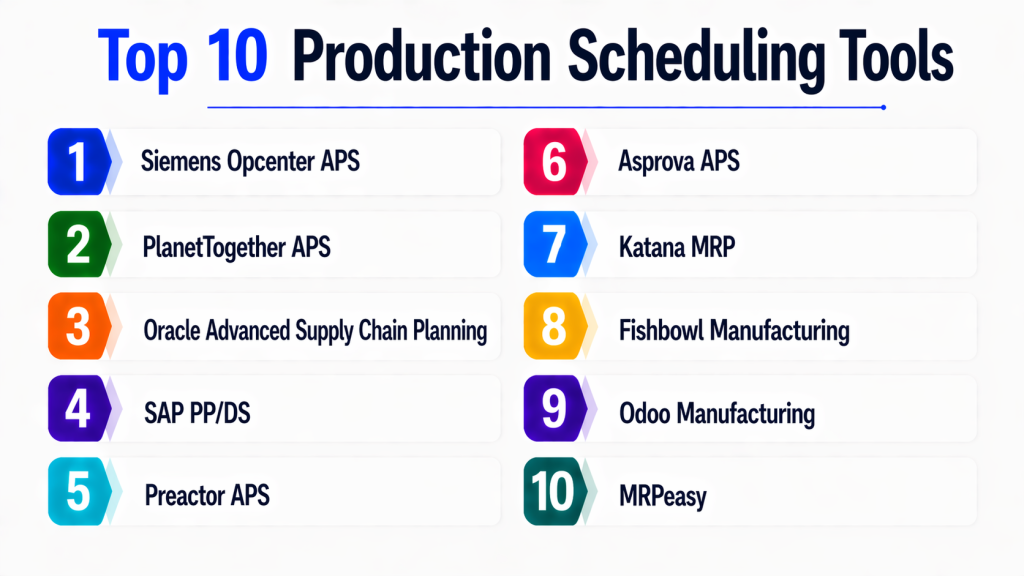
Top 10 Production Scheduling Tools
#1 — Siemens Opcenter APS
Short description:
Siemens Opcenter APS is an advanced planning and scheduling tool designed for complex manufacturing environments. It provides real-time scheduling, optimization, and resource management. The platform integrates with ERP and MES systems. It supports large-scale operations. It is ideal for enterprise manufacturing.
Key Features
- Advanced scheduling
- Resource optimization
- Real-time updates
- Integration
- Analytics
Pros
- Enterprise-grade
- Highly scalable
Cons
- Expensive
- Complex
Platforms / Deployment
- Cloud / On-premise
#2 — PlanetTogether APS
Short description:
PlanetTogether APS is a production scheduling tool that helps manufacturers optimize workflows and resource allocation. It provides real-time scheduling and integrates with ERP systems. The platform supports capacity planning. It is widely used in manufacturing. It is ideal for mid to large businesses.
Key Features
- Scheduling
- Capacity planning
- Integration
- Analytics
- Real-time updates
Pros
- Flexible
- Easy integration
Cons
- Learning curve
- Cost
Platforms / Deployment
- Cloud / On-premise
#3 — Oracle Advanced Supply Chain Planning
Short description:
Oracle Advanced Supply Chain Planning provides tools for production scheduling and supply chain optimization. It integrates with Oracle ERP systems. The platform supports demand planning and scheduling. It is scalable and reliable. It is ideal for enterprise environments.
Key Features
- Scheduling
- Supply chain planning
- Integration
- Analytics
- Forecasting
Pros
- Scalable
- Strong ecosystem
Cons
- Complex
- Expensive
Platforms / Deployment
- Cloud
#4 — SAP PP/DS
Short description:
SAP PP/DS is a production planning and scheduling tool that integrates with SAP ERP. It provides real-time scheduling and optimization. The platform supports complex manufacturing processes. It is widely used globally. It is ideal for SAP users.
Key Features
- Scheduling
- Planning
- Integration
- Optimization
- Analytics
Pros
- Strong integration
- Enterprise-ready
Cons
- Complex
- Cost
Platforms / Deployment
- Cloud / On-premise
#5 — Preactor APS (Siemens)
Short description:
Preactor APS is a production scheduling solution focused on optimizing manufacturing workflows. It provides tools for capacity planning and scheduling. The platform integrates with ERP systems. It is flexible and scalable. It is ideal for manufacturing optimization.
Key Features
- Scheduling
- Capacity planning
- Integration
- Optimization
- Reporting
Pros
- Flexible
- Scalable
Cons
- Setup complexity
- Cost
Platforms / Deployment
- Cloud / On-premise
#6 — Asprova APS
Short description:
Asprova APS is a production scheduling system designed for manufacturing optimization. It provides tools for scheduling, planning, and resource management. The platform supports real-time updates. It is widely used in Asia. It is ideal for manufacturing industries.
Key Features
- Scheduling
- Planning
- Resource management
- Optimization
- Real-time updates
Pros
- High performance
- Scalable
Cons
- Complex
- UI limitations
Platforms / Deployment
- Windows
#7 — Katana MRP
Short description:
Katana MRP is a production scheduling and inventory management tool designed for small to mid-sized manufacturers. It provides real-time visibility into production workflows. The platform integrates with e-commerce and accounting tools. It is easy to use. It is ideal for SMBs.
Key Features
- Scheduling
- Inventory management
- Real-time tracking
- Integration
- Reporting
Pros
- Easy to use
- Affordable
Cons
- Limited advanced features
- Scalability limits
Platforms / Deployment
- Cloud
#8 — Fishbowl Manufacturing
Short description:
Fishbowl Manufacturing provides tools for production scheduling and inventory management. It integrates with QuickBooks and ERP systems. The platform supports workflow optimization. It is widely used by SMBs. It is ideal for small manufacturers.
Key Features
- Scheduling
- Inventory
- Integration
- Workflow management
- Reporting
Pros
- Affordable
- Easy integration
Cons
- Limited scalability
- Basic features
Platforms / Deployment
- Windows / Cloud
#9 — Odoo Manufacturing
Short description:
Odoo Manufacturing provides production scheduling as part of its ERP platform. It supports planning, scheduling, and inventory management. The platform is modular and flexible. It is widely used by SMBs. It is ideal for integrated business management.
Key Features
- Scheduling
- Planning
- Inventory
- Integration
- Reporting
Pros
- Flexible
- Affordable
Cons
- Requires customization
- Learning curve
Platforms / Deployment
- Cloud / On-premise
#10 — MRPeasy
Short description:
MRPeasy is a cloud-based production scheduling tool designed for small manufacturers. It provides tools for planning, scheduling, and inventory management. The platform is easy to use. It supports real-time tracking. It is ideal for SMBs.
Key Features
- Scheduling
- Planning
- Inventory
- Reporting
- Real-time updates
Pros
- Easy to use
- Cost-effective
Cons
- Limited features
- Smaller ecosystem
Platforms / Deployment
- Cloud
Comparison Table (Top 10 Production Scheduling Tools)
| Tool Name | Best For | Platform(s) Supported | Deployment | Standout Feature | Public Rating |
|---|---|---|---|---|---|
| Siemens Opcenter APS | Enterprise | Multi | Hybrid | Optimization | N/A |
| PlanetTogether APS | Manufacturing | Multi | Hybrid | Flexibility | N/A |
| Oracle Planning | Enterprise | Cloud | Cloud | Supply chain | N/A |
| SAP PP/DS | SAP users | Multi | Hybrid | Integration | N/A |
| Preactor APS | Manufacturing | Multi | Hybrid | Scheduling | N/A |
| Asprova APS | Large factories | Windows | Local | Performance | N/A |
| Katana MRP | SMB | Cloud | Cloud | Ease of use | N/A |
| Fishbowl | SMB | Multi | Hybrid | Inventory | N/A |
| Odoo Mfg | SMB | Multi | Hybrid | ERP integration | N/A |
| MRPeasy | SMB | Cloud | Cloud | Simplicity | N/A |
Evaluation & Scoring of Production Scheduling Tools
| Tool Name | Core (25%) | Ease (15%) | Integrations (15%) | Security (10%) | Performance (10%) | Support (10%) | Value (15%) | Weighted Total |
|---|---|---|---|---|---|---|---|---|
| Siemens Opcenter | 9 | 6 | 9 | 9 | 9 | 9 | 7 | 8.5 |
| PlanetTogether | 8 | 7 | 8 | 8 | 8 | 8 | 8 | 8.0 |
| Oracle Planning | 9 | 7 | 9 | 9 | 8 | 8 | 6 | 8.2 |
| SAP PP/DS | 9 | 6 | 9 | 9 | 8 | 8 | 6 | 8.1 |
| Preactor APS | 8 | 7 | 8 | 8 | 8 | 8 | 7 | 7.9 |
| Asprova | 8 | 6 | 7 | 8 | 9 | 7 | 7 | 7.8 |
| Katana | 7 | 9 | 7 | 7 | 7 | 7 | 8 | 7.7 |
| Fishbowl | 7 | 8 | 7 | 7 | 7 | 7 | 8 | 7.5 |
| Odoo | 7 | 8 | 8 | 7 | 7 | 7 | 8 | 7.6 |
| MRPeasy | 7 | 9 | 7 | 7 | 7 | 7 | 8 | 7.7 |
Which Production Scheduling Tool Is Right for You?
Solo / Small Setup
- MRPeasy
SMB
- Katana MRP, Odoo Manufacturing
Mid-Market
- PlanetTogether, Fishbowl
Enterprise
- Siemens Opcenter APS, SAP PP/DS, Oracle Planning
Frequently Asked Questions (FAQs)1. What are production scheduling tools?
Production scheduling tools are software platforms that help plan, organize, and optimize manufacturing workflows. They allocate resources like machines, labor, and materials efficiently. These tools ensure that production tasks are completed on time. They provide visibility into operations. They are essential for improving manufacturing efficiency.
2. Why are production scheduling tools important?
These tools improve production efficiency by minimizing delays and bottlenecks. They help optimize resource utilization and reduce downtime. They ensure timely delivery of orders. They provide real-time insights into workflows. Overall, they enhance operational performance and productivity.
3. Who should use production scheduling tools?
Production scheduling tools are used by manufacturers, plant managers, and operations teams. Industries such as automotive, electronics, food processing, and pharmaceuticals rely on them. Any organization managing production workflows can benefit. They help streamline operations. Adoption is increasing across industries.
4. Are production scheduling tools expensive?
The cost of these tools varies depending on features, scale, and deployment model. Enterprise-grade solutions can be expensive. SMB-focused tools are more affordable. Pricing may include subscription or licensing fees. Organizations should evaluate ROI before investing.
5. Can production scheduling tools scale for large operations?
Yes, most modern tools are designed to scale with production needs. Cloud-based solutions provide better scalability and flexibility. They can handle multiple production lines and large datasets. Performance depends on system architecture. Scalability is crucial for growing businesses.
6. Do production scheduling tools integrate with ERP systems?
Yes, these tools are designed to integrate with ERP and MES systems. Integration helps connect production planning with business operations. It ensures seamless data flow across departments. This improves efficiency and coordination. Integration is a key feature of scheduling tools.
7. Are production scheduling tools easy to use?
Ease of use depends on the platform. Some tools provide intuitive dashboards and user-friendly interfaces. Others may require training and technical expertise. Documentation and onboarding support help improve usability. Choose a tool that matches your team’s skill level.
8. What industries use production scheduling tools?
Production scheduling tools are widely used in manufacturing industries such as automotive, electronics, food processing, and pharmaceuticals. They are also used in logistics and supply chain operations. Any industry with production workflows benefits from them. Adoption is growing globally.
9. How do I choose the right production scheduling tool?
Start by identifying your production requirements and scale. Evaluate features like real-time scheduling, integration, and analytics. Consider deployment options and ease of use. Testing tools with real data is recommended. Choose the one that fits your operational needs.
10. Do production scheduling tools support real-time updates?
Yes, most modern tools provide real-time updates and dynamic scheduling capabilities. They adjust schedules based on changes in demand or resources. This improves accuracy and efficiency. Real-time data helps in better decision-making. It is a key advantage of these tools.
Conclusion
Production scheduling tools are essential for optimizing manufacturing operations by ensuring efficient resource allocation, timely production, and minimal downtime. They help organizations manage complex workflows and improve overall productivity. With advancements in AI and real-time analytics, these tools are becoming more intelligent and adaptive.
Choosing the right production scheduling tool depends on your operational scale, complexity, and integration needs. While enterprise tools provide advanced optimization and scalability, SMB solutions offer ease of use and affordability. A practical approach is to evaluate multiple tools, test them in real-world scenarios, and select the one that aligns with your production strategy and business goals.
