Introduction
Manufacturing Resource Planning (MRP) Tools are software systems that help manufacturers plan, schedule, and manage production resources such as materials, labor, and machinery. These tools ensure that the right materials are available at the right time, optimizing production workflows and minimizing waste.
In modern manufacturing, MRP tools play a critical role in inventory management, production planning, demand forecasting, and supply chain coordination. With the rise of Industry 4.0, these systems now integrate with ERP platforms, IoT devices, analytics engines, and cloud infrastructure. They also align with Identity Management, Cybersecurity frameworks, Zero Trust architectures, and Access Control systems to ensure secure operations.
Real-world use cases include:
- Production scheduling and planning
- Inventory and material management
- Demand forecasting and supply chain optimization
- Order tracking and fulfillment
- Cost control and resource optimization
What buyers should evaluate:
- Production planning and scheduling capabilities
- Inventory and supply chain management features
- Integration with ERP and MES systems
- Scalability and performance
- Reporting and analytics capabilities
- Ease of use and implementation
- Security and compliance features
- Pricing and customization flexibility
Best for: Manufacturing companies, supply chain teams, production managers, and enterprises managing complex production workflows.
Not ideal for: Non-manufacturing businesses or very small operations without production complexity.
Key Trends in MRP Tools
- Cloud-based MRP solutions gaining popularity
- Integration with IoT and smart factory systems
- AI-driven demand forecasting and planning
- Real-time analytics and reporting
- Mobile access for production monitoring
- Integration with ERP and supply chain platforms
- Automation of production workflows
- Enhanced cybersecurity for industrial systems
- Scalable solutions for global manufacturing
- Low-code customization and flexibility
How We MRP Tools (Methodology)
We evaluated tools based on:
- Production planning and scheduling capabilities
- Inventory and supply chain management
- Integration with ERP and manufacturing systems
- Performance and scalability
- Security and compliance readiness
- Ease of use and implementation
- Vendor support and ecosystem
- Industry adoption and maturity
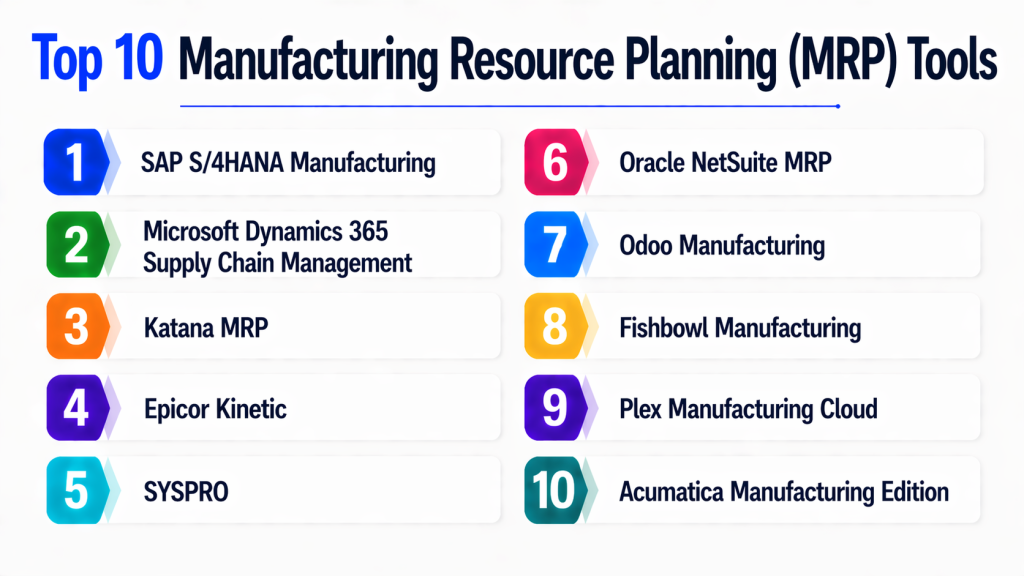
Top 10 Manufacturing Resource Planning (MRP) Tools
#1 — SAP S/4HANA Manufacturing
Short description :
SAP S/4HANA Manufacturing is a comprehensive enterprise MRP and ERP solution. It provides advanced planning, analytics, and real-time insights. Widely used by large enterprises. Supports complex manufacturing operations. Offers scalability and integration.
Key Features
- Advanced planning
- Real-time analytics
- Supply chain integration
- Production scheduling
Pros
- Enterprise-grade
- Highly scalable
Cons
- Expensive
- Complex implementation
Platforms / Deployment
Cloud / On-premise
Security & Compliance
Enterprise controls
Compliance: Varies
Integrations & Ecosystem
- SAP ecosystem
- ERP systems
Support & Community
Global enterprise support.
#2 — Oracle NetSuite MRP
Short description :
NetSuite MRP is a cloud-based manufacturing solution. It provides real-time visibility into production and inventory. Ideal for growing businesses. Offers automation and analytics.
Key Features
- Cloud-based
- Inventory management
- Demand planning
- Reporting tools
Pros
- Easy to use
- Scalable
Cons
- Subscription cost
- Customization limits
Platforms / Deployment
Cloud
Security & Compliance
Enterprise controls
Integrations & Ecosystem
- Oracle ecosystem
Support & Community
Strong support.
#3 — Microsoft Dynamics 365 Supply Chain
Short description :
Dynamics 365 offers MRP capabilities with supply chain management. It integrates with Microsoft ecosystem. Provides analytics and automation. Suitable for mid to large enterprises.
Key Features
- Supply chain planning
- Inventory management
- Analytics
- Automation
Pros
- Integration
- Flexible
Cons
- Learning curve
- Cost
Platforms / Deployment
Cloud / On-premise
Security & Compliance
Azure security controls
Integrations & Ecosystem
- Microsoft tools
Support & Community
Enterprise support.
#4 — Odoo Manufacturing
Short description :
Odoo Manufacturing is an open-source MRP solution. It provides modular features for production and inventory management. Ideal for SMBs. Offers flexibility and customization.
Key Features
- Modular design
- Inventory tracking
- Production planning
Pros
- Affordable
- Flexible
Cons
- Requires customization
- Limited enterprise features
Platforms / Deployment
Cloud / On-premise
Security & Compliance
Varies
Integrations & Ecosystem
- Odoo apps
Support & Community
Large community.
#5 — Katana MRP
Short description :
Katana is a modern cloud-based MRP tool for small manufacturers. It provides real-time production tracking. Easy to use and implement. Ideal for startups and SMBs.
Key Features
- Real-time tracking
- Inventory management
- Production planning
Pros
- User-friendly
- Quick setup
Cons
- Limited scalability
- Fewer advanced features
Platforms / Deployment
Cloud
Security & Compliance
Not publicly stated
Integrations & Ecosystem
- E-commerce tools
Support & Community
Growing support.
#6 — Fishbowl Manufacturing
Short description :
Fishbowl is an MRP solution focused on inventory and manufacturing. It integrates with accounting systems. Suitable for SMBs.
Key Features
- Inventory management
- Order tracking
- Integration tools
Pros
- Easy integration
- Affordable
Cons
- Limited advanced features
- Smaller ecosystem
Platforms / Deployment
On-premise / Cloud
Security & Compliance
Varies
Integrations & Ecosystem
- Accounting tools
Support & Community
Moderate support.
#7 — Epicor Kinetic
Short description :
Epicor Kinetic is a cloud-based MRP and ERP solution. It supports advanced manufacturing processes. Suitable for mid-market and enterprise businesses.
Key Features
- Production planning
- Supply chain management
- Analytics
Pros
- Scalable
- Feature-rich
Cons
- Complex
- Cost
Platforms / Deployment
Cloud / On-premise
Security & Compliance
Enterprise controls
Integrations & Ecosystem
- ERP systems
Support & Community
Enterprise support.
#8 — Plex Manufacturing Cloud
Short description :
Plex is a cloud-native manufacturing platform with MRP capabilities. It provides real-time visibility and automation. Ideal for modern factories.
Key Features
- Cloud-native
- Real-time analytics
- Automation
Pros
- Modern platform
- Scalable
Cons
- Premium pricing
- Limited customization
Platforms / Deployment
Cloud
Security & Compliance
Enterprise controls
Integrations & Ecosystem
- Manufacturing systems
Support & Community
Strong support.
#9 — SYSPRO
Short description :
SYSPRO is an MRP and ERP solution for manufacturers and distributors. It offers strong inventory and production management. Suitable for mid-sized businesses.
Key Features
- Inventory control
- Production planning
- Reporting
Pros
- Reliable
- Flexible
Cons
- UI outdated
- Learning curve
Platforms / Deployment
Cloud / On-premise
Security & Compliance
Varies
Integrations & Ecosystem
- ERP tools
Support & Community
Good support.
#10 — Acumatica Manufacturing Edition
Short description :
Acumatica Manufacturing Edition is a cloud-based MRP solution. It offers flexible deployment and strong analytics. Ideal for growing businesses.
Key Features
- Production planning
- Inventory management
- Analytics
Pros
- Flexible
- Scalable
Cons
- Cost
- Setup complexity
Platforms / Deployment
Cloud
Security & Compliance
Enterprise controls
Integrations & Ecosystem
- ERP systems
Support & Community
Strong support.
Comparison Table (Top 10)
| Tool Name | Best For | Platform(s) | Deployment | Standout Feature | Public Rating |
|---|---|---|---|---|---|
| SAP S/4HANA | Enterprise | Multi | Hybrid | Analytics | N/A |
| NetSuite | SMB | Cloud | Cloud | Simplicity | N/A |
| Dynamics 365 | Enterprise | Multi | Hybrid | Integration | N/A |
| Odoo | SMB | Multi | Hybrid | Flexibility | N/A |
| Katana | Startup | Cloud | Cloud | Ease | N/A |
| Fishbowl | SMB | Multi | Hybrid | Inventory | N/A |
| Epicor | Enterprise | Multi | Hybrid | Scalability | N/A |
| Plex | Modern factories | Cloud | Cloud | Real-time | N/A |
| SYSPRO | Mid-market | Multi | Hybrid | Reliability | N/A |
| Acumatica | Growing biz | Cloud | Cloud | Flexibility | N/A |
Evaluation & Scoring of MRP Tools
| Tool | Core | Ease | Integration | Security | Performance | Support | Value | Total |
|---|---|---|---|---|---|---|---|---|
| SAP | 10 | 7 | 10 | 9 | 10 | 10 | 7 | 9.1 |
| NetSuite | 9 | 9 | 9 | 8 | 9 | 9 | 8 | 8.9 |
| Dynamics | 9 | 8 | 10 | 9 | 9 | 9 | 8 | 9.0 |
| Odoo | 8 | 9 | 8 | 7 | 8 | 8 | 9 | 8.4 |
| Katana | 7 | 10 | 7 | 6 | 7 | 8 | 9 | 7.9 |
| Fishbowl | 8 | 8 | 7 | 7 | 8 | 7 | 8 | 7.9 |
| Epicor | 9 | 7 | 9 | 9 | 9 | 9 | 7 | 8.6 |
| Plex | 9 | 8 | 8 | 9 | 9 | 9 | 7 | 8.6 |
| SYSPRO | 8 | 7 | 8 | 8 | 8 | 8 | 8 | 8.0 |
| Acumatica | 9 | 8 | 9 | 9 | 9 | 9 | 8 | 8.9 |
Which MRP Tool Is Right for You?
Solo / Small Business
Use Katana, Odoo
SMB
Use Fishbowl, NetSuite
Mid-Market
Use SYSPRO, Acumatica
Enterprise
Use SAP, Dynamics, Epicor
Budget vs Premium
Budget: Odoo
Premium: SAP
Feature Depth vs Ease
Depth: SAP
Ease: Katana
Security & Compliance
Best: SAP, Dynamics
Frequently Asked Questions (FAQs)
1. What are MRP tools?
MRP tools are software systems used to plan and manage manufacturing resources like materials, inventory, and production schedules. They help ensure that the right materials are available at the right time. These tools are essential for improving efficiency in manufacturing operations. They also support better coordination between production and supply chain teams. Overall, they streamline manufacturing workflows.
2. Why are MRP tools important?
MRP tools play a key role in optimizing production processes and reducing operational inefficiencies. They help businesses avoid overstocking or stock shortages by improving inventory planning. These tools also enhance visibility across the supply chain. By automating planning tasks, they reduce manual errors and improve productivity. They are essential for scaling manufacturing operations.
3. Are MRP tools scalable?
Yes, most modern MRP tools are designed to scale from small businesses to large enterprises. Cloud-based solutions make it easier to expand operations without heavy infrastructure investments. Scalability depends on the tool’s architecture and integration capabilities. Enterprise-grade tools can handle complex, multi-location production environments. Proper implementation ensures smooth scaling as the business grows.
4. Are MRP tools secure?
Security in MRP tools depends on the vendor and deployment model. Most enterprise tools offer features like encryption, role-based access control, and audit logging. These features help protect sensitive production and business data. Organizations should follow best practices for configuration and access control. Compliance support may vary depending on industry standards.
5. Which MRP tool is best for beginners?
Tools like Odoo and Katana are often recommended for beginners due to their user-friendly interfaces and simple setup. They provide essential features without overwhelming complexity. These tools are suitable for small businesses or startups entering manufacturing. As users gain experience, they can transition to more advanced platforms. Choosing the right tool depends on business needs and technical expertise.
6. Can MRP tools integrate with ERP systems?
Yes, most MRP tools are designed to integrate seamlessly with ERP systems. This integration allows businesses to manage finance, inventory, and production from a unified platform. It improves data consistency and operational efficiency. Many modern tools also support API-based integrations. This makes it easier to connect with other business applications.
7. Are MRP tools expensive?
The cost of MRP tools varies widely depending on features, deployment model, and scale. Some tools offer affordable or open-source options for small businesses. Enterprise-grade solutions are typically more expensive due to advanced capabilities. Cloud-based tools often use subscription pricing models. Businesses should evaluate total cost based on long-term value and requirements.
8. What industries use MRP tools?
MRP tools are widely used in manufacturing industries such as automotive, electronics, food processing, and pharmaceuticals. They are also used in supply chain and logistics operations. These tools help manage production workflows and inventory efficiently. Their adoption is growing with digital transformation initiatives. They are essential for modern manufacturing environments.
9. What are the limitations of MRP tools?
MRP tools can be complex to implement and may require training for effective use. Some systems involve high upfront or subscription costs. Customization and integration can also be challenging in certain cases. Businesses may face vendor lock-in with proprietary solutions. Despite these challenges, the benefits often outweigh the limitations.
10. How do I choose the right MRP tool?
Choosing the right MRP tool depends on your business size, production complexity, and budget. Evaluate features like inventory management, scalability, and integration capabilities. It is important to test tools through demos or trials before making a decision. Consider long-term growth and support options. Selecting the right tool ensures better efficiency and operational success.
Conclusion
MRP tools are essential for modern manufacturing operations, helping businesses streamline production, manage inventory, and optimize resources efficiently. With advancements in cloud computing, AI, and IoT, these tools are becoming more powerful and accessible, enabling manufacturers to achieve higher productivity and better decision-making.
Choosing the right MRP tool depends on your business size, production complexity, and integration needs. While enterprise solutions like SAP and Microsoft Dynamics offer comprehensive capabilities, tools like Odoo and Katana provide flexibility and affordability for smaller businesses. Evaluating your requirements and testing multiple solutions will help you select the best fit for your manufacturing strategy.
