Introduction
AI Safety & Evaluation Tools are platforms that help organizations assess, monitor, and improve the reliability, fairness, and security of AI systems. These tools focus on detecting risks such as bias, hallucinations, unsafe outputs, and model drift while ensuring compliance with internal policies and external regulations.
As AI adoption accelerates, especially with large language models and generative AI, safety and evaluation have become non-negotiable. Enterprises must ensure that AI systems behave predictably, align with business goals, and meet compliance requirements. These tools also integrate with Identity Management, Cybersecurity frameworks, Zero Trust architectures, and Access Control systems to ensure secure AI deployment.
Real-world use cases include:
- Evaluating LLM outputs for accuracy and safety
- Detecting bias and fairness issues in AI models
- Monitoring model performance and drift
- Testing prompts and AI workflows
- Ensuring compliance and auditability
What buyers should evaluate:
- Evaluation capabilities and benchmarks
- Safety and guardrail features
- Integration with AI/ML pipelines
- Real-time monitoring and alerts
- Scalability and performance
- Ease of use and reporting
- Security and compliance readiness
- Customization and flexibility
Best for: AI engineers, ML teams, enterprises deploying AI at scale, compliance teams, and product teams building AI-powered applications.
Not ideal for: Simple AI use cases with minimal risk or no production deployment.
Key Trends in AI Safety & Evaluation Tools
- Growing focus on AI governance and compliance frameworks
- Automated evaluation pipelines for LLM outputs
- Bias detection and fairness metrics becoming standard
- Integration with prompt engineering and orchestration tools
- Real-time monitoring and observability for AI systems
- Zero Trust security applied to AI workflows
- Human-in-the-loop evaluation models
- Standardized benchmarks for LLM performance
- Multi-model evaluation across providers
- Increasing enterprise adoption for risk management
How We AI Safety & Evaluation Tools (Methodology)
We evaluated tools based on:
- Evaluation accuracy and benchmarking capabilities
- Safety features (bias detection, guardrails)
- Integration with AI systems and pipelines
- Performance and scalability
- Security and compliance readiness
- Ease of use and reporting
- Community and ecosystem support
- Adoption across industries
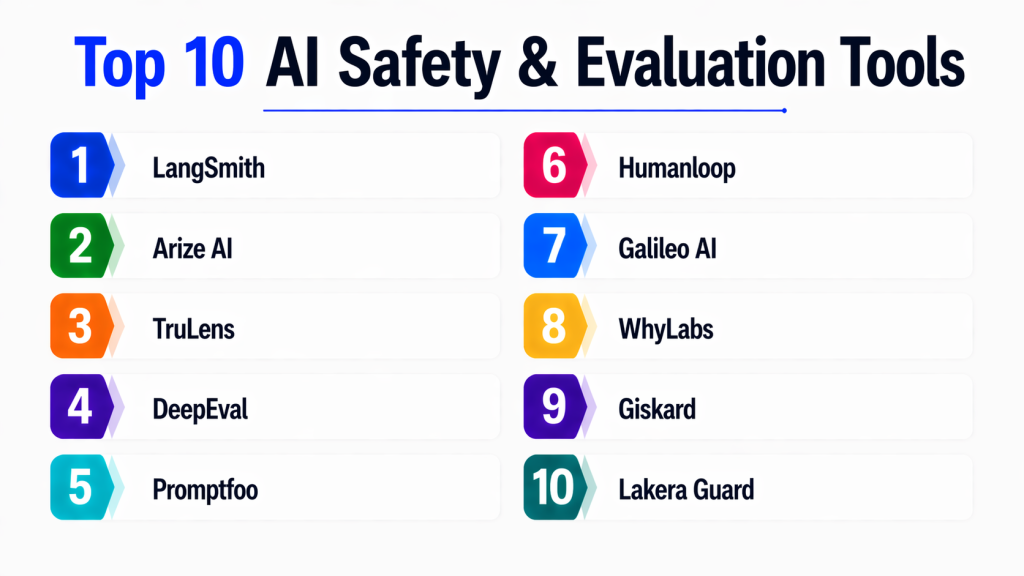
Top 10 AI Safety & Evaluation Tools
#1 — LangSmith
Short description :
LangSmith is an observability and evaluation platform for LLM applications. It helps developers debug, test, and monitor AI workflows. Widely used with orchestration frameworks. Provides deep insights into model behavior. Ideal for production AI systems.
Key Features
- Prompt evaluation
- Debugging tools
- Performance tracking
- Workflow observability
- Integration with LLM pipelines
Pros
- Strong analytics
- Developer-friendly
Cons
- Learning curve
- Best with specific ecosystems
Platforms / Deployment
Cloud
Security & Compliance
Varies
Integrations & Ecosystem
- LLM frameworks
- APIs
Support & Community
Active community.
#2 — Arize AI
Short description :
Arize AI focuses on AI observability and evaluation. It provides monitoring tools for model performance and drift. Designed for enterprise use. Helps ensure reliable AI systems. Suitable for large-scale deployments.
Key Features
- Model monitoring
- Drift detection
- Performance analytics
- Data quality tracking
Pros
- Enterprise-ready
- Strong monitoring
Cons
- Complex setup
- Premium pricing
Platforms / Deployment
Cloud
Security & Compliance
Enterprise controls
Compliance: Varies
Integrations & Ecosystem
- ML pipelines
- Data tools
Support & Community
Enterprise support.
#3 — TruLens
Short description :
TruLens is an open-source evaluation framework for LLM applications. It enables feedback and evaluation of model outputs. Ideal for developers and researchers. Focuses on transparency.
Key Features
- LLM evaluation
- Feedback loops
- Open-source framework
- Custom metrics
Pros
- Flexible
- Transparent
Cons
- Requires setup
- Limited UI
Platforms / Deployment
Local / Cloud
Security & Compliance
Not publicly stated
Integrations & Ecosystem
- LLM tools
Support & Community
Growing community.
#4 — DeepEval
Short description :
DeepEval is a testing framework for evaluating LLM outputs. It provides automated testing and benchmarking tools. Ideal for developers building AI applications. Focuses on quality assurance.
Key Features
- Automated testing
- Benchmarking
- Evaluation metrics
- LLM validation
Pros
- Easy testing
- Developer-focused
Cons
- Limited enterprise features
- Smaller ecosystem
Platforms / Deployment
Local / Cloud
Security & Compliance
Not publicly stated
Integrations & Ecosystem
- Dev tools
Support & Community
Growing support.
#5 — Promptfoo
Short description :
Promptfoo is a tool for testing and evaluating prompts. It allows developers to compare outputs across models. Ideal for prompt engineering workflows. Supports automated testing.
Key Features
- Prompt testing
- Model comparison
- Automated evaluation
- CLI tools
Pros
- Lightweight
- Flexible
Cons
- Developer-focused
- Limited UI
Platforms / Deployment
Local
Security & Compliance
Not publicly stated
Integrations & Ecosystem
- LLM APIs
Support & Community
Active community.
#6 — Humanloop
Short description :
Humanloop provides evaluation and monitoring tools for AI systems. It supports prompt testing and collaboration. Ideal for enterprise AI teams. Focuses on governance and safety.
Key Features
- Prompt evaluation
- Collaboration tools
- Monitoring
- Version control
Pros
- Enterprise-ready
- Strong governance
Cons
- Premium pricing
- Limited open-source
Platforms / Deployment
Cloud
Security & Compliance
Enterprise controls
Compliance: Varies
Integrations & Ecosystem
- APIs
- AI tools
Support & Community
Enterprise support.
#7 — Galileo AI
Short description :
Galileo AI focuses on evaluating and monitoring AI models. It provides insights into model behavior and performance. Suitable for enterprise use. Helps improve reliability.
Key Features
- Model evaluation
- Monitoring tools
- Performance analytics
Pros
- Strong insights
- Scalable
Cons
- Complex setup
- Limited adoption
Platforms / Deployment
Cloud
Security & Compliance
Varies
Integrations & Ecosystem
- ML tools
Support & Community
Emerging community.
#8 — WhyLabs
Short description :
WhyLabs provides AI observability and monitoring tools. It helps detect anomalies and ensure data quality. Suitable for ML and AI systems. Focuses on reliability.
Key Features
- Data monitoring
- Anomaly detection
- Observability tools
Pros
- Strong monitoring
- Scalable
Cons
- Limited evaluation features
- Learning curve
Platforms / Deployment
Cloud
Security & Compliance
Enterprise controls
Compliance: Varies
Integrations & Ecosystem
- Data tools
Support & Community
Enterprise support.
#9 — Giskard
Short description :
Giskard is an AI testing and evaluation platform. It focuses on detecting risks such as bias and hallucinations. Ideal for responsible AI development. Supports automated testing.
Key Features
- Bias detection
- Risk assessment
- Automated testing
- LLM evaluation
Pros
- Strong safety focus
- Easy testing
Cons
- Smaller ecosystem
- Limited integrations
Platforms / Deployment
Cloud / Local
Security & Compliance
Not publicly stated
Integrations & Ecosystem
- AI tools
Support & Community
Growing community.
#10 — Lakera Guard
Short description :
Lakera Guard provides real-time protection for AI systems. It focuses on detecting unsafe inputs and outputs. Ideal for securing AI applications. Designed for enterprise use.
Key Features
- Input/output filtering
- Real-time protection
- Threat detection
- Guardrails
Pros
- Strong security
- Real-time protection
Cons
- Premium pricing
- Limited open-source
Platforms / Deployment
Cloud
Security & Compliance
Enterprise-grade controls
Compliance: Varies
Integrations & Ecosystem
- APIs
- AI platforms
Support & Community
Enterprise support.
Comparison Table (Top 10)
| Tool Name | Best For | Platform(s) | Deployment | Standout Feature | Public Rating |
|---|---|---|---|---|---|
| LangSmith | LLM apps | Cloud | Cloud | Observability | N/A |
| Arize AI | Enterprise | Cloud | Cloud | Monitoring | N/A |
| TruLens | Developers | Multi | Hybrid | Open-source | N/A |
| DeepEval | Testing | Multi | Hybrid | Benchmarking | N/A |
| Promptfoo | Prompt testing | Local | Local | CLI tools | N/A |
| Humanloop | Enterprise | Cloud | Cloud | Governance | N/A |
| Galileo | Monitoring | Cloud | Cloud | Insights | N/A |
| WhyLabs | Data quality | Cloud | Cloud | Observability | N/A |
| Giskard | Safety | Multi | Hybrid | Risk detection | N/A |
| Lakera Guard | Security | Cloud | Cloud | Guardrails | N/A |
Evaluation & Scoring of AI Safety & Evaluation Tools
| Tool | Core | Ease | Integration | Security | Performance | Support | Value | Total |
|---|---|---|---|---|---|---|---|---|
| LangSmith | 10 | 8 | 10 | 8 | 9 | 10 | 9 | 9.2 |
| Arize AI | 9 | 7 | 9 | 9 | 9 | 9 | 7 | 8.6 |
| TruLens | 8 | 7 | 8 | 7 | 8 | 8 | 9 | 8.0 |
| DeepEval | 8 | 8 | 8 | 7 | 8 | 7 | 8 | 7.9 |
| Promptfoo | 7 | 9 | 7 | 6 | 7 | 7 | 9 | 7.7 |
| Humanloop | 9 | 8 | 9 | 9 | 8 | 9 | 7 | 8.5 |
| Galileo | 8 | 7 | 8 | 8 | 8 | 7 | 7 | 7.7 |
| WhyLabs | 8 | 7 | 8 | 9 | 8 | 8 | 7 | 8.0 |
| Giskard | 9 | 8 | 8 | 9 | 8 | 8 | 8 | 8.4 |
| Lakera | 9 | 7 | 8 | 10 | 9 | 8 | 7 | 8.6 |
Which AI Safety & Evaluation Tool Is Right for You?
Solo / Freelancer
Use Promptfoo, TruLens
SMB
Use Giskard, DeepEval
Mid-Market
Use LangSmith, WhyLabs
Enterprise
Use Arize AI, Humanloop, Lakera Guard
Budget vs Premium
Budget: Promptfoo
Premium: Arize AI
Feature Depth vs Ease
Depth: LangSmith
Ease: Promptfoo
Security & Compliance
Best: Lakera Guard, Arize AI
Frequently Asked Questions (FAQs)
1. What are AI safety tools?
AI safety tools are platforms that help ensure AI systems behave reliably and securely. They detect risks such as bias and unsafe outputs. These tools improve trust in AI systems. They are essential for production deployments. They support governance and compliance.
2. Why are AI evaluation tools important?
They help measure the performance and accuracy of AI systems. Without evaluation, AI outputs may be unreliable. These tools provide benchmarks and testing frameworks. They improve quality and consistency. They are critical for enterprise AI.
3. Can I deploy AI without safety tools?
Yes, but it is not recommended for production systems. Safety tools reduce risks and improve reliability. They help identify issues early. They are essential for scaling AI. They support compliance requirements.
4. Are these tools secure?
Enterprise tools provide strong security features. Security depends on deployment and configuration. Proper usage ensures safety. Sensitive data must be handled carefully. Compliance varies by tool.
5. Which tool is best for beginners?
Promptfoo and TruLens are easier to start with. They provide simple interfaces and flexibility. Advanced tools may require expertise. Beginners should start small. Gradual learning is recommended.
6. Do these tools support multiple models?
Yes, most tools support multiple AI models. This allows comparison and benchmarking. It improves flexibility. Multi-model support is common. It enables better evaluation.
7. Are AI safety tools expensive?
Some tools are open-source and free. Enterprise tools require payment. Costs depend on scale and features. Pricing varies across platforms. Evaluate based on needs.
8. Can these tools scale?
Yes, they are designed for scalable AI systems. They support cloud deployments. Performance depends on architecture. Proper setup ensures scalability. Suitable for enterprise use.
9. What are common mistakes when using these tools?
Common mistakes include ignoring evaluation results and poor configuration. Overlooking monitoring can cause issues. Lack of testing reduces reliability. Proper planning is important. Continuous evaluation improves results.
10. How do I choose the right tool?
Choose based on your use case and complexity. Evaluate features and integrations. Test multiple tools before deciding. Consider scalability and security. Select the best fit for your workflow.
Conclusion
AI safety and evaluation tools are becoming essential for organizations deploying AI systems at scale. As AI models grow more powerful and complex, the risks associated with bias, hallucinations, and security vulnerabilities also increase. These tools help ensure that AI systems remain reliable, transparent, and aligned with business and regulatory requirements, making them a critical component of modern AI infrastructure.
Choosing the right tool depends on your specific needs, whether it is real-time monitoring, evaluation benchmarking, or security-focused guardrails. Instead of relying on a single platform, it is recommended to test multiple tools, evaluate their capabilities in real-world scenarios, and select the one that best aligns with your operational, security, and compliance requirements.
