Introduction
Reverse ETL tools help organizations move cleaned, modeled, analytics-ready data out of the warehouse and into business applications where teams actually work. In simple terms, these platforms take trusted data from systems like Snowflake, BigQuery, Redshift, Databricks, or PostgreSQL and sync it into tools such as Salesforce, HubSpot, Marketo, Zendesk, Intercom, ad platforms, support tools, and internal operational systems. Instead of keeping useful customer, product, revenue, and lifecycle insights trapped inside the data team’s environment, reverse ETL turns warehouse data into action across sales, marketing, customer success, finance, and operations.
This category matters even more now because companies increasingly want a single source of truth in the warehouse while still enabling downstream teams to act on data in real time or near real time. Reverse ETL has become essential for operational analytics, customer 360 programs, lead scoring, lifecycle automation, product-led growth workflows, churn prevention, ad audience syncing, and territory planning. It also fits naturally with modern composable data stack strategies, where the warehouse is the core and specialized tools activate data across the business.
Common use cases include:
- Syncing customer health scores into CRM or support tools
- Sending product usage traits into lifecycle and marketing platforms
- Updating lead qualification and account intelligence in sales systems
- Powering customer segmentation in advertising and engagement tools
- Delivering trusted finance or operations data into business applications
Buyers should evaluate:
- Source and destination coverage
- Sync reliability and monitoring
- Data transformation and mapping flexibility
- Identity resolution and record matching logic
- Security and governance controls
- Ease of setup for data and business teams
- Support for real-time or scheduled syncs
- Error handling and observability
- Pricing model and scalability
- Compatibility with the existing modern data stack
Best for: data teams, RevOps, growth teams, lifecycle marketers, CRM admins, customer success leaders, and companies that already use a warehouse as the main analytical foundation. Reverse ETL tools are especially valuable for mid-market and enterprise organizations that want warehouse-quality data to drive action inside operational systems.
Not ideal for: companies that do not yet have a reliable warehouse, mature data models, or clear operational use cases. If your team is still struggling to centralize data or define consistent customer logic, a reverse ETL layer may be premature. In those cases, core data foundation work should come first.
Key Trends in Reverse ETL Tools
- Warehouse-first operations are becoming standard. More teams now treat the warehouse as the primary source of truth and use reverse ETL to activate governed data across business tools.
- Composable CDP overlap is increasing. Reverse ETL platforms are increasingly competing with or expanding into customer data platform territory through audience building, identity logic, and activation workflows.
- Real-time activation is becoming more important. Buyers increasingly expect lower-latency syncing for lifecycle, product-led growth, and support use cases.
- AI-ready operational data is a growing theme. Reverse ETL tools are being used to move model outputs, scores, and predictive insights into frontline tools.
- Governance and security expectations are rising. Buyers want auditability, role-based controls, encrypted pipelines, and strong admin visibility.
- Non-technical usability matters more. Teams increasingly prefer platforms that let operations and business users participate in data activation without depending on engineering for every change.
- Destination depth is a competitive differentiator. It is not just about how many connectors exist, but how deeply they support object mapping, custom fields, and operational logic.
- Monitoring and observability are becoming buying criteria. Reliable alerting, sync visibility, retry logic, and issue handling matter more as reverse ETL becomes mission-critical.
- Vendor convergence is increasing. Some reverse ETL tools now extend into data movement, event-based workflows, cataloging, orchestration, and audience management.
- Value measurement is becoming more operational. Buyers increasingly want to connect reverse ETL investments to revenue workflows, customer outcomes, conversion efficiency, and retention improvements.
How We Chose These Reverse ETL Tools (Methodology)
We selected the Top 10 reverse ETL tools using a practical evaluation model based on what real buyers care about:
- We prioritized vendors with strong category recognition and meaningful production adoption.
- We looked for broad and credible support across modern warehouses and key business destinations.
- We evaluated sync reliability, scheduling flexibility, and monitoring capabilities.
- We considered transformation, mapping, and identity handling depth.
- We factored in ease of use for both technical and non-technical users.
- We reviewed security posture signals such as encryption, access controls, and administrative governance.
- We considered ecosystem fit with the modern data stack, including dbt, warehouses, orchestration, and business systems.
- We included a mix of dedicated reverse ETL specialists and adjacent platforms where relevant.
- We considered fit across SMB, mid-market, and enterprise adoption scenarios.
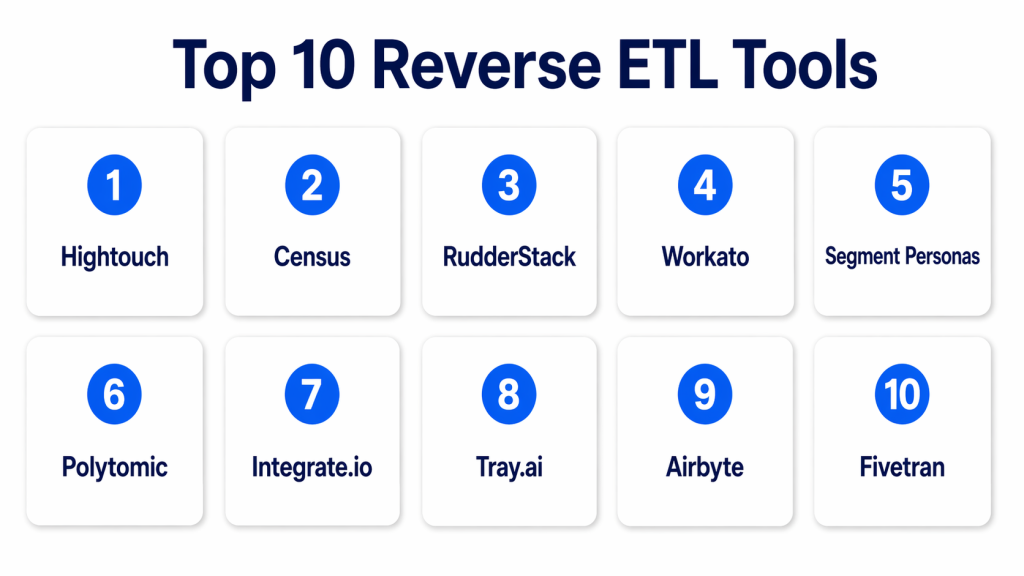
Top 10 Reverse ETL Tools
#1 — Hightouch
Short description : Hightouch is one of the best-known reverse ETL platforms and is widely considered a category leader for warehouse-to-SaaS activation. It helps companies sync trusted data from cloud warehouses into operational tools used by sales, marketing, support, and success teams. Hightouch is especially strong for warehouse-first companies that want a polished product, broad connector coverage, and flexible audience or sync workflows. It is also increasingly relevant in composable CDP conversations. For many organizations, it is the default tool to evaluate first.
Key Features
- Broad support for cloud warehouses and operational destinations
- Flexible model syncing and field mapping
- Strong audience activation and segmentation capabilities
- Support for scheduled and event-driven workflows
- Monitoring, alerting, and sync observability features
- Good fit for CRM, marketing, and customer lifecycle use cases
- Expanding composable CDP functionality
Pros
- Mature product with strong category recognition
- Broad destination coverage and strong usability
- Works well for both technical teams and business-facing activation workflows
Cons
- Pricing can become premium as usage grows
- Advanced setups may still require careful data modeling
- Some organizations may not need the broader composable feature set
Platforms / Deployment
Cloud
Security & Compliance
Supports enterprise-oriented security controls, encrypted data handling, and administrative governance capabilities. Specific compliance details vary by plan and deployment context.
Integrations & Ecosystem
Hightouch fits naturally into modern data stack environments and works well with warehouses, dbt-centered workflows, and go-to-market tools. It is especially strong when organizations want analytics-grade data to directly drive operational systems.
- Warehouse integrations
- CRM and marketing platform support
- dbt-friendly workflow compatibility
- Audience and activation workflows
- Operational SaaS destination coverage
Support & Community
Hightouch has strong market visibility, solid documentation, and growing enterprise maturity. It is well regarded among modern data stack practitioners and has good implementation support.
#2 — Census
Short description : Census is another leading reverse ETL platform and is often shortlisted directly alongside Hightouch. It is designed to sync warehouse data into business tools while emphasizing reliability, operational use cases, and accessible setup. Census is especially attractive for data teams that want clear sync logic, dependable execution, and strong destination coverage without unnecessary complexity. It works well for CRM updates, customer segmentation, sales enrichment, and internal workflow activation. For many buyers, it is one of the strongest category alternatives.
Key Features
- Reverse ETL syncing from modern warehouses to SaaS applications
- Strong support for CRM and marketing activation
- Clear model-based sync configuration
- Sync monitoring and operational controls
- Good usability for data and operations teams
- Support for warehouse-first operational workflows
- Scalable production sync capabilities
Pros
- Strong focus on reliability and operational clarity
- Good balance between usability and technical control
- Well suited for modern GTM and lifecycle use cases
Cons
- Premium positioning may not fit every smaller team
- Some deeper composable CDP-style features may lag broader platform players
- Full value depends on a mature warehouse environment
Platforms / Deployment
Cloud
Security & Compliance
Supports enterprise security expectations such as secure data transfer and administrative controls. Broader compliance scope depends on subscription tier and deployment specifics.
Integrations & Ecosystem
Census integrates well into the modern warehouse-first operating model. It works best when a company already has clean data models and wants to make them operational across sales, success, support, and marketing systems.
- Warehouse and database source support
- CRM and operational SaaS integrations
- dbt and analytics workflow alignment
- Sync observability and management features
Support & Community
Census has good product maturity, a strong reputation in the reverse ETL space, and solid documentation. It is a credible choice for both mid-market and enterprise teams.
#3 — RudderStack
Short description : RudderStack is best known as a customer data infrastructure platform, but it is also highly relevant in reverse ETL discussions because of its warehouse-centric activation and event pipeline capabilities. It is especially attractive to organizations that want a broader data movement and activation platform rather than a narrowly defined reverse ETL point solution. RudderStack works well for customer data, lifecycle marketing, and event-driven activation use cases. It is particularly useful when teams want tighter control over data flow between warehouse and downstream systems. For composable architectures, it is a serious contender.
Key Features
- Warehouse-centric activation and data movement capabilities
- Strong customer data and event pipeline support
- Reverse ETL relevance for SaaS activation workflows
- Good fit for composable customer data strategies
- Broad destination and pipeline capabilities
- Suitable for engineering-led and growth-led teams
- Flexibility across event and model-based workflows
Pros
- Strong option for teams wanting more than pure reverse ETL
- Useful in composable CDP and customer data architectures
- Good flexibility for event-driven and warehouse-driven activation
Cons
- Can be broader and more complex than needed for simple sync use cases
- Some buyers may prefer a more focused reverse ETL experience
- Best value often comes when multiple RudderStack capabilities are used
Platforms / Deployment
Cloud / Self-hosted / Hybrid
Security & Compliance
Supports enterprise-oriented security controls and governance patterns appropriate for customer data infrastructure. Exact compliance scope depends on deployment model and service tier.
Integrations & Ecosystem
RudderStack fits well in composable customer data stacks and engineering-heavy environments. It is especially strong where event collection, warehouse syncing, and downstream activation are all part of the same strategic architecture.
- Warehouse-centered integrations
- Customer data pipeline compatibility
- Marketing and analytics destination support
- Engineering and API-oriented workflows
- Composable data stack relevance
Support & Community
RudderStack has strong technical credibility and a growing enterprise presence. It is particularly appealing to data and engineering teams that want flexibility and broader infrastructure capability.
#4 — Workato
Short description : Workato is not a reverse ETL specialist in the narrowest sense, but it is highly relevant because many organizations use it to operationalize warehouse-driven data across business systems. It combines integration automation, workflow logic, and app connectivity in a way that can support reverse ETL-like use cases at scale. Workato is especially strong when data activation is only one part of a broader automation strategy. It works well in organizations that want business process automation layered on top of data movement. For enterprise workflow-driven activation, it can be very powerful.
Key Features
- Broad automation and application integration platform
- Strong workflow logic and orchestration capabilities
- Useful for warehouse-driven operational data movement
- Supports business process automation beyond simple syncing
- Enterprise-grade integration coverage
- Strong fit for cross-functional process activation
- Suitable for more complex app-to-app and data-to-app workflows
Pros
- Excellent for organizations combining reverse ETL with automation
- Broad enterprise integration ecosystem
- Strong workflow depth beyond simple sync tools
Cons
- Not as specialized as dedicated reverse ETL vendors
- Can be heavier and more expensive for simple use cases
- Setup and governance may require more process design work
Platforms / Deployment
Cloud / Hybrid
Security & Compliance
Supports enterprise-grade integration security controls, administrative policies, and governance capabilities. Exact compliance coverage depends on the plan and environment.
Integrations & Ecosystem
Workato shines in environments where the destination action matters as much as the sync itself. It is particularly strong when teams want warehouse data to trigger approvals, routing logic, updates, notifications, and downstream operational automation.
- Broad SaaS app integration coverage
- Automation workflow support
- Enterprise process orchestration
- API and business system connectivity
- Operational activation use cases
Support & Community
Workato has strong enterprise support maturity and wide adoption in integration-led organizations. It is best suited to teams that want both operational automation and data activation in one platform.
#5 — Segment Personas
Short description : Segment Personas is closely related to composable customer data and audience activation rather than being a pure reverse ETL specialist, but it remains relevant for organizations that want to sync rich customer traits and audiences into downstream systems. It is especially appealing for companies already using Segment for event collection and customer data infrastructure. Personas helps operational teams activate modeled user and account traits across marketing, support, and sales tools. It is strongest in customer-centric use cases. For customer data activation, it remains an important option.
Key Features
- Audience and trait activation into downstream tools
- Strong relevance in customer data stack environments
- Useful for lifecycle, segmentation, and personalization workflows
- Works well with event-driven customer data pipelines
- Good fit for operationalizing customer profiles
- Broad marketing and engagement destination relevance
- Suitable for growth and lifecycle teams
Pros
- Strong fit for customer data activation use cases
- Useful when Segment is already part of the architecture
- Good for profile and audience-based downstream syncing
Cons
- Less of a broad warehouse-to-anything reverse ETL specialist
- Best value usually depends on existing Segment adoption
- May not be ideal for non-customer operational use cases
Platforms / Deployment
Cloud
Security & Compliance
Supports enterprise-oriented customer data security and governance patterns. Exact compliance and control scope depends on subscription and configuration.
Integrations & Ecosystem
Segment Personas is strongest when customer data collection, identity handling, and activation are already managed in the broader Segment environment. It fits growth, lifecycle, and engagement use cases especially well.
- Customer data infrastructure alignment
- Marketing destination support
- Audience activation workflows
- Profile and trait syncing
- Lifecycle and engagement use cases
Support & Community
Segment has strong market recognition and a large ecosystem. Personas is most compelling for teams already committed to Segment’s broader customer data infrastructure.
#6 — Polytomic
Short description : Polytomic is a reverse ETL platform built to help companies activate warehouse data across business tools with relatively fast setup and practical operational utility. It is especially relevant for data teams that want a dedicated reverse ETL tool without necessarily moving into broader customer data platform territory. Polytomic supports modern sources and operational destinations and is particularly useful for customer, revenue, and lifecycle data use cases. It is often considered by teams that want focused capability without excessive complexity. For direct warehouse-to-tool syncing, it is a credible option.
Key Features
- Warehouse-to-SaaS sync workflows
- Focused reverse ETL product positioning
- Suitable for customer and revenue operations use cases
- Support for common business destinations
- Monitoring and sync management capabilities
- Practical operational activation workflows
- Good fit for warehouse-first environments
Pros
- More focused than broader customer data platforms
- Useful for direct reverse ETL needs
- Good fit for operational teams syncing modeled data
Cons
- Smaller market presence than category leaders
- Ecosystem breadth may be lighter than top competitors
- Some enterprises may want more advanced governance or workflow depth
Platforms / Deployment
Cloud
Security & Compliance
Supports secure data syncing and administrative controls expected in modern SaaS data activation platforms. Exact compliance scope varies by service level.
Integrations & Ecosystem
Polytomic works well in modern warehouse-first environments where the primary goal is to push modeled data into operational apps quickly and reliably without building custom pipelines.
- Warehouse source connectivity
- SaaS destination support
- Revenue and customer data workflows
- Operational sync use cases
Support & Community
Polytomic is more specialized and smaller in market visibility, but it remains credible for focused reverse ETL adoption. It appeals most to teams wanting practical activation without major platform sprawl.
#7 — Integrate.io
Short description : Integrate.io is known more broadly for data integration, but it is relevant here because many teams use it for moving and operationalizing data across analytics and business systems. It can support reverse ETL-style workflows where transformed warehouse data needs to flow into operational applications. It is especially useful for organizations that want a broader integration platform rather than a narrowly scoped reverse ETL product. For mixed ETL and reverse ETL requirements, it can be attractive. It is best evaluated in companies looking for flexibility across data movement scenarios.
Key Features
- Broad data integration platform functionality
- Can support reverse ETL-style operational workflows
- Useful for mixed ETL and activation needs
- Supports data movement between warehouse and business tools
- Flexible orchestration options
- Good fit for organizations consolidating integration tasks
- Relevant for analytics and operational sync use cases
Pros
- Useful when ETL and reverse ETL needs overlap
- Broad integration flexibility
- Can reduce vendor sprawl for some teams
Cons
- Less specialized than dedicated reverse ETL leaders
- May not offer the same polished activation experience
- Best fit depends on broader integration strategy
Platforms / Deployment
Cloud
Security & Compliance
Supports modern platform security and data transfer protections appropriate for integration use cases. Specific compliance coverage varies by subscription and use case.
Integrations & Ecosystem
Integrate.io is strongest when an organization wants to combine multiple data movement needs under one umbrella. It is more of a flexible integration option than a pure-play reverse ETL specialist.
- Warehouse and database connectivity
- SaaS application integration
- Mixed ETL and reverse ETL relevance
- Operational workflow support
Support & Community
It offers practical support for integration-led teams and fits best in organizations already thinking broadly about data movement rather than narrowly about warehouse activation.
#8 — Tray.ai
Short description : Tray.ai is primarily an automation and integration platform, but it is relevant in reverse ETL discussions when organizations need to operationalize warehouse-derived insights across go-to-market and service workflows. It is especially appealing when syncing data is only part of the broader requirement and automation logic is equally important. Tray.ai works well for operational teams that want flexible orchestration, app connectivity, and custom logic layered over data movement. For workflow-rich reverse ETL scenarios, it can be effective. It is more process-driven than category-pure.
Key Features
- Strong integration and automation platform
- Useful for workflow-rich reverse ETL scenarios
- Broad SaaS application connectivity
- Flexible orchestration and logic handling
- Good fit for operational process activation
- Supports custom workflows around data updates
- Suitable for GTM and support-oriented use cases
Pros
- Strong option when automation logic matters as much as syncing
- Broad app ecosystem compatibility
- Good fit for process-heavy activation scenarios
Cons
- Not a dedicated reverse ETL specialist
- May be excessive for simple warehouse-to-destination syncing
- Governance and maintenance can become complex in large automations
Platforms / Deployment
Cloud
Security & Compliance
Supports enterprise integration security and administrative governance patterns. Exact control depth depends on edition and organizational setup.
Integrations & Ecosystem
Tray.ai is strongest where teams want to combine data activation with routing logic, notifications, app automation, and operational workflows rather than only syncing fields from one system to another.
- SaaS integration ecosystem
- Automation workflow support
- GTM and customer process relevance
- API and orchestration compatibility
Support & Community
Tray.ai is well known in automation-led organizations and offers good support for workflow-driven use cases. It is best for teams comfortable with integration-platform-style design.
#9 — Airbyte
Short description : Airbyte is primarily known for data ingestion, but it has growing relevance in data movement conversations where organizations want flexible connector-based workflows and more control over how data flows between systems. It is not a traditional reverse ETL leader in the same way as Hightouch or Census, but some teams consider it when they want open, extensible movement patterns across sources and destinations. It is particularly attractive to technically capable teams. For engineering-led architectures, it can play a role in reverse ETL-like workflows. It is more builder-friendly than business-user-friendly.
Key Features
- Broad connector-based data movement approach
- Strong relevance for engineering-led data infrastructure
- Flexible architecture for source and destination connectivity
- Useful in open and extensible data stack environments
- Supports broader movement patterns beyond classic ingestion
- Good fit for technically capable teams
- Adaptable to custom workflow needs
Pros
- Flexible and attractive for engineering-led environments
- Useful where customization matters
- Strong connector mindset across the data stack
Cons
- Not a purpose-built reverse ETL leader
- May require more engineering effort to operationalize
- Less polished for business-facing activation use cases
Platforms / Deployment
Cloud / Self-hosted / Hybrid
Security & Compliance
Supports modern platform security controls, with overall governance posture depending heavily on the chosen deployment model and operational design.
Integrations & Ecosystem
Airbyte fits best where the organization wants open connector-driven data movement and is comfortable assembling a broader architecture. It is more infrastructure-oriented than operator-oriented.
- Broad connector ecosystem
- Flexible deployment support
- Engineering-first data movement workflows
- Compatibility with modern data stack patterns
Support & Community
Airbyte has strong community visibility and good momentum among engineering teams. It is especially attractive for technically mature organizations comfortable with platform ownership.
#10 — Fivetran
Short description : Fivetran is primarily associated with ELT and data ingestion, but it is increasingly part of broader data movement conversations in organizations looking to reduce the number of platforms they manage. While it is not a reverse ETL specialist first, some teams evaluate it because of its strong connector reputation and broader data pipeline credibility. It makes the most sense when a buyer prefers platform consolidation and already uses Fivetran extensively. For pure reverse ETL, there are usually more specialized choices. Still, it is relevant enough to consider in adjacent evaluations.
Key Features
- Strong data connector reputation
- Broader data pipeline platform relevance
- Useful in organizations consolidating data movement vendors
- Suitable for modern warehouse-centered architectures
- Strong operational reliability reputation
- Good ecosystem compatibility
- Relevant in broader integration strategy discussions
Pros
- Well known for reliability and connector quality
- Attractive for vendor consolidation discussions
- Strong credibility in modern data stack environments
Cons
- Not a pure reverse ETL leader
- Reverse ETL-specific workflow depth may not match specialists
- Best fit usually depends on broader Fivetran platform adoption
Platforms / Deployment
Cloud
Security & Compliance
Supports enterprise-grade data pipeline security controls and administrative governance expectations. Exact compliance applicability depends on plan and deployment specifics.
Integrations & Ecosystem
Fivetran is most relevant here for organizations already committed to a broader modern data stack and interested in reducing tool fragmentation. It is more adjacent than central in the reverse ETL category.
- Modern data stack compatibility
- Broad connector ecosystem
- Warehouse-centered architecture fit
- Vendor consolidation relevance
Support & Community
Fivetran has strong market recognition, mature documentation, and solid enterprise support. It is most appealing in organizations that already trust its broader data pipeline capabilities.
Comparison Table (Top 10)
| Tool Name | Best For | Platform(s) Supported | Deployment | Standout Feature | Public Rating |
|---|---|---|---|---|---|
| Hightouch | Warehouse-first operational data activation | Web / Cloud | Cloud | Mature reverse ETL plus composable CDP momentum | N/A |
| Census | Reliable warehouse-to-SaaS syncing | Web / Cloud | Cloud | Strong operational reverse ETL clarity and usability | N/A |
| RudderStack | Composable customer data and activation | Web / Cloud / Linux | Cloud / Self-hosted / Hybrid | Combines data pipelines and warehouse-centric activation | N/A |
| Workato | Workflow-driven operational activation | Web / Cloud | Cloud / Hybrid | Deep automation layered on data movement | N/A |
| Segment Personas | Customer trait and audience activation | Web / Cloud | Cloud | Strong fit for customer data activation use cases | N/A |
| Polytomic | Focused reverse ETL syncing | Web / Cloud | Cloud | Practical dedicated warehouse-to-SaaS activation | N/A |
| Integrate.io | Mixed ETL and reverse ETL needs | Web / Cloud | Cloud | Flexible broader integration platform relevance | N/A |
| Tray.ai | Process-heavy operational data workflows | Web / Cloud | Cloud | Strong automation and orchestration flexibility | N/A |
| Airbyte | Engineering-led connector-based activation patterns | Web / Cloud / Linux | Cloud / Self-hosted / Hybrid | Open and extensible connector-driven architecture | N/A |
| Fivetran | Vendor consolidation in modern data stacks | Web / Cloud | Cloud | Strong data pipeline credibility and connector reliability | N/A |
Evaluation & Scoring of Reverse ETL Tools
| Tool Name | Core (25%) | Ease (15%) | Integrations (15%) | Security (10%) | Performance (10%) | Support (10%) | Value (15%) | Weighted Total (0–10) |
|---|---|---|---|---|---|---|---|---|
| Hightouch | 9.4 | 8.8 | 9.2 | 8.7 | 8.9 | 8.8 | 7.8 | 8.78 |
| Census | 9.1 | 8.7 | 8.9 | 8.6 | 8.8 | 8.7 | 7.9 | 8.61 |
| RudderStack | 8.7 | 7.8 | 9.0 | 8.5 | 8.6 | 8.4 | 8.1 | 8.40 |
| Workato | 8.2 | 7.5 | 9.2 | 8.8 | 8.5 | 8.8 | 7.2 | 8.19 |
| Segment Personas | 8.1 | 8.0 | 8.5 | 8.4 | 8.2 | 8.4 | 7.5 | 8.07 |
| Polytomic | 7.9 | 8.1 | 7.8 | 8.1 | 8.0 | 7.8 | 8.2 | 7.97 |
| Integrate.io | 7.8 | 7.4 | 8.3 | 8.2 | 8.0 | 7.9 | 8.0 | 7.92 |
| Tray.ai | 7.7 | 7.3 | 8.6 | 8.2 | 8.0 | 8.0 | 7.7 | 7.95 |
| Airbyte | 7.4 | 6.8 | 8.5 | 7.8 | 8.0 | 7.8 | 8.6 | 7.83 |
| Fivetran | 7.5 | 8.0 | 8.7 | 8.5 | 8.7 | 8.7 | 7.1 | 8.03 |
These scores are comparative, not universal truths. A tool with a lower total may still be the best fit if it aligns better with your team’s operating model, existing architecture, or preference for integration versus specialization. Dedicated reverse ETL vendors usually score highest on core activation workflows, while broader automation or pipeline platforms may score better for ecosystem flexibility. Value scores can vary significantly depending on sync volume, destination complexity, and broader platform usage. Use this table to compare trade-offs, not to declare one universal winner.
Which Reverse ETL Tool Is Right for You?
Solo / Freelancer
If you are a solo operator, consultant, or very small startup, a full reverse ETL platform may be more than you need unless you already have a mature warehouse and clear operational activation use cases. If you do need one, Polytomic or a narrowly scoped setup with Census can be easier to justify than a broader platform-heavy deployment. In many early-stage environments, simpler native integrations may still be enough.
SMB
SMBs usually need a balance between ease of setup, destination depth, and pricing clarity. Census and Hightouch are often the strongest choices for SMBs with a mature warehouse and real go-to-market data activation needs. RudderStack can also be attractive for teams that want customer data infrastructure and activation in one broader system. The right pick depends on whether you want pure reverse ETL or a broader composable stack.
Mid-Market
Mid-market organizations often get the most value from reverse ETL because they have enough warehouse maturity to benefit, but still need fast operational impact across CRM, support, and lifecycle systems. Hightouch and Census are usually the first tools to shortlist. Workato or Tray.ai make more sense if syncs must also drive workflow automation. RudderStack is a strong fit where customer data movement is central to the business model.
Enterprise
Enterprises should usually start with Hightouch, Census, RudderStack, and Workato. These tools are strong for governed activation, broad integrations, and enterprise operating models. Segment Personas becomes especially relevant for customer data-heavy organizations already invested in Segment. Enterprises should evaluate security controls, sync reliability, role separation, observability, and how well the tool supports multiple teams without operational chaos.
Budget vs Premium
For budget-conscious teams, Polytomic, Airbyte, or broader connector-driven approaches may look attractive, especially if the organization has stronger engineering capacity. Premium buyers often prefer Hightouch, Census, or Workato because they reduce operational friction and provide more mature controls. The best option depends on whether your team prefers lower software cost or lower implementation overhead.
Feature Depth vs Ease of Use
If you want the most polished dedicated reverse ETL experience, Hightouch and Census are the safest bets. If you want broad workflow depth beyond syncing, Workato and Tray.ai offer more process flexibility. If you want broader customer data infrastructure, RudderStack and Segment Personas become stronger options. Choose based on whether syncing itself is the product or only one piece of a larger automation strategy.
Integrations & Scalability
Choose Hightouch or Census when wide warehouse and destination support is the core requirement. Choose RudderStack for composable customer data architectures. Choose Workato or Tray.ai when integration logic and downstream automation matter heavily. Choose Airbyte if extensibility and engineering control are more important than business-user polish.
Security & Compliance Needs
For stricter operational and enterprise governance requirements, start with Hightouch, Census, Workato, and RudderStack. These are usually the strongest first-pass candidates for mature organizations that care about security controls, sync monitoring, admin separation, and governed operational data usage. In all cases, validate encryption, access controls, logging, credential handling, and destination-level governance during pilot testing.
Frequently Asked Questions (FAQs)
1. What is a reverse ETL tool?
A reverse ETL tool takes clean, modeled data from a warehouse and syncs it into business applications where teams actually work. It is the reverse of traditional ETL because instead of moving data into the warehouse, it moves trusted data out of the warehouse into operational tools. This helps sales, marketing, support, and success teams use warehouse-quality data without logging into analytics systems. It is especially useful in warehouse-first architectures.
2. How is reverse ETL different from ETL or ELT?
ETL and ELT are primarily about moving raw or source data into a central system for analysis. Reverse ETL is about taking already transformed and trusted data out of that central system and operationalizing it in downstream apps. In other words, ETL and ELT support analytics creation, while reverse ETL supports analytics activation. The two are complementary, not competing categories. Most modern data stacks benefit from both.
3. When does a company actually need reverse ETL?
A company usually needs reverse ETL when important business data is already in the warehouse, but operational teams cannot act on it easily in their day-to-day tools. This often happens when lifecycle scores, product usage data, lead quality models, or support health indicators exist in analytics systems but not in CRM, ad, or support platforms. Reverse ETL closes that gap. It becomes especially valuable once the warehouse is trusted as the source of truth.
4. Is reverse ETL the same as a composable CDP?
Not exactly, but the two categories overlap. Reverse ETL focuses on syncing modeled data from the warehouse into downstream systems. A composable CDP often includes reverse ETL but adds customer profile construction, identity logic, audience building, and customer journey activation. Some reverse ETL vendors now move into composable CDP territory. The difference usually depends on how customer-centric and activation-rich the platform is.
5. Which reverse ETL tool is best for CRM and sales workflows?
For CRM and sales use cases, Hightouch and Census are usually the strongest starting points because they are highly focused on reliable warehouse-to-SaaS syncing. Workato can also be excellent if the workflow requires more automation logic beyond simple field updates. The best choice depends on whether you only need syncing or want broader process orchestration. Destination depth also matters, especially with complex CRM object structures.
6. Are reverse ETL tools only useful for marketing teams?
No. Marketing is an important use case, but reverse ETL is just as useful for sales, customer success, support, finance, operations, and product-led growth teams. Any team that needs trusted warehouse data inside operational systems can benefit. Examples include customer health scoring, support prioritization, account planning, revenue workflows, product usage alerts, and lifecycle engagement. It is really about operationalizing trusted data, not about one department.
7. What are the biggest mistakes teams make with reverse ETL?
A common mistake is trying to activate data before the warehouse models are actually trustworthy. Another is syncing too many fields without a clear operational use case, which creates confusion rather than action. Some teams also underestimate identity matching complexity, especially across customers, accounts, leads, and product users. Others ignore monitoring and only realize a sync is broken after business impact appears. The best reverse ETL programs start with a few high-value use cases and clean data models.
8. Can reverse ETL support real-time use cases?
Some reverse ETL platforms support near-real-time or lower-latency workflows, but not every use case needs true real time. Many business processes work well with scheduled or frequent batch syncs. Real-time expectations should be evaluated carefully because they can affect complexity, cost, and architectural choices. If lifecycle messaging, support actions, or product triggers are time-sensitive, lower latency becomes more important. Buyers should validate this early during evaluation.
9. Is reverse ETL secure enough for enterprise use?
Leading reverse ETL platforms are designed for enterprise use, but the exact security posture depends on the vendor, configuration, and destination model. Buyers should validate encryption, credential handling, role-based controls, logging, access policies, and sync auditability. It is also important to review how the tool interacts with warehouse permissions and destination permissions. Security should be tested as part of the pilot, not assumed from product positioning.
10. How hard is reverse ETL implementation?
Implementation is usually easier than building custom activation pipelines, but success still depends on the quality of your data models and operational requirements. Basic syncing can be fast, but advanced use cases require careful field mapping, identity logic, testing, and stakeholder alignment. The technical setup is only one part of the work. The real challenge is ensuring that the synced data is useful, trusted, and actionable for the teams receiving it.
11. Should I choose a dedicated reverse ETL tool or a broader automation platform?
Choose a dedicated reverse ETL tool if syncing warehouse data into operational systems is the main requirement and you want the cleanest, most purpose-built experience. Choose a broader automation platform if the sync must be part of a wider workflow involving approvals, notifications, routing, branching logic, or business process orchestration. Neither approach is universally better. The right answer depends on whether you are solving a data activation problem or a workflow automation problem.
12. How should I shortlist reverse ETL tools?
Start with your actual operational use cases, not with connector counts alone. Identify the warehouses and destinations that matter most, then test how well each tool handles mapping, monitoring, reliability, and business usability. Shortlist two or three tools that fit your architecture and team maturity. Run a pilot around one or two high-value workflows such as CRM health scores or product-usage-driven lifecycle activation. That will reveal far more than a generic feature comparison.
Conclusion
Reverse ETL tools have become an important part of the modern data stack because they help organizations turn warehouse data into real operational action. Instead of keeping trusted models trapped inside analytics environments, these platforms push useful data into CRM, marketing automation, support, lifecycle, and business systems where teams can actually work with it. The strongest tools differ in where they win. Hightouch and Census lead as dedicated reverse ETL specialists, RudderStack is strong in composable customer data architectures, Workato and Tray.ai bring powerful automation depth, and tools like Segment Personas, Polytomic, Integrate.io, Airbyte, and Fivetran each fit specific activation or platform-consolidation needs.
The best reverse ETL tool depends on your warehouse maturity, destination requirements, team structure, and whether you need pure syncing or broader automation. Instead of looking for one universal winner, shortlist two or three tools that match your operational use cases and data architecture. Then run a focused pilot around a real business workflow such as lead scoring, customer health, or lifecycle activation. That approach will give you the clearest view of which platform your teams can actually trust, manage, and scale.
