Introduction
Data Loss Prevention (DLP) tools are cybersecurity solutions designed to detect, monitor, and prevent the unauthorized sharing or leakage of sensitive data across endpoints, networks, and cloud environments. These tools help organizations protect critical information such as financial data, intellectual property, and personal data.
In today’s digital-first world, where remote work, cloud adoption, and SaaS usage are rapidly increasing, the risk of data exposure is higher than ever. DLP tools provide real-time monitoring, policy enforcement, and automated protection mechanisms to prevent data breaches. Modern platforms also leverage AI-driven classification, behavior analytics, and integration with Zero Trust security frameworks.
Real-world use cases:
- Preventing data leaks via email and cloud apps
- Monitoring insider threats and user activity
- Protecting sensitive files on endpoints
- Enforcing compliance with data protection regulations
- Securing data transfers across networks
What buyers should evaluate:
- Data discovery and classification capabilities
- Endpoint, network, and cloud coverage
- Policy creation and enforcement
- Integration with security tools (CASB, SIEM, IAM)
- Real-time monitoring and alerts
- Automation and remediation features
- Ease of use and reporting dashboards
- Scalability across users and environments
- Compliance support (GDPR, HIPAA, etc.)
- Pricing and licensing
Best for: Enterprises, compliance-driven organizations, IT security teams, and industries handling sensitive data
Not ideal for: Organizations with minimal data security requirements
Key Trends in Data Loss Prevention (DLP)
- AI-driven data classification and risk detection
- Integration with Zero Trust security models
- Expansion into cloud and SaaS environments
- User behavior analytics (UBA) integration
- Real-time monitoring and automated response
- Unified endpoint, network, and cloud DLP solutions
- Integration with CASB and SSE platforms
- Focus on insider threat prevention
- API-based integration and automation
- Data-centric security approaches
How We Selected These Tools (Methodology)
- Market adoption and reputation
- Coverage across endpoints, network, and cloud
- Strength of data classification and protection capabilities
- Integration with security ecosystems
- Automation and analytics features
- Scalability across environments
- Ease of deployment and usability
- Vendor innovation and maturity
- Support and community strength
- Fit across SMB and enterprise environments
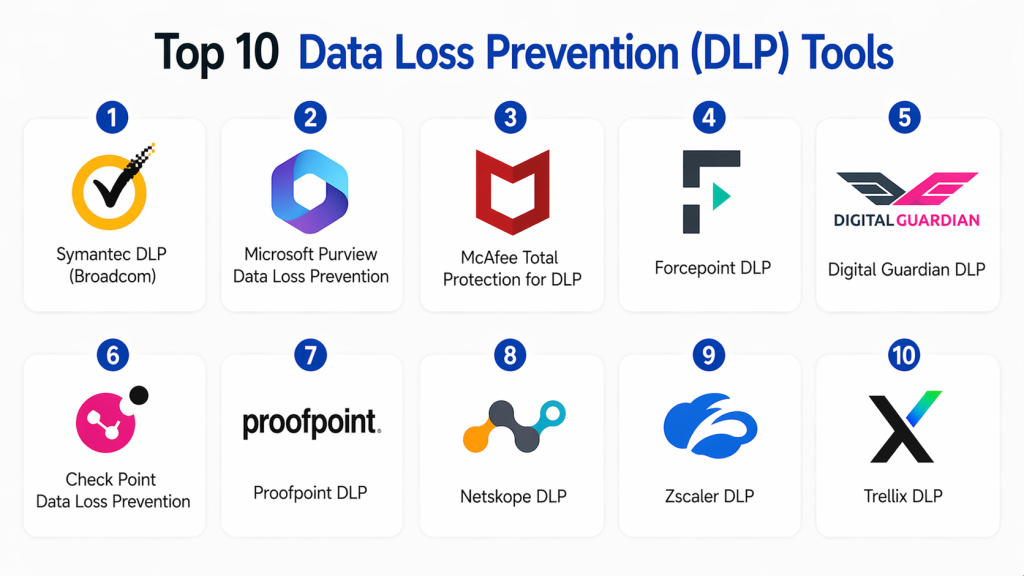
Top 10 Data Loss Prevention (DLP) Tools
#1 — Symantec DLP (Broadcom)
Short description :
Symantec DLP is a comprehensive data protection platform offering strong visibility and control over sensitive data. It monitors endpoints, networks, and cloud environments. It supports advanced policy enforcement. It is scalable. It is widely used by enterprises.
Key Features
- Data discovery
- Policy enforcement
- Monitoring
- Integration
- Reporting
Pros
- Comprehensive coverage
- Scalable
- Enterprise-ready
Cons
- Complex setup
- Expensive
Platforms / Deployment
- Cloud / On-prem
Security & Compliance
- RBAC
- Compliance: Not publicly stated
Integrations & Ecosystem
- SIEM
- CASB
- APIs
Support & Community
- Enterprise support
#2 — Microsoft Purview DLP
Short description :
Microsoft Purview DLP provides data protection across Microsoft 365 and cloud environments. It offers classification and policy enforcement. It integrates with Microsoft ecosystem. It is scalable. It supports compliance.
Key Features
- Data classification
- Policy enforcement
- Monitoring
- Integration
- Reporting
Pros
- Strong integration
- Scalable
- Easy deployment
Cons
- Microsoft dependency
- Limited outside ecosystem
Platforms / Deployment
- Cloud
Security & Compliance
- RBAC
- Compliance: Not publicly stated
#3 — McAfee Total Protection for DLP
Short description :
McAfee DLP provides data protection with strong monitoring and policy enforcement. It covers endpoints and networks. It supports automation. It is scalable. It is suitable for enterprises. It provides strong detection.
Key Features
- Data monitoring
- Policy enforcement
- Integration
- Automation
- Reporting
Pros
- Strong detection
- Scalable
- Flexible
Cons
- Complex
- Cost
Platforms / Deployment
- Cloud / On-prem
Security & Compliance
- RBAC
- Compliance: Not publicly stated
#4 — Forcepoint DLP
Short description :
Forcepoint DLP offers data protection with user behavior analytics. It monitors data across endpoints and cloud. It supports policy enforcement. It is scalable. It provides strong insights.
Key Features
- Data monitoring
- User behavior analytics
- Policy enforcement
- Integration
- Reporting
Pros
- Strong analytics
- Scalable
- Flexible
Cons
- Learning curve
- Cost
Platforms / Deployment
- Cloud / Hybrid
Security & Compliance
- RBAC
- Compliance: Not publicly stated
#5 — Digital Guardian DLP
Short description :
Digital Guardian provides DLP with strong endpoint protection and data visibility. It monitors sensitive data movement. It supports compliance. It integrates with security tools. It is scalable.
Key Features
- Endpoint protection
- Data monitoring
- Compliance
- Integration
- Reporting
Pros
- Strong endpoint security
- Scalable
- Reliable
Cons
- Complex
- Cost
Platforms / Deployment
- Cloud / On-prem
Security & Compliance
- RBAC
- Compliance: Not publicly stated
#6 — Check Point DLP
Short description :
Check Point DLP provides data protection with policy enforcement and monitoring. It integrates with Check Point security ecosystem. It supports compliance. It is scalable. It offers strong visibility.
Key Features
- Data monitoring
- Policy enforcement
- Integration
- Reporting
- Analytics
Pros
- Strong integration
- Scalable
- Reliable
Cons
- Limited flexibility
- Cost
Platforms / Deployment
- Cloud
Security & Compliance
- RBAC
- Compliance: Not publicly stated
#7 — Proofpoint DLP
Short description :
Proofpoint DLP focuses on email and cloud data protection. It identifies sensitive data and prevents leaks. It integrates with security tools. It is scalable. It provides strong detection.
Key Features
- Email protection
- Data detection
- Monitoring
- Integration
- Reporting
Pros
- Strong email security
- Scalable
- Easy to use
Cons
- Limited endpoint coverage
- Cost
Platforms / Deployment
- Cloud
Security & Compliance
- RBAC
- Compliance: Not publicly stated
#8 — Netskope DLP
Short description :
Netskope DLP provides cloud-native data protection with strong visibility. It monitors SaaS and cloud environments. It supports automation. It integrates with Netskope platform. It is scalable.
Key Features
- Cloud data protection
- Monitoring
- Integration
- Automation
- Reporting
Pros
- Strong cloud security
- Scalable
- Flexible
Cons
- Complex
- Learning curve
Platforms / Deployment
- Cloud
Security & Compliance
- RBAC
- Compliance: Not publicly stated
#9 — Zscaler DLP
Short description :
Zscaler DLP provides cloud-based data protection with real-time monitoring. It secures data across users and applications. It integrates with Zero Trust architecture. It is scalable. It provides strong insights.
Key Features
- Data monitoring
- Policy enforcement
- Integration
- Analytics
- Reporting
Pros
- Strong cloud integration
- Scalable
- Reliable
Cons
- Limited customization
- Cost
Platforms / Deployment
- Cloud
Security & Compliance
- RBAC
- Compliance: Not publicly stated
#10 — Trellix DLP
Short description :
Trellix DLP provides data protection with monitoring and policy enforcement capabilities. It covers endpoints and networks. It integrates with security tools. It is scalable. It provides strong detection.
Key Features
- Data monitoring
- Policy enforcement
- Integration
- Reporting
- Analytics
Pros
- Strong detection
- Scalable
- Flexible
Cons
- Complex
- Cost
Platforms / Deployment
- Cloud / On-prem
Security & Compliance
- RBAC
- Compliance: Not publicly stated
Comparison Table
| Tool | Best For | Platform | Deployment | Feature | Rating |
|---|---|---|---|---|---|
| Symantec | Enterprise | Multi | Hybrid | Full DLP | N/A |
| Microsoft | Enterprise | Cloud | Cloud | Integration | N/A |
| McAfee | Enterprise | Multi | Hybrid | Monitoring | N/A |
| Forcepoint | Enterprise | Multi | Hybrid | Analytics | N/A |
| Digital Guardian | Enterprise | Multi | Hybrid | Endpoint | N/A |
| Check Point | Enterprise | Cloud | Cloud | Policy | N/A |
| Proofpoint | SMB | Cloud | Cloud | N/A | |
| Netskope | Enterprise | Cloud | Cloud | Cloud DLP | N/A |
| Zscaler | Enterprise | Cloud | Cloud | Zero Trust | N/A |
| Trellix | Enterprise | Multi | Hybrid | Detection | N/A |
Evaluation & Scoring of DLP Tools
| Tool | Core | Ease | Integration | Security | Performance | Support | Value | Total |
|---|---|---|---|---|---|---|---|---|
| Symantec | 10 | 7 | 9 | 10 | 9 | 9 | 7 | 8.9 |
| Microsoft | 9 | 9 | 10 | 9 | 9 | 9 | 9 | 9.2 |
| McAfee | 9 | 7 | 8 | 9 | 8 | 8 | 8 | 8.4 |
| Forcepoint | 9 | 8 | 8 | 9 | 8 | 8 | 8 | 8.5 |
| Digital Guardian | 9 | 7 | 8 | 9 | 8 | 8 | 8 | 8.4 |
| Check Point | 9 | 8 | 8 | 9 | 8 | 8 | 8 | 8.5 |
| Proofpoint | 8 | 9 | 7 | 8 | 8 | 8 | 9 | 8.4 |
| Netskope | 9 | 8 | 9 | 9 | 8 | 8 | 8 | 8.6 |
| Zscaler | 9 | 8 | 9 | 9 | 8 | 8 | 8 | 8.6 |
| Trellix | 9 | 7 | 8 | 9 | 8 | 8 | 8 | 8.4 |
Which DLP Tool Is Right for You?
Solo / Freelancer
- Not required
SMB
- Proofpoint
Mid-Market
- Forcepoint, Netskope
Enterprise
- Symantec, Microsoft, Zscaler
Budget vs Premium
- Budget → Proofpoint
- Premium → Symantec
Feature Depth vs Ease
- Easy → Microsoft
- Advanced → Symantec
Integrations & Scalability
- Best → Microsoft
Security Needs
- High security → Symantec
Frequently Asked Questions (FAQs)
1. What is Data Loss Prevention (DLP)?
DLP is a security solution that prevents sensitive data from being lost or accessed by unauthorized users. It monitors data movement across systems and networks. It helps organizations protect critical information. It improves overall data security posture.
2. Why is DLP important?
DLP is important because data breaches can cause financial and reputational damage. It helps prevent unauthorized data sharing. It ensures compliance with data protection regulations. It strengthens organizational security.
3. How does DLP work?
DLP tools monitor data across endpoints, networks, and cloud environments. They classify sensitive data and enforce policies. They generate alerts and block risky actions. This helps prevent data leaks.
4. Who should use DLP tools?
DLP tools are used by enterprises and organizations handling sensitive data. They are ideal for IT and security teams. Industries like finance and healthcare benefit the most. They help protect critical information.
5. Are DLP tools scalable?
Yes, DLP tools are designed to scale across large environments. They support cloud and hybrid deployments. This ensures consistent data protection. Scalability is important for growing organizations.
6. Do DLP tools integrate with other tools?
Yes, they integrate with SIEM, CASB, and security platforms. This creates a unified security ecosystem. Integration improves workflows and automation. It enables faster threat detection.
7. Are DLP tools secure?
Yes, DLP tools include strong security controls like encryption and access management. They help improve data security. Proper configuration ensures optimal protection. They reduce risk exposure.
8. Are DLP tools difficult to implement?
Implementation depends on the tool and environment. Some tools are easy to deploy, especially cloud-based ones. Advanced configurations may require expertise. Proper planning ensures success.
9. What are alternatives to DLP?
Alternatives include CASB and endpoint security tools. These tools focus on specific areas. DLP provides broader data protection. It complements other security solutions.
10. Are DLP tools expensive?
Pricing varies based on features and scale. SMB tools are affordable, while enterprise tools can be costly. Flexible pricing models are available. Investing in DLP helps prevent costly data breaches.
Conclusion
Data Loss Prevention (DLP) tools are essential for protecting sensitive data across modern IT environments by preventing unauthorized access and data leakage. As organizations handle increasing volumes of data, DLP platforms play a critical role in maintaining compliance and security.
The right DLP solution depends on your organization’s needs. Enterprise tools like Symantec and Microsoft Purview provide advanced capabilities, while tools like Proofpoint offer cost-effective options. Organizations should evaluate their requirements, test solutions, and integrate DLP into their broader security strategy.
