Introduction
Cloud Security Posture Management (CSPM) tools are cybersecurity solutions that continuously monitor cloud environments to identify misconfigurations, compliance violations, and security risks. They help organizations maintain a strong security posture across cloud platforms like AWS, Azure, and Google Cloud.
As cloud adoption accelerates, misconfigurations have become one of the leading causes of data breaches. CSPM tools address this by providing automated visibility, compliance checks, and risk remediation recommendations. Modern platforms also incorporate AI-driven insights, automation, and integration with DevSecOps pipelines to improve cloud security.
Real-world use cases:
- Detecting cloud misconfigurations
- Monitoring compliance across cloud environments
- Identifying exposed storage and services
- Managing multi-cloud security posture
- Automating security audits and reporting
What buyers should evaluate:
- Multi-cloud support (AWS, Azure, GCP)
- Continuous monitoring capabilities
- Compliance frameworks (GDPR, ISO, etc.)
- Risk prioritization and remediation guidance
- Integration with DevOps and security tools
- Automation and alerting features
- Ease of use and dashboards
- Scalability across environments
- API and extensibility
- Pricing and licensing
Best for: Enterprises, DevOps teams, cloud security teams, and organizations using multi-cloud or hybrid environments
Not ideal for: Organizations not using cloud infrastructure
Key Trends in CSPM Tools
- AI-driven cloud risk analysis
- Integration with DevSecOps pipelines
- Shift toward CNAPP (Cloud-Native Application Protection Platforms)
- Continuous compliance monitoring
- Automation of remediation workflows
- Multi-cloud and hybrid cloud security coverage
- Integration with IAM and Zero Trust models
- Real-time alerts and dashboards
- API and infrastructure-as-code scanning
- Unified cloud security platforms
How We Selected These Tools (Methodology)
- Market adoption and reputation
- Multi-cloud support capabilities
- Accuracy in detecting misconfigurations
- Integration with cloud ecosystems
- Automation and analytics features
- Scalability across cloud environments
- Ease of deployment and usability
- Vendor innovation and maturity
- Support and community strength
- Fit across SMB and enterprise environments
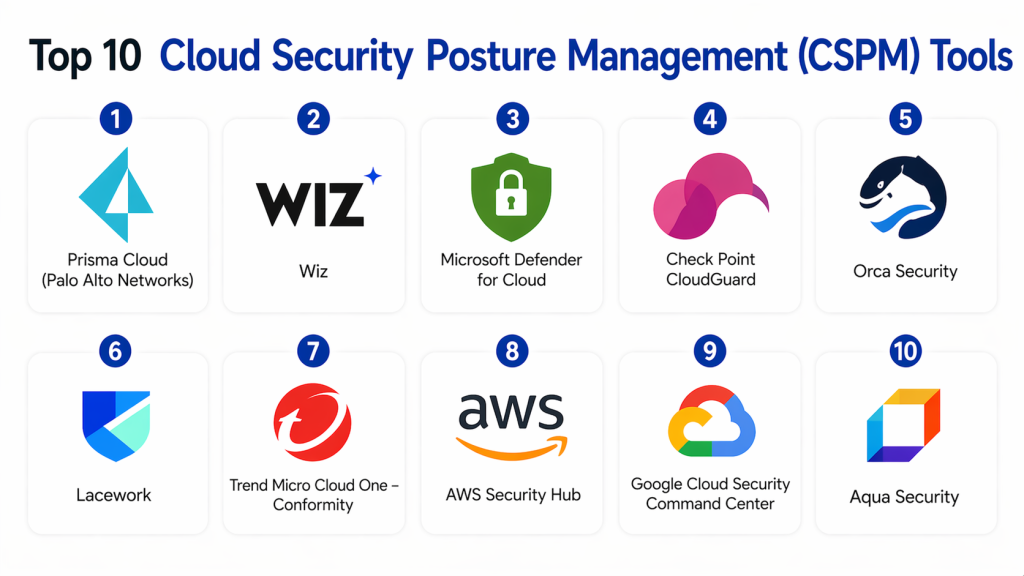
Top 10 Cloud Security Posture Management (CSPM) Tools
#1 — Prisma Cloud (Palo Alto Networks)
Short description :
Prisma Cloud is a comprehensive CSPM solution offering visibility across multi-cloud environments. It helps detect misconfigurations and risks. It integrates with cloud platforms. It supports automation. It is scalable. It is suitable for enterprises.
Key Features
- Multi-cloud security
- Misconfiguration detection
- Compliance monitoring
- Automation
- Integration
Pros
- Strong multi-cloud support
- Scalable
- Advanced features
Cons
- Complex setup
- Expensive
Platforms / Deployment
- Cloud
Security & Compliance
- RBAC
- Compliance: Not publicly stated
Integrations & Ecosystem
- Cloud providers
- APIs
Support & Community
- Enterprise support
#2 — Wiz
Short description :
Wiz provides agentless CSPM with deep visibility into cloud environments. It identifies risks across infrastructure and workloads. It is easy to deploy. It is scalable. It supports multi-cloud. It provides strong analytics.
Key Features
- Agentless scanning
- Risk visibility
- Multi-cloud support
- Analytics
- Integration
Pros
- Easy deployment
- Scalable
- Strong insights
Cons
- Premium pricing
- Limited customization
Platforms / Deployment
- Cloud
Security & Compliance
- RBAC
- Compliance: Not publicly stated
#3 — Microsoft Defender for Cloud
Short description :
Microsoft Defender for Cloud provides CSPM capabilities integrated with Azure and hybrid environments. It offers continuous monitoring and risk assessment. It supports compliance frameworks. It is scalable. It integrates well with Microsoft ecosystem.
Key Features
- Cloud monitoring
- Risk assessment
- Compliance
- Integration
- Reporting
Pros
- Strong integration
- Scalable
- Easy to use
Cons
- Microsoft dependency
- Limited outside ecosystem
Platforms / Deployment
- Cloud
Security & Compliance
- RBAC
- Compliance: Not publicly stated
#4 — Check Point CloudGuard
Short description :
CloudGuard provides CSPM with strong compliance and security monitoring features. It supports multi-cloud environments. It offers risk detection. It integrates with security tools. It is scalable. It provides strong visibility.
Key Features
- Compliance monitoring
- Risk detection
- Multi-cloud support
- Integration
- Reporting
Pros
- Strong compliance
- Scalable
- Flexible
Cons
- Complex UI
- Learning curve
Platforms / Deployment
- Cloud
Security & Compliance
- RBAC
- Compliance: Not publicly stated
#5 — Orca Security
Short description :
Orca Security offers agentless CSPM with deep cloud visibility. It identifies risks and vulnerabilities. It supports automation. It is scalable. It provides strong insights. It is suitable for enterprises.
Key Features
- Agentless scanning
- Risk detection
- Monitoring
- Analytics
- Integration
Pros
- Easy deployment
- Scalable
- Strong visibility
Cons
- Cost
- Limited customization
Platforms / Deployment
- Cloud
Security & Compliance
- RBAC
- Compliance: Not publicly stated
#6 — Lacework
Short description :
Lacework provides CSPM with behavioral analytics and anomaly detection. It monitors cloud environments. It integrates with DevOps tools. It is scalable. It offers automation. It provides strong insights.
Key Features
- Behavioral analytics
- Monitoring
- Integration
- Automation
- Reporting
Pros
- Strong analytics
- Scalable
- Flexible
Cons
- Complex
- Learning curve
Platforms / Deployment
- Cloud
Security & Compliance
- RBAC
- Compliance: Not publicly stated
#7 — Trend Micro Cloud One – Conformity
Short description :
Trend Micro Conformity provides CSPM for detecting misconfigurations and compliance issues. It supports multi-cloud environments. It offers monitoring and reporting. It is scalable. It is easy to use.
Key Features
- Misconfiguration detection
- Compliance monitoring
- Reporting
- Integration
- Automation
Pros
- Easy to use
- Scalable
- Strong compliance
Cons
- Limited advanced features
- Smaller ecosystem
Platforms / Deployment
- Cloud
Security & Compliance
- RBAC
- Compliance: Not publicly stated
#8 — AWS Security Hub
Short description :
AWS Security Hub provides CSPM capabilities within AWS ecosystem. It aggregates security findings and provides insights. It supports compliance. It is scalable. It integrates with AWS services. It provides strong monitoring.
Key Features
- Security findings aggregation
- Compliance monitoring
- Integration
- Reporting
- Analytics
Pros
- Native AWS integration
- Scalable
- Easy to use
Cons
- AWS-only
- Limited multi-cloud support
Platforms / Deployment
- Cloud
Security & Compliance
- RBAC
- Compliance: Not publicly stated
#9 — Google Cloud Security Command Center
Short description :
Google Cloud Security Command Center provides CSPM capabilities for GCP environments. It offers risk detection and monitoring. It integrates with Google Cloud. It is scalable. It supports compliance. It provides strong visibility.
Key Features
- Risk detection
- Monitoring
- Integration
- Reporting
- Analytics
Pros
- Strong GCP integration
- Scalable
- Reliable
Cons
- GCP-focused
- Limited multi-cloud
Platforms / Deployment
- Cloud
Security & Compliance
- RBAC
- Compliance: Not publicly stated
#10 — Aqua Security (CSPM)
Short description :
Aqua Security provides CSPM capabilities with focus on cloud-native workloads. It supports container and Kubernetes security. It integrates with DevOps pipelines. It is scalable. It offers strong detection and monitoring.
Key Features
- Cloud-native security
- Monitoring
- Integration
- Analytics
- Automation
Pros
- Strong container security
- Scalable
- Flexible
Cons
- Complex setup
- Requires expertise
Platforms / Deployment
- Cloud
Security & Compliance
- RBAC
- Compliance: Not publicly stated
Comparison Table
| Tool | Best For | Platform | Deployment | Feature | Rating |
|---|---|---|---|---|---|
| Prisma | Enterprise | Cloud | Cloud | Multi-cloud | N/A |
| Wiz | Enterprise | Cloud | Cloud | Agentless | N/A |
| Microsoft | Enterprise | Cloud | Cloud | Integration | N/A |
| CloudGuard | Enterprise | Cloud | Cloud | Compliance | N/A |
| Orca | Enterprise | Cloud | Cloud | Visibility | N/A |
| Lacework | Enterprise | Cloud | Cloud | Analytics | N/A |
| Trend Micro | SMB | Cloud | Cloud | Simplicity | N/A |
| AWS | AWS users | Cloud | Cloud | Native | N/A |
| GCP users | Cloud | Cloud | Native | N/A | |
| Aqua | DevOps | Cloud | Cloud | Containers | N/A |
Evaluation & Scoring of CSPM Tools
| Tool | Core | Ease | Integration | Security | Performance | Support | Value | Total |
|---|---|---|---|---|---|---|---|---|
| Prisma | 10 | 7 | 9 | 10 | 9 | 9 | 7 | 8.9 |
| Wiz | 9 | 9 | 9 | 9 | 9 | 9 | 8 | 9.0 |
| Microsoft | 9 | 9 | 10 | 9 | 9 | 9 | 9 | 9.2 |
| CloudGuard | 9 | 8 | 8 | 9 | 8 | 8 | 8 | 8.5 |
| Orca | 9 | 9 | 8 | 9 | 9 | 8 | 8 | 8.8 |
| Lacework | 9 | 7 | 8 | 9 | 8 | 8 | 8 | 8.4 |
| Trend Micro | 8 | 9 | 7 | 8 | 8 | 8 | 9 | 8.4 |
| AWS | 8 | 9 | 8 | 8 | 8 | 8 | 9 | 8.4 |
| 8 | 9 | 8 | 8 | 8 | 8 | 9 | 8.4 | |
| Aqua | 9 | 7 | 8 | 9 | 8 | 8 | 7 | 8.2 |
Which CSPM Tool Is Right for You?
Solo / Freelancer
- Not required
SMB
- Trend Micro
Mid-Market
- Orca, Wiz
Enterprise
- Prisma, Microsoft
Budget vs Premium
- Budget → AWS Security Hub
- Premium → Prisma Cloud
Feature Depth vs Ease
- Easy → Wiz
- Advanced → Prisma
Integrations & Scalability
- Best → Microsoft
Security Needs
- High security → Prisma
Frequently Asked Questions (FAQs)
1. What is CSPM?
CSPM is a security solution that monitors cloud environments for misconfigurations and risks. It helps organizations maintain a strong cloud security posture. These tools provide visibility into cloud assets. They help prevent security breaches.
2. Why is CSPM important?
CSPM is important because cloud misconfigurations are a major cause of security incidents. It helps identify and fix these issues quickly. It also ensures compliance with security standards. This improves overall cloud security.
3. How does CSPM work?
CSPM tools scan cloud environments continuously. They analyze configurations and identify risks. They provide alerts and recommendations. This helps security teams take corrective actions.
4. Who should use CSPM tools?
CSPM tools are used by organizations with cloud infrastructure. They are ideal for DevOps teams, security teams, and enterprises. Companies using multi-cloud environments benefit the most. They help manage cloud risks effectively.
5. Are CSPM tools scalable?
Yes, CSPM tools are designed to scale across large cloud environments. They support multi-cloud and hybrid setups. Cloud-based platforms make scaling easier. This ensures consistent security coverage.
6. Do CSPM tools integrate with other tools?
Yes, CSPM tools integrate with DevOps, SIEM, and security platforms. This creates a unified security ecosystem. Integration improves workflows and automation. It helps in faster threat detection.
7. Are CSPM tools secure?
Yes, CSPM tools are designed with security controls such as access management and encryption. They help improve overall security posture. Proper configuration is important. They provide insights to reduce risks.
8. Are CSPM tools difficult to implement?
Implementation depends on the platform and environment. Many tools are easy to deploy in cloud environments. Advanced configurations may require expertise. Proper planning ensures successful setup.
9. What are alternatives to CSPM?
Alternatives include CNAPP and cloud workload protection tools. However, these tools focus on specific areas. CSPM provides broader visibility. It complements other cloud security solutions.
10. Are CSPM tools expensive?
Pricing varies depending on features and scale. SMB tools are more affordable. Enterprise tools can be costly. Investing in CSPM helps prevent expensive cloud breaches.
Conclusion
Cloud Security Posture Management (CSPM) tools are essential for securing modern cloud environments by identifying misconfigurations and ensuring compliance. As organizations increasingly adopt multi-cloud strategies, CSPM platforms play a critical role in maintaining visibility and reducing risks.
The right CSPM solution depends on your organization’s needs. Enterprise tools like Prisma Cloud and Microsoft Defender for Cloud provide advanced capabilities, while tools like AWS Security Hub and Trend Micro offer cost-effective options. Organizations should evaluate their requirements, test tools, and integrate CSPM into their cloud security strategy.
