Introduction
Vulnerability Assessment Tools are cybersecurity solutions used to identify, analyze, and prioritize security weaknesses across systems, networks, applications, and infrastructure. These tools scan environments to detect vulnerabilities such as outdated software, misconfigurations, and security gaps before attackers can exploit them.
In today’s rapidly evolving threat landscape, organizations must adopt a proactive security approach. Vulnerability assessment tools help reduce risk by continuously scanning assets and providing actionable insights. Modern tools also leverage automation, AI-based prioritization, and integration with DevSecOps workflows to improve efficiency.
Real-world use cases:
- Scanning networks and systems for vulnerabilities
- Identifying outdated software and patch gaps
- Supporting compliance audits and reporting
- Prioritizing risks based on severity
- Enhancing security posture management
What buyers should evaluate:
- Coverage of assets (network, cloud, applications)
- Accuracy of vulnerability detection
- Risk prioritization and scoring
- Integration with patch management tools
- Automation and scheduling capabilities
- Reporting and compliance features
- Ease of deployment and use
- Scalability across environments
- Cloud vs on-prem support
- Pricing and licensing
Best for: IT security teams, enterprises, compliance-driven organizations, DevOps teams, and cloud environments
Not ideal for: Very small environments with minimal infrastructure
Key Trends in Vulnerability Assessment Tools
- AI-driven vulnerability prioritization
- Integration with DevSecOps pipelines
- Continuous and real-time vulnerability scanning
- Cloud-native vulnerability management
- Risk-based vulnerability management (RBVM)
- Automation of patching workflows
- Integration with SIEM and SOAR platforms
- Expansion into container and Kubernetes security
- Focus on compliance and audit readiness
- Unified security posture platforms
How We Selected These Tools (Methodology)
- Market adoption and reputation
- Accuracy and depth of vulnerability detection
- Integration with security ecosystems
- Automation and analytics capabilities
- Scalability and performance
- Ease of deployment and usability
- Vendor maturity and innovation
- Compliance and reporting capabilities
- Support and community strength
- Fit across SMB and enterprise environments
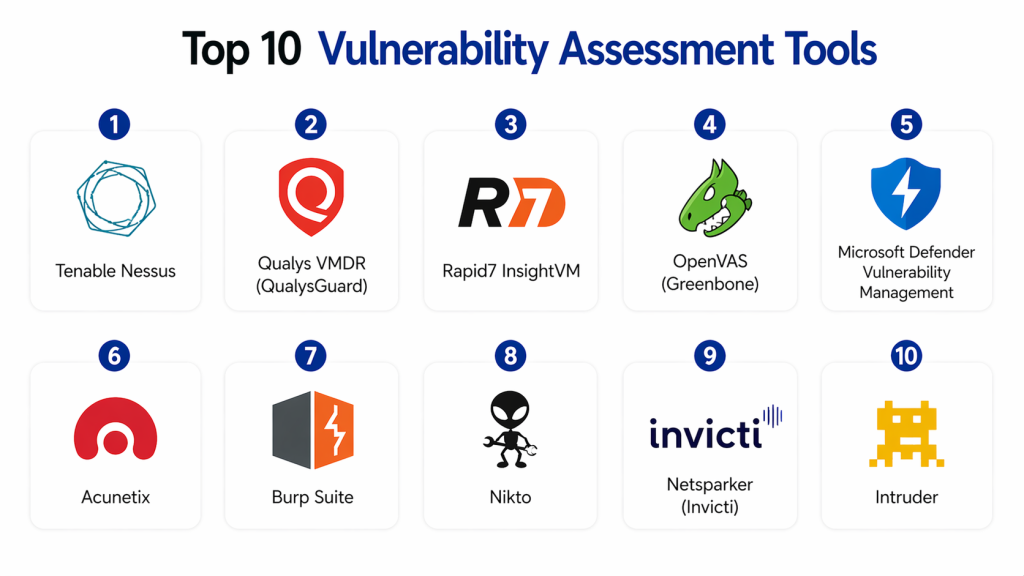
Top 10 Vulnerability Assessment Tools
#1 — Tenable Nessus
Short description :
Tenable Nessus is one of the most widely used vulnerability assessment tools. It provides comprehensive scanning capabilities across systems and networks. It is known for its accuracy and ease of use. It supports compliance checks. It is scalable. It is suitable for both SMB and enterprise environments.
Key Features
- Vulnerability scanning
- Risk prioritization
- Compliance checks
- Reporting
- Integration
Pros
- Easy to use
- Accurate detection
- Scalable
Cons
- Limited advanced features
- Requires licensing
Platforms / Deployment
- Windows / Linux
- Cloud / On-prem
Security & Compliance
- RBAC
- Compliance: Not publicly stated
Integrations & Ecosystem
- SIEM tools
- APIs
Support & Community
- Strong community support
#2 — Qualys VMDR
Short description :
Qualys VMDR offers vulnerability management with detection, prioritization, and remediation. It is cloud-based and scalable. It provides continuous monitoring. It integrates with enterprise systems. It supports compliance. It is widely used.
Key Features
- Vulnerability detection
- Risk prioritization
- Asset management
- Automation
- Reporting
Pros
- Cloud-native
- Scalable
- Comprehensive
Cons
- Complex interface
- Cost
Platforms / Deployment
- Cloud
Security & Compliance
- RBAC
- Compliance: Not publicly stated
#3 — Rapid7 InsightVM
Short description :
Rapid7 InsightVM provides vulnerability management with real-time insights. It offers risk-based prioritization and analytics. It integrates with Rapid7 ecosystem. It is scalable. It supports enterprises. It provides strong reporting.
Key Features
- Vulnerability scanning
- Risk prioritization
- Analytics
- Integration
- Reporting
Pros
- Strong analytics
- Scalable
- Flexible
Cons
- Complex setup
- Cost
Platforms / Deployment
- Cloud / On-prem
Security & Compliance
- RBAC
- Compliance: Not publicly stated
#4 — OpenVAS (Greenbone)
Short description :
OpenVAS is an open-source vulnerability scanning tool offering comprehensive security testing. It supports network scanning and reporting. It is flexible and customizable. It is suitable for developers and SMBs. It is scalable. It provides strong detection.
Key Features
- Vulnerability scanning
- Network testing
- Reporting
- Integration
- Open platform
Pros
- Open-source
- Flexible
- Cost-effective
Cons
- Requires expertise
- Setup complexity
Platforms / Deployment
- Linux
- Self-hosted
Security & Compliance
- Not publicly stated
#5 — Microsoft Defender Vulnerability Management
Short description :
Microsoft Defender Vulnerability Management provides vulnerability assessment integrated with endpoint security. It offers continuous monitoring and risk insights. It integrates with Microsoft ecosystem. It is scalable. It is suitable for enterprises.
Key Features
- Vulnerability detection
- Risk scoring
- Monitoring
- Integration
- Reporting
Pros
- Strong integration
- Scalable
- Easy deployment
Cons
- Limited outside Microsoft
- Requires configuration
Platforms / Deployment
- Windows / Cloud
Security & Compliance
- RBAC
- Compliance: Not publicly stated
#6 — Intruder
Short description:
Intruder is a cloud-based vulnerability scanning tool designed for ease of use. It provides automated scanning and reporting. It supports continuous monitoring. It integrates with security tools. It is scalable. It is suitable for SMBs and enterprises.
Key Features
- Vulnerability scanning
- Automation
- Monitoring
- Reporting
- Integration
Pros
- Easy to use
- Cloud-native
- Scalable
Cons
- Limited advanced features
- Smaller ecosystem
Platforms / Deployment
- Cloud
Security & Compliance
- RBAC
- Compliance: Not publicly stated
#7 — Acunetix
Short description :
Acunetix focuses on web application vulnerability scanning. It detects security flaws such as SQL injection and XSS. It is easy to use. It integrates with development workflows. It is scalable. It is suitable for developers and enterprises.
Key Features
- Web vulnerability scanning
- Detection
- Reporting
- Integration
- Automation
Pros
- Strong web scanning
- Easy deployment
- Scalable
Cons
- Limited network scanning
- Cost
Platforms / Deployment
- Windows / Cloud
Security & Compliance
- RBAC
- Compliance: Not publicly stated
#8 — Burp Suite
Short description :
Burp Suite is a popular tool for web vulnerability testing. It offers manual and automated scanning. It is widely used by security professionals. It provides strong analysis capabilities. It is flexible. It supports customization.
Key Features
- Web scanning
- Manual testing
- Automation
- Reporting
- Integration
Pros
- Flexible
- Strong features
- Widely used
Cons
- Requires expertise
- Not beginner-friendly
Platforms / Deployment
- Windows / macOS / Linux
Security & Compliance
- Not publicly stated
#9 — Nikto
Short description :
Nikto is an open-source web server vulnerability scanner. It identifies vulnerabilities and misconfigurations. It is lightweight. It is easy to use. It is suitable for basic scanning. It provides quick results.
Key Features
- Web scanning
- Detection
- Reporting
- Open-source
- Lightweight
Pros
- Free
- Simple
- Lightweight
Cons
- Limited features
- Basic detection
Platforms / Deployment
- Linux
Security & Compliance
- Not publicly stated
#10 — Netsparker (Invicti)
Short description :
Netsparker (Invicti) provides web vulnerability scanning with strong automation. It detects security flaws and vulnerabilities. It is scalable. It integrates with DevOps tools. It is suitable for enterprises. It offers strong reporting.
Key Features
- Web scanning
- Automation
- Detection
- Integration
- Reporting
Pros
- Strong automation
- Scalable
- Accurate
Cons
- Expensive
- Limited network scanning
Platforms / Deployment
- Windows / Cloud
Security & Compliance
- RBAC
- Compliance: Not publicly stated
Comparison Table
| Tool | Best For | Platform | Deployment | Feature | Rating |
|---|---|---|---|---|---|
| Nessus | SMB | Multi | Hybrid | Accuracy | N/A |
| Qualys | Enterprise | Cloud | Cloud | VMDR | N/A |
| Rapid7 | Enterprise | Multi | Hybrid | Analytics | N/A |
| OpenVAS | SMB | Linux | On-prem | Open-source | N/A |
| Microsoft | Enterprise | Multi | Cloud | Integration | N/A |
| Intruder | SMB | Cloud | Cloud | Simplicity | N/A |
| Acunetix | Devs | Multi | Hybrid | Web scanning | N/A |
| Burp | Devs | Multi | Local | Testing | N/A |
| Nikto | SMB | Linux | Local | Lightweight | N/A |
| Netsparker | Enterprise | Multi | Hybrid | Automation | N/A |
Evaluation & Scoring of Vulnerability Assessment Tools
| Tool | Core | Ease | Integration | Security | Performance | Support | Value | Total |
|---|---|---|---|---|---|---|---|---|
| Nessus | 9 | 9 | 8 | 9 | 9 | 8 | 9 | 8.9 |
| Qualys | 10 | 8 | 9 | 10 | 9 | 9 | 8 | 9.1 |
| Rapid7 | 9 | 8 | 9 | 9 | 8 | 8 | 8 | 8.6 |
| OpenVAS | 8 | 7 | 8 | 8 | 8 | 7 | 9 | 8.0 |
| Microsoft | 9 | 9 | 10 | 9 | 9 | 9 | 9 | 9.2 |
| Intruder | 8 | 9 | 7 | 8 | 8 | 8 | 9 | 8.4 |
| Acunetix | 9 | 8 | 8 | 9 | 8 | 8 | 8 | 8.5 |
| Burp | 9 | 7 | 8 | 9 | 8 | 7 | 8 | 8.3 |
| Nikto | 7 | 9 | 6 | 7 | 8 | 7 | 9 | 7.8 |
| Netsparker | 9 | 8 | 8 | 9 | 8 | 8 | 7 | 8.4 |
Which Vulnerability Assessment Tool Is Right for You?
Solo / Freelancer
- Nikto
SMB
- Nessus, Intruder
Mid-Market
- Rapid7, Acunetix
Enterprise
- Qualys, Microsoft
Budget vs Premium
- Budget → OpenVAS
- Premium → Qualys
Feature Depth vs Ease
- Easy → Intruder
- Advanced → Qualys
Integrations & Scalability
- Best → Microsoft
Security Needs
- High security → Qualys
Frequently Asked Questions (FAQs)
1. What are Vulnerability Assessment Tools?
Vulnerability assessment tools are security solutions that scan systems, networks, and applications to identify weaknesses. They help detect issues like outdated software and misconfigurations. These tools provide reports and risk insights. This allows organizations to fix problems before attackers exploit them.
2. Why are vulnerability assessment tools important?
These tools are important because they help organizations identify and fix security gaps proactively. They reduce the risk of cyberattacks by detecting vulnerabilities early. They also support compliance with security standards. This improves overall security posture.
3. How do vulnerability assessment tools work?
They scan systems and compare findings against known vulnerability databases. They analyze configurations and software versions. When issues are found, they generate reports and risk scores. This helps teams prioritize remediation efforts effectively.
4. Who should use vulnerability assessment tools?
These tools are used by IT teams, security professionals, and organizations with digital infrastructure. Enterprises and SMBs both benefit from them. They are especially important for companies handling sensitive data. Any organization concerned about security should use them.
5. Are vulnerability assessment tools scalable?
Yes, most modern tools are highly scalable and support large environments. Cloud-based solutions allow organizations to scan multiple assets efficiently. This makes them suitable for growing businesses. Scalability ensures consistent security coverage.
6. Do these tools integrate with other security solutions?
Yes, they integrate with SIEM, SOAR, and patch management tools. This helps create a unified security ecosystem. Integration improves workflow automation. It allows faster detection and remediation of vulnerabilities.
7. Are vulnerability assessment tools secure?
Yes, they are designed with security in mind and include access controls and encryption. They help improve security rather than introduce risk. Proper configuration is important. They also provide insights to strengthen defenses.
8. Are vulnerability assessment tools difficult to implement?
Implementation complexity varies by tool and environment. Some cloud-based tools are easy to deploy. Advanced tools may require expertise and planning. Proper setup ensures accurate results and effective usage.
9. What are alternatives to vulnerability assessment tools?
Alternatives include penetration testing and security audits. However, these are often manual and periodic. Vulnerability tools provide continuous monitoring. They are typically used alongside other security solutions.
10. Are vulnerability assessment tools expensive?
Pricing varies depending on features and scale. SMB tools are generally affordable, while enterprise solutions can be costly. Many tools offer flexible pricing models. Investing in these tools helps prevent costly security incidents.
Conclusion
Vulnerability Assessment Tools are essential for maintaining a strong cybersecurity posture by identifying and addressing weaknesses before they can be exploited. As organizations continue to expand their digital footprint, these tools play a vital role in proactive security management.
The right tool depends on your organization’s size and needs. Solutions like Qualys and Microsoft provide enterprise-grade capabilities, while tools like OpenVAS and Nikto offer cost-effective options. Organizations should evaluate their requirements, test tools, and integrate vulnerability assessment into their overall security strategy.
