Introduction
DNS Management Tools are platforms used to configure, manage, and optimize domain name system (DNS) records that map domain names to IP addresses. In simple terms, they ensure that users can reliably access websites, applications, and services without delays or failures.
As digital infrastructure becomes more distributed across cloud, edge, and hybrid environments, DNS plays a critical role in performance, availability, and security. Modern DNS tools go beyond basic record management—they provide traffic routing, failover, load balancing, and protection against DDoS attacks.
Real-World Use Cases
- Managing DNS records for websites and applications
- Traffic routing across global data centers
- Failover and disaster recovery
- Improving website performance through geo-routing
- Protecting domains from DDoS attacks
What Buyers Should Evaluate
- Global DNS performance and latency
- Ease of DNS record management
- Traffic routing and load balancing features
- Security capabilities (DDoS protection, DNSSEC)
- API access and automation
- Integration with cloud platforms
- Scalability and uptime guarantees
- Pricing and usage-based billing
Best for: DevOps teams, cloud engineers, enterprises, SaaS companies, and businesses with global web presence.
Not ideal for: Small static websites with minimal traffic or users relying on basic hosting DNS without advanced needs.
Key Trends in DNS Management Tools
- Anycast-based global DNS networks for low latency
- AI-driven traffic routing optimization
- Built-in DDoS protection and DNS firewalling
- Integration with edge computing platforms
- API-first DNS management for automation
- Multi-cloud DNS orchestration
- Zero Trust security alignment
- Serverless and edge-based DNS services
- Real-time monitoring and analytics dashboards
How We Selected These Tools (Methodology)
- Strong global adoption and reliability reputation
- High-performance Anycast DNS infrastructure
- Comprehensive DNS and traffic management features
- Proven uptime and availability
- Advanced security capabilities (DNSSEC, DDoS protection)
- Rich API and integration ecosystem
- Support across enterprise and SMB use cases
- Availability of documentation and support
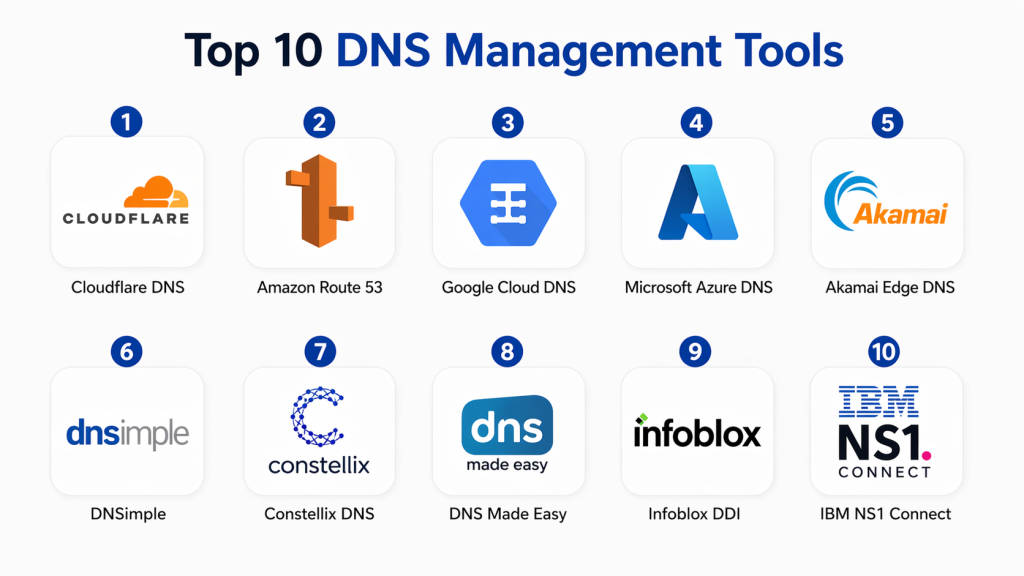
Top 10 DNS Management Tools
#1 — Cloudflare DNS
Short description :
Cloudflare DNS is a globally distributed DNS platform known for speed and security. It uses an Anycast network to ensure low latency and high availability. The platform includes built-in DDoS protection and DNSSEC. It is ideal for businesses of all sizes looking for reliable and secure DNS management. It also integrates with Cloudflare’s broader edge services.
Key Features
- Anycast global network
- DNSSEC support
- DDoS protection
- Real-time analytics
- API-driven management
Pros
- Extremely fast performance
- Strong security features
Cons
- Advanced features require higher plans
- Can be complex for beginners
Platforms / Deployment
Cloud
Security & Compliance
DNSSEC, DDoS protection, encryption
Integrations & Ecosystem
Cloudflare integrates with web performance and security services.
- APIs
- Edge services
- Security tools
Support & Community
Strong documentation and large user base
#2 — Amazon Route 53
Short description :
Amazon Route 53 is a scalable DNS service tightly integrated with AWS. It offers reliable DNS routing, health checks, and failover capabilities. Ideal for AWS-based infrastructures. It supports advanced routing policies and automation.
Key Features
- Health checks
- Traffic routing policies
- Failover support
- Domain registration
- API automation
Pros
- Highly scalable
- Deep AWS integration
Cons
- Pricing complexity
- AWS dependency
Platforms / Deployment
Cloud
Security & Compliance
DNSSEC, IAM controls
Integrations & Ecosystem
- AWS services
- APIs
Support & Community
Strong enterprise support
#3 — Google Cloud DNS
Short description :
Google Cloud DNS provides a high-performance DNS service using Google’s infrastructure. It offers low latency and high availability. Ideal for organizations using Google Cloud. Supports automation and scalable DNS management.
Key Features
- Anycast DNS
- High availability
- Managed zones
- API integration
Pros
- Fast and reliable
- Easy integration with GCP
Cons
- Limited advanced routing
- GCP-focused
Platforms / Deployment
Cloud
Security & Compliance
DNSSEC
Integrations & Ecosystem
- Google Cloud services
- APIs
Support & Community
Strong support ecosystem
#4 — Microsoft Azure DNS
Short description :
Azure DNS provides reliable DNS hosting integrated with Microsoft Azure. It enables seamless domain management and automation. Ideal for Azure-based infrastructures.
Key Features
- DNS hosting
- Traffic management
- Automation via APIs
- Integration with Azure
Pros
- Seamless Azure integration
- Scalable
Cons
- Limited outside Azure
- Pricing complexity
Platforms / Deployment
Cloud
Security & Compliance
DNSSEC
Integrations & Ecosystem
- Azure services
- APIs
Support & Community
Enterprise support
#5 — Akamai Edge DNS
Short description :
Akamai Edge DNS is an enterprise-grade DNS solution focused on performance and security. It leverages Akamai’s global CDN. Ideal for large-scale applications.
Key Features
- Global DNS network
- DDoS protection
- Traffic management
- High availability
Pros
- Enterprise performance
- Strong security
Cons
- Expensive
- Complex setup
Platforms / Deployment
Cloud
Security & Compliance
DDoS protection, DNSSEC
Integrations & Ecosystem
- CDN services
- APIs
Support & Community
Enterprise support
#6 — DNSimple
Short description :
DNSimple is a developer-friendly DNS management platform. It offers simplicity and automation. Ideal for startups and small teams.
Key Features
- Simple DNS management
- API access
- Domain registration
- Automation
Pros
- Easy to use
- Developer-friendly
Cons
- Limited enterprise features
- Smaller network
Platforms / Deployment
Cloud
Security & Compliance
Not publicly stated
Integrations & Ecosystem
- APIs
- Dev tools
Support & Community
Good support
#7 — Constellix DNS
Short description :
Constellix DNS offers advanced traffic management and monitoring. It supports geo-routing and performance optimization. Ideal for performance-critical applications.
Key Features
- Geo-routing
- DNS failover
- Monitoring
- Load balancing
Pros
- Advanced routing
- Strong monitoring
Cons
- Complex interface
- Pricing tiers
Platforms / Deployment
Cloud
Security & Compliance
DDoS protection
Integrations & Ecosystem
- APIs
- Monitoring tools
Support & Community
Good support
#8 — DNS Made Easy
Short description :
DNS Made Easy is a reliable DNS provider known for uptime and performance. It offers easy DNS management and failover capabilities.
Key Features
- Failover DNS
- Load balancing
- Monitoring
- Traffic routing
Pros
- High uptime
- Reliable performance
Cons
- Limited UI features
- Fewer integrations
Platforms / Deployment
Cloud
Security & Compliance
DDoS protection
Integrations & Ecosystem
- APIs
Support & Community
Reliable support
#9 — Infoblox DDI
Short description :
Infoblox DDI combines DNS, DHCP, and IP address management. It provides centralized control and automation. Ideal for enterprises.
Key Features
- DNS + DHCP + IPAM
- Automation
- Centralized management
Pros
- Comprehensive solution
- Enterprise-ready
Cons
- Expensive
- Complex
Platforms / Deployment
On-premise / Hybrid
Security & Compliance
RBAC, audit logs
Integrations & Ecosystem
- Enterprise tools
- APIs
Support & Community
Enterprise support
#10 — IBM NS1 Connect
Short description :
IBM NS1 Connect is an advanced DNS platform focused on traffic optimization and performance. It offers programmable DNS and analytics. Ideal for large-scale applications.
Key Features
- Intelligent routing
- Traffic steering
- Analytics
- API-driven DNS
Pros
- Advanced routing
- High performance
Cons
- Complex
- Premium pricing
Platforms / Deployment
Cloud
Security & Compliance
DNSSEC
Integrations & Ecosystem
- APIs
- Cloud services
Support & Community
Strong enterprise support
Comparison Table (Top 10)
| Tool Name | Best For | Platform(s) Supported | Deployment | Standout Feature | Public Rating |
|---|---|---|---|---|---|
| Cloudflare DNS | All sizes | Web | Cloud | Speed & security | N/A |
| Amazon Route 53 | AWS users | Web | Cloud | Deep AWS integration | N/A |
| Google Cloud DNS | GCP users | Web | Cloud | High performance | N/A |
| Azure DNS | Azure users | Web | Cloud | Azure integration | N/A |
| Akamai Edge DNS | Enterprise | Web | Cloud | Global CDN DNS | N/A |
| DNSimple | Startups | Web | Cloud | Simplicity | N/A |
| Constellix | Performance apps | Web | Cloud | Geo-routing | N/A |
| DNS Made Easy | SMB | Web | Cloud | Reliability | N/A |
| Infoblox DDI | Enterprise | Varies | Hybrid | DDI platform | N/A |
| IBM NS1 | Enterprise | Web | Cloud | Intelligent routing | N/A |
Evaluation & Scoring of DNS Management Tools
| Tool Name | Core (25%) | Ease (15%) | Integrations (15%) | Security (10%) | Performance (10%) | Support (10%) | Value (15%) | Weighted Total |
|---|---|---|---|---|---|---|---|---|
| Cloudflare | 9 | 8 | 8 | 9 | 10 | 9 | 9 | 9.0 |
| Route 53 | 9 | 7 | 9 | 9 | 9 | 8 | 8 | 8.6 |
| Google DNS | 8 | 8 | 8 | 8 | 9 | 8 | 8 | 8.3 |
| Azure DNS | 8 | 7 | 8 | 8 | 8 | 8 | 7 | 7.9 |
| Akamai | 9 | 6 | 8 | 9 | 10 | 9 | 6 | 8.4 |
| DNSimple | 7 | 9 | 7 | 6 | 7 | 7 | 9 | 7.8 |
| Constellix | 8 | 6 | 7 | 7 | 8 | 7 | 7 | 7.5 |
| DNS Made Easy | 8 | 7 | 6 | 7 | 8 | 7 | 8 | 7.6 |
| Infoblox | 9 | 6 | 8 | 9 | 8 | 9 | 6 | 8.2 |
| IBM NS1 | 9 | 6 | 8 | 8 | 9 | 8 | 7 | 8.1 |
How to interpret:
These scores provide a relative comparison across key evaluation criteria. Higher scores indicate stronger overall capability, particularly for enterprise environments. However, smaller teams may prioritize ease of use and value over advanced features. Always evaluate tools based on your specific requirements and infrastructure.
Which DNS Management Tool Is Right for You?
Solo / Freelancer
Use simple platforms like DNSimple. Focus on ease of use and minimal setup.
SMB
Cloudflare or DNS Made Easy offer strong performance and simplicity.
Mid-Market
Amazon Route 53 or Google Cloud DNS provide scalability and integration.
Enterprise
Akamai, Infoblox, or IBM NS1 are best for performance and control.
Budget vs Premium
- Budget: DNSimple, DNS Made Easy
- Premium: Akamai, Infoblox
Feature Depth vs Ease of Use
- Advanced: NS1, Akamai
- Easy: Cloudflare, DNSimple
Integrations & Scalability
Choose API-driven platforms for automation and scaling.
Security & Compliance Needs
Prioritize DNSSEC, DDoS protection, and audit capabilities.
Frequently Asked Questions (FAQs)
1. What is DNS management?
DNS management is the process of configuring and maintaining DNS records that map domain names to IP addresses. It ensures users can access websites and services reliably. Modern tools also provide automation and performance optimization. DNS is critical for uptime and availability. Effective management reduces downtime and improves user experience.
2. How much do DNS tools cost?
DNS pricing varies based on usage, queries, and features. Some providers offer free tiers with limited features. Enterprise solutions can be expensive due to advanced capabilities. Pricing may include query-based billing. Always evaluate cost based on expected traffic and features.
3. What is DNSSEC?
DNSSEC is a security extension that protects DNS queries from tampering. It ensures that responses are authentic and not modified by attackers. It is important for preventing DNS spoofing attacks. Many modern DNS providers support DNSSEC. It is recommended for secure environments.
4. How do DNS tools improve performance?
DNS tools use global Anycast networks to reduce latency. They route users to the nearest server. Advanced tools offer traffic optimization and load balancing. This improves website speed and reliability. Performance optimization is a key benefit.
5. Are DNS tools secure?
Most modern DNS tools include security features like DDoS protection and encryption. They also support DNSSEC. Security depends on configuration and provider capabilities. Enterprises should prioritize secure providers. Proper setup is essential.
6. Can DNS tools handle failover?
Yes, many DNS tools provide failover capabilities. They automatically redirect traffic if a server fails. This ensures high availability. Failover is critical for business continuity. It is a common feature in enterprise tools.
7. Do DNS tools support automation?
Yes, most tools provide APIs for automation. This allows integration with DevOps workflows. Automation reduces manual errors. It improves efficiency and scalability. It is essential for modern infrastructure.
8. How long does DNS setup take?
Basic DNS setup can be completed in minutes. Complex configurations may take longer. Propagation time also affects visibility. Planning and testing are important. Most tools provide quick deployment.
9. What are common mistakes in DNS management?
Common mistakes include incorrect configurations and lack of redundancy. Ignoring security features can lead to vulnerabilities. Poor monitoring can cause downtime. Not using failover is another issue. Proper planning is critical.
10. How to choose the right DNS tool?
Evaluate your traffic, performance needs, and budget. Consider security features and integrations. Test a few tools before deciding. Ensure scalability for future growth. Choose based on long-term requirements.
Conclusion
DNS Management Tools are essential for ensuring fast, reliable, and secure access to digital services. As organizations move toward cloud-first and globally distributed architectures, DNS becomes a critical layer for performance optimization and resilience. The right tool can significantly improve uptime, reduce latency, and protect against threats like DDoS attacks. However, the best choice depends on your specific needs—whether it’s simplicity for small teams or advanced routing and security for enterprises. It’s important to evaluate features, scalability, and integrations before making a decision. A practical approach is to shortlist two or three tools, test them in your environment, and validate performance, reliability, and security before full adoption.
