Introduction
Certificate Management Tools are platforms designed to manage the lifecycle of digital certificates, including SSL/TLS certificates, encryption keys, and identities used across applications, servers, and networks. These tools help automate issuance, renewal, revocation, and monitoring of certificates to prevent outages and security risks.
In modern IT environments, where applications rely heavily on encrypted communication, managing certificates manually can lead to expired certificates, downtime, and vulnerabilities. Certificate management tools ensure continuous encryption, compliance, and trust across systems.
Common real-world use cases:
- Automating SSL/TLS certificate issuance and renewal
- Managing certificates across cloud and on-prem environments
- Preventing certificate expiration outages
- Enforcing encryption policies across infrastructure
- Supporting compliance and audit requirements
What buyers should evaluate:
- Automation of certificate lifecycle management
- Integration with cloud and DevOps tools
- Scalability across environments
- Support for multiple certificate authorities
- Monitoring and alerting capabilities
- Security controls and encryption standards
- Ease of deployment and use
- Reporting and compliance features
- API and automation support
Best for: Security teams, DevOps engineers, IT administrators, and enterprises managing large-scale infrastructure.
Not ideal for: Small environments with minimal certificate usage or simple manual processes.
Key Trends in Certificate Management Tools
- Increased adoption of automated certificate lifecycle management
- Growing importance of zero trust security models
- Integration with cloud-native and hybrid environments
- Expansion of ACME protocol-based automation
- Enhanced real-time monitoring and alerting
- Centralized management for multi-cloud infrastructures
- Integration with DevOps and CI/CD pipelines
- AI-driven anomaly detection for certificate usage
- Compliance-driven certificate tracking and reporting
- Focus on short-lived certificates and automation
How We Selected These Tools (Methodology)
- Market adoption and industry recognition
- Strong certificate lifecycle management capabilities
- Integration with cloud and enterprise systems
- Scalability across large infrastructures
- Security and compliance features
- Ease of use and automation capabilities
- Support for multiple certificate authorities
- Developer and DevOps friendliness
- Innovation in automation and monitoring
- Community and enterprise support
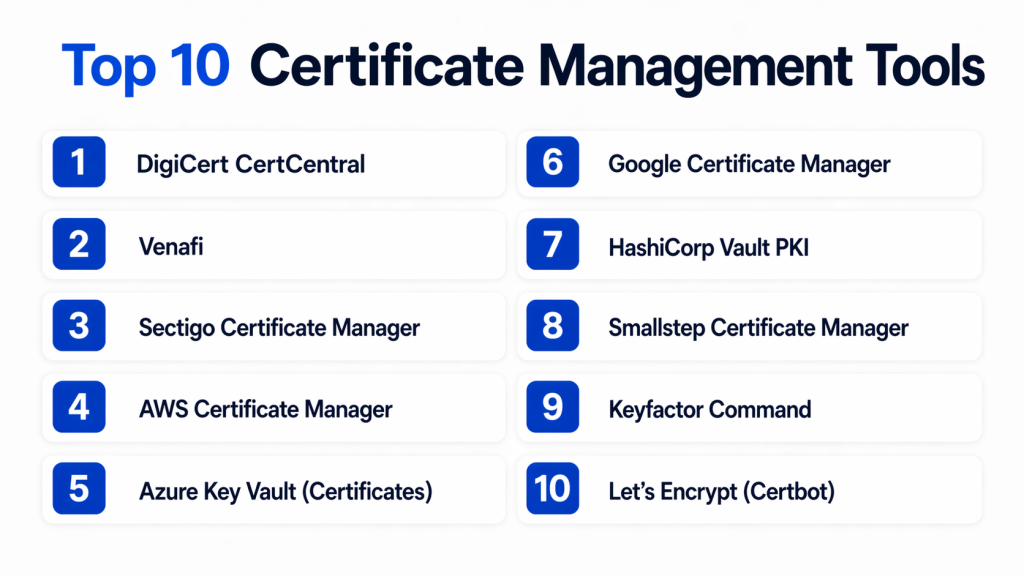
Top 10 Certificate Management Tools
#1 — DigiCert CertCentral
Short description: DigiCert CertCentral is a comprehensive certificate lifecycle management platform designed for enterprises. It provides centralized control over SSL/TLS certificates and automates issuance, renewal, and monitoring.
Key Features
- Certificate lifecycle automation
- Centralized management dashboard
- Multi-domain certificate support
- Real-time monitoring and alerts
- API integration
- Compliance reporting
Pros
- Enterprise-grade reliability
- Strong automation features
Cons
- Premium pricing
- Complex setup for beginners
Platforms / Deployment
- Cloud
Security & Compliance
- Encryption, audit logs
Integrations & Ecosystem
Integrates with enterprise IT and security systems.
- Cloud platforms
- DevOps tools
- APIs
Support & Community
Enterprise-level support with extensive documentation.
#2 — Venafi
Short description: Venafi is a leading platform for machine identity management and certificate lifecycle automation. It is widely used by enterprises to secure and manage certificates across complex infrastructures.
Key Features
- Certificate lifecycle management
- Machine identity protection
- Policy enforcement
- Automated renewal
- Visibility across environments
Pros
- Strong enterprise security
- Advanced automation
Cons
- Expensive
- Requires expertise
Platforms / Deployment
- Cloud / Self-hosted
Security & Compliance
- RBAC, audit logs
Integrations & Ecosystem
Works across enterprise and cloud environments.
- Cloud platforms
- DevOps pipelines
Support & Community
Enterprise-grade support.
#3 — Sectigo Certificate Manager
Short description: Sectigo Certificate Manager provides automated certificate lifecycle management with strong compliance and reporting features for enterprises.
Key Features
- Automated certificate issuance
- Renewal and revocation
- Certificate discovery
- Compliance reporting
- Multi-CA support
Pros
- Easy to use
- Good automation
Cons
- Limited customization
- UI improvements needed
Platforms / Deployment
- Cloud
Security & Compliance
- Encryption, audit logs
Integrations & Ecosystem
Supports integration with enterprise IT systems.
- DevOps tools
- APIs
Support & Community
Good support with enterprise focus.
#4 — AWS Certificate Manager
Short description: AWS Certificate Manager simplifies the provisioning and management of SSL/TLS certificates within cloud environments, offering automated renewal and integration with cloud services.
Key Features
- Free certificate provisioning
- Automatic renewal
- Integration with cloud services
- Load balancer support
- API access
Pros
- Easy to use
- Strong cloud integration
Cons
- Limited outside AWS
- Vendor dependency
Platforms / Deployment
- Cloud
Security & Compliance
- IAM, encryption
Integrations & Ecosystem
Deep integration with cloud infrastructure.
- Cloud services
- DevOps pipelines
Support & Community
Enterprise support available.
#5 — Azure Key Vault (Certificates)
Short description: Azure Key Vault provides certificate management along with key and secret storage, enabling secure lifecycle management within cloud environments.
Key Features
- Certificate storage
- Automated renewal
- Access control
- Integration with cloud services
- Monitoring
Pros
- Strong integration with Azure
- Easy to use
Cons
- Limited multi-cloud support
- Requires Azure environment
Platforms / Deployment
- Cloud
Security & Compliance
- RBAC, encryption
Integrations & Ecosystem
Works within Microsoft cloud ecosystem.
- Cloud services
- DevOps pipelines
Support & Community
Strong enterprise support.
#6 — Google Certificate Manager
Short description: Google Certificate Manager helps manage SSL/TLS certificates across cloud-based applications with automation and scalability.
Key Features
- Certificate provisioning
- Automated renewal
- Integration with cloud services
- Global load balancing support
- API access
Pros
- Easy to scale
- Cloud-native
Cons
- Limited outside GCP
- Vendor dependency
Platforms / Deployment
- Cloud
Security & Compliance
- IAM, encryption
Integrations & Ecosystem
Integrates with cloud infrastructure and services.
- Cloud services
- CI/CD pipelines
Support & Community
Enterprise support.
#7 — HashiCorp Vault PKI
Short description: HashiCorp Vault PKI enables dynamic certificate generation and management, supporting short-lived certificates for enhanced security.
Key Features
- Dynamic certificate issuance
- Short-lived certificates
- Access control
- API-based automation
- PKI infrastructure
Pros
- Highly secure
- Flexible
Cons
- Complex setup
- Requires expertise
Platforms / Deployment
- Cloud / Self-hosted
Security & Compliance
- RBAC, encryption
Integrations & Ecosystem
Integrates with DevOps and infrastructure tools.
- Kubernetes
- CI/CD pipelines
Support & Community
Strong community and enterprise support.
#8 — Smallstep Certificate Manager
Short description: Smallstep provides modern certificate management with a focus on automation and developer-friendly workflows.
Key Features
- Automated certificate issuance
- ACME protocol support
- Short-lived certificates
- API-driven workflows
- Identity management
Pros
- Developer-friendly
- Modern architecture
Cons
- Smaller ecosystem
- Limited enterprise features
Platforms / Deployment
- Cloud / Self-hosted
Security & Compliance
- Encryption
Integrations & Ecosystem
Works with modern DevOps workflows.
- APIs
- CI/CD tools
Support & Community
Growing community.
#9 — Keyfactor Command
Short description: Keyfactor Command is an enterprise platform for certificate lifecycle automation and PKI management, providing visibility and control across environments.
Key Features
- Certificate discovery
- Lifecycle automation
- Policy enforcement
- Reporting and analytics
- Integration with PKI systems
Pros
- Strong enterprise capabilities
- Comprehensive visibility
Cons
- Expensive
- Complex setup
Platforms / Deployment
- Cloud / Self-hosted
Security & Compliance
- RBAC, audit logs
Integrations & Ecosystem
Supports integration with enterprise systems.
- PKI systems
- DevOps tools
Support & Community
Enterprise support.
#10 — Let’s Encrypt (Certbot)
Short description: Let’s Encrypt with Certbot provides free automated certificate issuance and renewal, making it a popular choice for small to medium environments.
Key Features
- Free SSL/TLS certificates
- Automated renewal
- ACME protocol support
- Wide adoption
- Easy integration
Pros
- Cost-effective
- Easy automation
Cons
- Limited enterprise features
- Less control over advanced policies
Platforms / Deployment
- Local / Cloud
Security & Compliance
- Not publicly stated
Integrations & Ecosystem
Works with web servers and hosting environments.
- Web servers
- Hosting platforms
Support & Community
Large global community support.
Comparison Table (Top 10)
| Tool Name | Best For | Platform(s) Supported | Deployment | Standout Feature | Public Rating |
|---|---|---|---|---|---|
| DigiCert | Enterprises | Web | Cloud | Lifecycle automation | N/A |
| Venafi | Large enterprises | Web | Hybrid | Machine identity | N/A |
| Sectigo | SMB & Enterprise | Web | Cloud | Multi-CA support | N/A |
| AWS Certificate Manager | Cloud users | Web | Cloud | Auto renewal | N/A |
| Azure Key Vault | Microsoft users | Web | Cloud | Integrated certificates | N/A |
| Google Certificate Manager | Cloud users | Web | Cloud | Global scaling | N/A |
| Vault PKI | DevOps teams | CLI/Web | Hybrid | Dynamic certificates | N/A |
| Smallstep | Developers | CLI/Web | Hybrid | ACME automation | N/A |
| Keyfactor | Enterprises | Web | Hybrid | Certificate discovery | N/A |
| Let’s Encrypt | Small teams | CLI | Local/Cloud | Free certificates | N/A |
Evaluation & Scoring of Certificate Management Tools
| Tool Name | Core (25%) | Ease (15%) | Integrations (15%) | Security (10%) | Performance (10%) | Support (10%) | Value (15%) | Weighted Total (0–10) |
|---|---|---|---|---|---|---|---|---|
| DigiCert | 9 | 8 | 9 | 9 | 9 | 9 | 7 | 8.6 |
| Venafi | 9 | 7 | 9 | 9 | 9 | 9 | 6 | 8.5 |
| Sectigo | 8 | 8 | 8 | 8 | 8 | 8 | 8 | 8.0 |
| AWS CM | 8 | 9 | 9 | 9 | 8 | 8 | 8 | 8.4 |
| Azure KV | 8 | 8 | 8 | 9 | 8 | 8 | 8 | 8.1 |
| Google CM | 8 | 8 | 8 | 9 | 8 | 8 | 8 | 8.1 |
| Vault PKI | 9 | 6 | 9 | 9 | 9 | 8 | 7 | 8.3 |
| Smallstep | 8 | 8 | 7 | 8 | 8 | 7 | 8 | 7.9 |
| Keyfactor | 9 | 7 | 9 | 9 | 8 | 8 | 6 | 8.2 |
| Let’s Encrypt | 7 | 9 | 7 | 7 | 8 | 8 | 10 | 8.0 |
How to interpret scores:
These scores provide a comparative overview across tools based on weighted criteria. Higher scores indicate stronger overall capabilities, but the best tool depends on your environment and needs. Enterprise tools offer advanced features, while simpler tools focus on ease of use and cost efficiency.
Which Certificate Management Tool Is Right for You?
Solo / Freelancer
Let’s Encrypt with Certbot is ideal due to its simplicity and cost-effectiveness. It provides automated certificate issuance without complex setup. This makes it perfect for small websites and personal projects. It ensures secure communication with minimal effort.
SMB
Sectigo and Azure Key Vault offer a balance of usability and functionality. They provide automation and integration with cloud services. These tools are easy to deploy and scale as needed. SMBs benefit from their reliability and moderate complexity.
Mid-Market
Smallstep and AWS Certificate Manager provide better scalability and automation. They support growing infrastructure and DevOps practices. These tools help manage increasing certificate complexity. They are suitable for expanding teams.
Enterprise
Venafi, DigiCert, and Keyfactor are best suited for large organizations with complex environments. They offer advanced automation, compliance, and visibility. Enterprises benefit from their robust security and scalability. These tools handle large-scale deployments effectively.
Budget vs Premium
- Budget: Let’s Encrypt
- Premium: Venafi, DigiCert
Feature Depth vs Ease of Use
- Easy: Let’s Encrypt, AWS Certificate Manager
- Advanced: Venafi, Vault PKI
Integrations & Scalability
Choose tools that integrate with cloud platforms and DevOps pipelines. Scalability is essential for handling large infrastructures. Ensure the tool supports automation and multi-environment management. Integration flexibility is key for long-term growth.
Security & Compliance Needs
Prioritize tools with strong encryption, access control, and audit capabilities. Compliance requirements vary across industries. Tools with reporting and monitoring features provide better governance. Continuous monitoring ensures security and uptime.
Frequently Asked Questions (FAQs)
1. What is a certificate management tool?
A certificate management tool helps manage the lifecycle of digital certificates, including issuance, renewal, and revocation. It ensures certificates are always valid and properly configured. These tools reduce the risk of outages caused by expired certificates. They are essential for maintaining secure communication across systems.
2. Why is certificate management important?
Certificate management is important because expired or misconfigured certificates can lead to service outages and security vulnerabilities. Automated management ensures continuous encryption and trust. It also helps organizations meet compliance requirements. Proper management reduces operational risks.
3. What types of certificates can be managed?
These tools manage SSL/TLS certificates, code signing certificates, and other digital identities. They can also handle encryption keys and certificates used in APIs and services. Centralized management ensures consistency. It simplifies tracking and renewal processes.
4. Can certificate management tools automate renewals?
Yes, most modern tools support automated certificate renewal. This prevents downtime caused by expired certificates. Automation ensures certificates are updated without manual intervention. It improves reliability and reduces operational effort.
5. Do these tools integrate with cloud platforms?
Yes, many certificate management tools integrate with major cloud platforms. This allows seamless deployment and management across environments. Integration ensures consistent security practices. It also simplifies scaling applications.
6. Are open-source certificate tools reliable?
Open-source tools like Certbot are widely used and reliable for many use cases. They offer cost-effective solutions with strong community support. However, they may lack advanced enterprise features. Organizations should evaluate their requirements before choosing.
7. How difficult is implementation?
Implementation complexity depends on the tool and environment. Some tools are easy to deploy, while others require configuration and expertise. Proper planning helps simplify the process. Starting with small deployments can ease adoption.
8. Can these tools support multi-cloud environments?
Yes, many tools are designed to support multi-cloud and hybrid environments. They provide centralized management across different platforms. This ensures consistent certificate policies. It is important for organizations with diverse infrastructure.
9. What are common mistakes in certificate management?
Common mistakes include manual tracking, lack of automation, and poor visibility into certificate usage. These issues can lead to outages and security risks. Using automated tools helps avoid these problems. Proper monitoring and policies are essential.
10. What are alternatives to certificate management tools?
Alternatives include manual certificate handling or basic scripts. However, these approaches are error-prone and difficult to scale. Certificate management tools provide automation and centralized control. They are the preferred solution for modern environments.
Conclusion
Certificate management tools are essential for maintaining secure and reliable communication across modern IT environments. They automate critical processes like certificate issuance, renewal, and monitoring, reducing the risk of outages and security vulnerabilities. As organizations move toward cloud-native and distributed architectures, managing certificates manually becomes increasingly challenging. Tools like DigiCert and Venafi provide enterprise-grade capabilities, while solutions like Let’s Encrypt offer simplicity and cost efficiency. The best choice depends on your infrastructure, team size, and security requirements. Start by evaluating your certificate usage, test a few tools in your environment, and implement the solution that aligns best with your operational and compliance needs.
