Introduction
Software Asset Management (SAM) tools help organizations track, control, and optimize software across its full lifecycle. That includes procurement, deployment, usage monitoring, renewals, compliance, and retirement. In simple terms, SAM platforms tell IT teams what software they own, where it is being used, whether licenses are compliant, and where money is being wasted.
This category matters more than ever because modern businesses now manage a mix of on-prem software, SaaS subscriptions, cloud licenses, and user-based application access. Without proper SAM processes, teams often overpay for unused licenses, miss renewal deadlines, struggle during vendor audits, and lose visibility into shadow IT. A strong SAM platform improves compliance, reduces waste, and supports smarter budgeting.
Common use cases include:
- Tracking software inventory across endpoints and cloud environments
- Managing renewals, entitlements, and vendor contracts
- Reducing overspending through license optimization
- Supporting internal reviews and audit preparation
- Improving visibility into SaaS sprawl and unused applications
What buyers should evaluate:
- Software discovery accuracy
- SaaS and cloud visibility
- License compliance management
- Renewal and contract tracking
- Integration with ITSM, ITAM, CMDB, and procurement systems
- Reporting and analytics
- Automation for reclamation and renewals
- Scalability across global environments
- Ease of deployment and usability
Best for: IT asset managers, procurement leaders, finance teams, compliance teams, IT operations leaders, and enterprises managing large software estates.
Not ideal for: Very small businesses with only a handful of licenses, or teams that only need simple inventory tracking without compliance, optimization, or renewal management.
Key Trends in Software Asset Management (SAM) Tools
- AI-assisted license optimization is becoming more practical for identifying underused software and reclaiming wasted spend.
- SaaS management is now a core SAM requirement, not an optional add-on.
- More vendors are combining SAM, ITAM, SaaS management, and cloud cost control in one platform.
- Audit readiness and compliance reporting are becoming more automated and continuous.
- Enterprises increasingly expect integration with identity, procurement, and finance systems.
- Usage analytics is becoming more important than simple software inventory.
- Cloud license governance is gaining attention as hybrid environments expand.
- Workflow automation for renewals, approvals, and reclamation is becoming standard.
- API-first design is becoming more important for enterprise extensibility.
- Pricing models are becoming more modular, especially for organizations with mixed software environments.
How We Selected These Tools (Methodology)
- We prioritized vendors with strong market recognition in SAM, ITAM, SaaS management, or license optimization.
- We favored platforms with broad software discovery and lifecycle visibility.
- We considered feature completeness across compliance, optimization, renewals, reporting, and analytics.
- We looked for practical integrations with ITSM, finance, procurement, cloud, and identity tools.
- We included a mix of enterprise-focused, mid-market, and specialized solutions.
- We evaluated how well each tool supports both on-prem and SaaS-heavy environments.
- We considered operational usability, not just feature depth.
- We gave weight to ecosystem maturity, APIs, and implementation flexibility.
- We considered support strength, documentation quality, and onboarding experience.
- We focused on tools that are still relevant for modern hybrid IT environments.
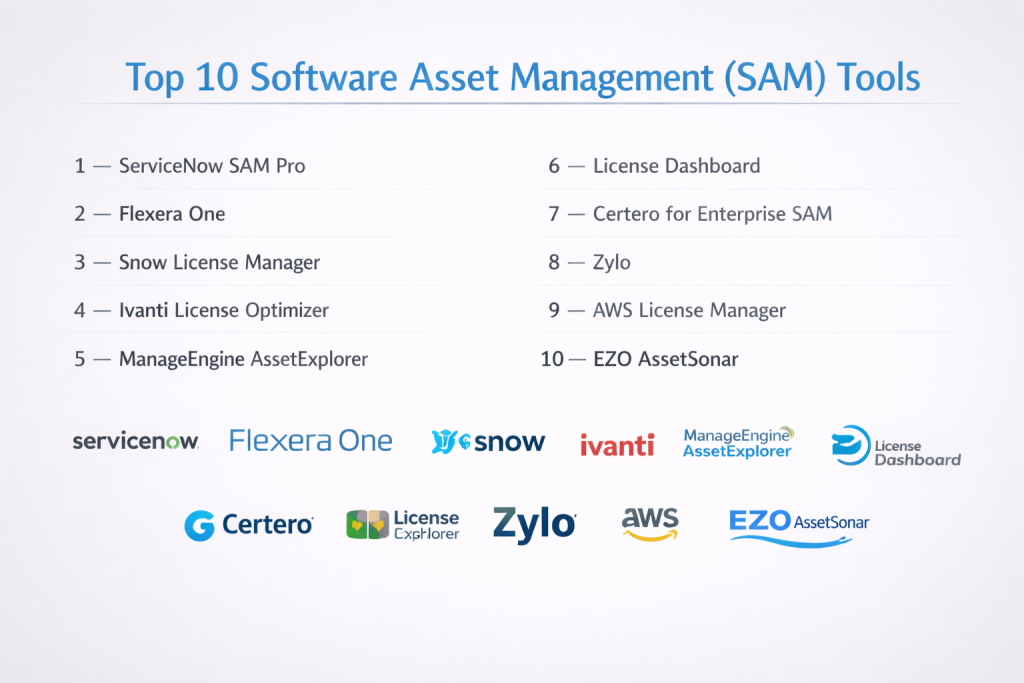
Top 10 Software Asset Management (SAM) Tools
#1 — ServiceNow SAM Pro
Short description (4–5 lines):
ServiceNow SAM Pro is an enterprise-grade software asset management platform built for organizations that need strong governance, workflow automation, and close integration with IT operations. It is especially well suited for large companies already using the broader ServiceNow ecosystem. The platform focuses on software lifecycle control, license optimization, audit readiness, and SaaS visibility. For enterprises with mature ITSM and CMDB practices, it can act as a central system for software governance.
Key Features
- Software entitlement and license lifecycle management
- SaaS and on-prem software discovery
- Audit preparation and compliance workflows
- Optimization insights for license usage
- Integration with CMDB and ITSM workflows
- Vendor and contract management support
- Automated reclamation and policy workflows
Pros
- Strong enterprise process depth
- Deep integration with broader ServiceNow workflows
- Good fit for large, multi-team environments
Cons
- Can be costly for smaller organizations
- Implementation may require specialist expertise
- Best value often depends on broader ServiceNow adoption
Platforms / Deployment
Web
Cloud
Security & Compliance
RBAC, audit logs; other certifications: Not publicly stated
Integrations & Ecosystem
ServiceNow SAM Pro fits best in organizations that want software asset management tightly connected to service management, CMDB, procurement, and workflow automation. Its strength is less about being a standalone niche tool and more about being part of a larger operational platform.
- ITSM integrations
- CMDB integration
- Procurement workflows
- APIs
- Enterprise ecosystem connectors
Support & Community
Strong enterprise support structure, broad implementation partner network, extensive documentation, and a large admin community. Onboarding quality often depends on deployment scope and internal maturity.
#2 — Flexera One
Short description (4–5 lines):
Flexera One is a widely recognized SAM platform built for enterprises that want advanced software license optimization and strong visibility across hybrid environments. It is particularly strong in managing complex vendor licensing and helping organizations reduce software waste. The platform also appeals to teams that want SAM tied more closely to cloud and technology spend management. It is a strong choice for enterprises dealing with compliance pressure and large software estates.
Key Features
- License optimization across major software vendors
- SaaS and cloud visibility
- Compliance tracking and audit preparation
- Software inventory normalization
- Spend and usage analytics
- Vendor and contract management support
- Reporting for enterprise software governance
Pros
- Strong depth for complex licensing scenarios
- Good enterprise-scale optimization capabilities
- Useful for cost governance alongside compliance
Cons
- Higher cost profile than lighter tools
- Can be complex to implement fully
- Best suited to teams with dedicated SAM ownership
Platforms / Deployment
Web
Cloud
Security & Compliance
RBAC, audit logs; other certifications: Not publicly stated
Integrations & Ecosystem
Flexera One is most valuable in environments where software licensing, cloud cost control, and procurement visibility need to work together. It is often chosen by enterprises that want deep analytics and mature governance across multiple vendor ecosystems.
- ITSM integrations
- Cloud platform integrations
- Procurement-related integrations
- APIs
- Enterprise reporting ecosystem
Support & Community
Well suited for enterprise support models, with strong documentation and implementation resources. Community presence is more enterprise-oriented than open community driven.
#3 — Snow License Manager
Short description (4–5 lines):
Snow License Manager is designed for organizations that want strong visibility into software usage, licensing, and compliance across complex environments. It is known for software intelligence and for helping enterprises understand what they have installed, what is being used, and where licensing risk exists. The platform is especially useful for teams trying to improve vendor negotiation and compliance readiness. It fits best in organizations with mature governance needs.
Key Features
- Software inventory and usage visibility
- License compliance tracking
- SaaS management support
- Audit readiness reporting
- Software normalization and recognition
- Policy-based optimization workflows
- Enterprise reporting and analytics
Pros
- Strong software intelligence capabilities
- Good for audit preparation and compliance
- Useful for large-scale license visibility
Cons
- Interface can feel complex for some teams
- May require expertise to unlock full value
- Less ideal for very small businesses
Platforms / Deployment
Web
Cloud / Self-hosted
Security & Compliance
RBAC; other certifications: Not publicly stated
Integrations & Ecosystem
Snow License Manager fits organizations that need centralized software intelligence across many systems. It works best where software visibility, usage analysis, and governance must feed broader IT and operational decision-making.
- ITSM integrations
- APIs
- Cloud connectors
- Software discovery integrations
- Enterprise reporting ecosystem
Support & Community
Enterprise-focused support model with good product documentation. Community strength exists but is more formal and professional than community-led.
#4 — Ivanti License Optimizer
Short description (4–5 lines):
Ivanti License Optimizer is aimed at organizations that need license compliance, optimization, and automation within a broader enterprise IT management environment. It is particularly relevant for teams already using Ivanti products and looking to extend governance into software asset management. The platform supports cost control, vendor visibility, and compliance preparation. It is best suited for mid-market and enterprise organizations with structured IT operations.
Key Features
- License optimization and reclamation workflows
- Software usage and compliance tracking
- SaaS and software visibility
- Risk and audit support
- Reporting and analytics
- Workflow automation
- Enterprise policy support
Pros
- Good fit for structured enterprise IT teams
- Strong compliance and optimization capabilities
- Benefits from broader Ivanti ecosystem use
Cons
- Setup may require planning and expertise
- Learning curve for less mature teams
- Can feel more enterprise-heavy than SMB-focused
Platforms / Deployment
Web / Windows
Cloud / Self-hosted
Security & Compliance
RBAC, audit logs; other certifications: Not publicly stated
Integrations & Ecosystem
Ivanti License Optimizer is strongest when used as part of a broader IT operations environment. It supports organizations that want software governance linked to service management, endpoint visibility, and operational workflows.
- ITSM integrations
- Enterprise APIs
- Endpoint management ecosystem
- Reporting integrations
- Broader Ivanti ecosystem support
Support & Community
Enterprise-grade support options and formal documentation are available. Community engagement exists, though less visible than tools with broader SMB or open-source reach.
#5 — ManageEngine AssetExplorer
Short description (4–5 lines):
ManageEngine AssetExplorer is a practical choice for organizations that want software asset management without the cost and complexity of large enterprise suites. It combines asset visibility, license tracking, procurement awareness, and reporting in a platform that is often attractive to SMB and mid-market teams. While it may not match the deepest enterprise SAM tools in optimization sophistication, it offers solid operational coverage. It is a strong value choice for teams wanting balanced functionality and affordability.
Key Features
- Software discovery and inventory tracking
- License management and compliance support
- Purchase order and procurement visibility
- Asset lifecycle tracking
- Reporting and dashboards
- Integration with broader ManageEngine tools
- Basic workflow support
Pros
- Good value for SMB and mid-market buyers
- Easier to deploy than many enterprise suites
- Works well for teams needing practical coverage
Cons
- Less advanced for complex license optimization
- UI may feel dated to some users
- Advanced enterprise workflows may be limited
Platforms / Deployment
Web / Windows
Cloud / Self-hosted
Security & Compliance
RBAC; other certifications: Not publicly stated
Integrations & Ecosystem
AssetExplorer works well for organizations already using ManageEngine tools or seeking straightforward integrations into everyday IT operations. Its ecosystem value is strongest for practical IT management rather than highly specialized SAM analytics.
- ITSM integrations
- ManageEngine ecosystem support
- APIs
- Monitoring integrations
- Reporting integrations
Support & Community
Good documentation, accessible support experience, and solid fit for teams that need a manageable implementation path. Community visibility is decent in SMB and mid-market environments.
#6 — License Dashboard
Short description (4–5 lines):
License Dashboard is focused on helping organizations manage software licensing, especially in Microsoft-heavy environments. It is designed for teams that want stronger compliance visibility, license analysis, and audit readiness without necessarily adopting a broader IT operations platform. Its narrower focus can be an advantage for organizations with clear licensing priorities. It is best suited for enterprises and procurement-conscious IT teams.
Key Features
- License optimization workflows
- Compliance visibility and reporting
- Audit support
- Microsoft-focused licensing analysis
- Vendor management support
- Reporting dashboards
- Renewal awareness
Pros
- Strong fit for Microsoft-centric environments
- Useful for compliance and audit preparation
- More focused than general-purpose IT suites
Cons
- Narrower scope than broader SAM platforms
- May be less suitable for mixed-vendor complexity
- Enterprise orientation may reduce SMB fit
Platforms / Deployment
Web
Cloud
Security & Compliance
Not publicly stated
Integrations & Ecosystem
License Dashboard is best for organizations that want focused SAM capability rather than a broad IT operations suite. Its ecosystem value depends heavily on how central software licensing governance is to the organization’s software estate.
- APIs
- Microsoft ecosystem support
- Reporting integrations
- Vendor management workflows
Support & Community
Support tends to align with enterprise customer expectations. Community presence is more specialized and less broad than larger all-in-one platforms.
#7 — Certero for Enterprise SAM
Short description (4–5 lines):
Certero for Enterprise SAM is built for organizations that want software visibility across cloud, SaaS, and on-prem environments from a unified platform. It is designed to help enterprises improve software compliance, optimize spend, and gain better operational visibility into software estates. The platform is most relevant for organizations with mixed environments and governance requirements. It appeals to teams that need more than simple inventory tracking.
Key Features
- Unified software discovery
- License optimization support
- SaaS management visibility
- Compliance and audit reporting
- Usage analytics
- Reporting dashboards
- Enterprise workflow support
Pros
- Broad visibility across mixed environments
- Strong focus on software governance
- Good fit for larger estates with complexity
Cons
- Can be more complex than SMB tools
- Cost may be higher than lighter platforms
- May require internal process maturity
Platforms / Deployment
Web
Cloud / Self-hosted
Security & Compliance
RBAC; other certifications: Not publicly stated
Integrations & Ecosystem
Certero is suited to organizations that need broad software visibility without limiting themselves to one software model. Its value grows when software governance must connect to procurement, compliance, and operational reporting.
- Cloud integrations
- ITSM integrations
- APIs
- Reporting integrations
- SaaS visibility ecosystem
Support & Community
Enterprise-oriented support with formal documentation and guided deployment value. Community reach is moderate rather than mass-market.
#8 — Zylo
Short description (4–5 lines):
Zylo is best known for helping organizations manage SaaS application portfolios, subscription sprawl, and software spend. It is not a traditional all-purpose SAM tool in the same sense as large enterprise suites, but it is highly relevant for modern organizations where SaaS is the main software challenge. The platform is particularly useful for finance, procurement, and IT teams seeking subscription optimization. It is strongest in SaaS-heavy environments rather than classic on-prem licensing estates.
Key Features
- SaaS discovery and visibility
- Subscription management
- Spend optimization insights
- Renewal tracking
- Usage reporting
- Vendor intelligence support
- SaaS governance workflows
Pros
- Strong focus on modern SaaS management
- Easier to understand than many enterprise SAM suites
- Useful for spend reduction and subscription control
Cons
- Less suitable for deep on-prem software licensing
- Narrower than full-spectrum SAM platforms
- Best value depends on SaaS-heavy environments
Platforms / Deployment
Web
Cloud
Security & Compliance
Not publicly stated
Integrations & Ecosystem
Zylo fits organizations where SaaS management is the main SAM challenge. It works especially well when procurement, finance, and IT need a shared view of subscription usage and software spend.
- SaaS app integrations
- Finance system integrations
- APIs
- Procurement-related workflows
- Reporting integrations
Support & Community
Generally considered approachable for onboarding, with good support for subscription-focused use cases. Community presence is growing, particularly among SaaS operations teams.
#9 — AWS License Manager
Short description (4–5 lines):
AWS License Manager is a cloud-native option for organizations that need to manage software licensing inside AWS environments. It is useful for teams that want policy enforcement and license tracking tied directly to cloud operations. While it is not a broad standalone SAM platform for every environment, it can be highly effective for AWS-centric estates. It is most relevant for cloud infrastructure teams rather than general-purpose SAM programs.
Key Features
- License tracking within AWS environments
- Policy-based compliance controls
- Automated enforcement workflows
- Integration with AWS services
- Cloud usage visibility
- Governance for supported licensing scenarios
- Operational reporting
Pros
- Strong fit for AWS-native operations
- Useful for cloud policy enforcement
- Native integration simplifies cloud workflows
Cons
- Limited value outside AWS environments
- Not a full replacement for broad enterprise SAM
- Best for cloud-centric use cases only
Platforms / Deployment
Web
Cloud
Security & Compliance
IAM-based controls; other certifications: Not publicly stated
Integrations & Ecosystem
AWS License Manager is most valuable when software licensing governance is tightly connected to AWS infrastructure operations. It is not the broadest SAM solution, but it fits well in organizations already standardized on AWS.
- AWS ecosystem integrations
- APIs
- Cloud governance workflows
- AWS-native operational tooling
Support & Community
Strong documentation and support within the AWS ecosystem. Community strength is high among cloud practitioners, though SAM-specific community depth is narrower.
#10 — EZO AssetSonar
Short description (4–5 lines):
EZO AssetSonar is a practical asset and software management platform aimed at organizations that want straightforward visibility into software and hardware usage. It is often appealing to mid-market teams that need better control without adopting a heavyweight enterprise suite. The platform supports software tracking, reporting, and lifecycle awareness in a more accessible package. It is a balanced option for teams prioritizing usability and operational simplicity.
Key Features
- Software and asset discovery support
- License tracking
- Lifecycle management visibility
- Reporting and dashboards
- Automation support
- Hybrid environment awareness
- User and asset assignment tracking
Pros
- More approachable than large enterprise suites
- Balanced functionality for mid-sized organizations
- Good fit for teams wanting quick operational value
Cons
- Less deep than top enterprise SAM tools
- May not meet complex global licensing needs
- Advanced optimization capabilities are more limited
Platforms / Deployment
Web
Cloud
Security & Compliance
Not publicly stated
Integrations & Ecosystem
AssetSonar works best for teams wanting practical integrations and manageable implementation effort. Its ecosystem is oriented toward day-to-day IT and operational workflows rather than highly specialized global licensing complexity.
- APIs
- ITSM integrations
- HR and operational system integrations
- Reporting tools
- Workflow integrations
Support & Community
Good support experience for practical deployments, with documentation that is generally accessible. Community size is smaller than the largest enterprise vendors but growing.
Comparison Table (Top 10)
| Tool Name | Best For | Platform(s) Supported | Deployment | Standout Feature | Public Rating |
|---|---|---|---|---|---|
| ServiceNow SAM Pro | Large enterprises | Web | Cloud | Deep ITSM and workflow integration | N/A |
| Flexera One | Enterprise license optimization | Web | Cloud | Advanced optimization and spend visibility | N/A |
| Snow License Manager | Compliance-focused enterprises | Web | Cloud / Self-hosted | Strong software intelligence | N/A |
| Ivanti License Optimizer | Structured enterprise IT teams | Web / Windows | Cloud / Self-hosted | Compliance and operational alignment | N/A |
| ManageEngine AssetExplorer | SMB and mid-market | Web / Windows | Cloud / Self-hosted | Strong value and practical coverage | N/A |
| License Dashboard | Microsoft-heavy organizations | Web | Cloud | Focused Microsoft licensing insight | N/A |
| Certero for Enterprise SAM | Hybrid enterprises | Web | Cloud / Self-hosted | Unified software visibility | N/A |
| Zylo | SaaS-heavy organizations | Web | Cloud | SaaS subscription optimization | N/A |
| AWS License Manager | AWS-centric teams | Web | Cloud | Native AWS licensing control | N/A |
| EZO AssetSonar | Mid-market teams | Web | Cloud | Accessible hybrid asset visibility | N/A |
Evaluation & Scoring of Software Asset Management (SAM) Tools
| Tool Name | Core (25%) | Ease (15%) | Integrations (15%) | Security (10%) | Performance (10%) | Support (10%) | Value (15%) | Weighted Total (0–10) |
|---|---|---|---|---|---|---|---|---|
| ServiceNow SAM Pro | 9 | 6 | 9 | 8 | 9 | 9 | 6 | 8.10 |
| Flexera One | 9 | 6 | 9 | 8 | 9 | 8 | 6 | 7.95 |
| Snow License Manager | 8 | 6 | 8 | 7 | 8 | 8 | 7 | 7.40 |
| Ivanti License Optimizer | 8 | 6 | 8 | 7 | 8 | 8 | 7 | 7.40 |
| ManageEngine AssetExplorer | 7 | 8 | 7 | 6 | 7 | 8 | 9 | 7.45 |
| License Dashboard | 7 | 7 | 6 | 6 | 7 | 7 | 7 | 6.80 |
| Certero for Enterprise SAM | 8 | 6 | 8 | 7 | 8 | 7 | 7 | 7.25 |
| Zylo | 7 | 8 | 7 | 6 | 7 | 8 | 8 | 7.25 |
| AWS License Manager | 6 | 8 | 8 | 7 | 8 | 7 | 8 | 7.20 |
| EZO AssetSonar | 7 | 8 | 6 | 6 | 7 | 7 | 8 | 7.00 |
These scores are comparative, not absolute. A higher total does not always mean a better fit for every organization. Enterprise tools often score well on depth and integrations, while mid-market tools may perform better on usability and value. Teams should treat the table as a structured shortlist aid rather than a final answer. The right choice depends on software complexity, compliance exposure, internal expertise, and budget priorities.
Which Software Asset Management (SAM) Tool Is Right for You?
Solo / Freelancer
Most solo users do not need a full SAM platform. If you mainly want visibility into subscriptions and software usage, lightweight tracking or SaaS-focused tools are usually enough. Zylo-style SaaS visibility makes more sense than a heavyweight enterprise suite. In many solo scenarios, a full SAM platform may be more than you actually need.
SMB
SMBs usually benefit most from practical, lower-overhead tools. ManageEngine AssetExplorer and EZO AssetSonar are often the better fit when teams need visibility, reporting, and license tracking without large implementation effort. These tools generally offer a better balance of usability and cost than enterprise-heavy platforms. If SaaS sprawl is the main issue, Zylo can also be a strong option.
Mid-Market
Mid-market teams often need more structure than SMB tools provide, but may not want the complexity of the largest enterprise suites. Certero, ManageEngine, and AssetSonar can work well depending on how software-heavy the environment is. If SaaS is growing quickly, Zylo becomes more relevant. If compliance pressure is rising, stepping up to Ivanti or Snow may make sense.
Enterprise
Large enterprises usually need stronger governance, broader integrations, and better compliance reporting. ServiceNow SAM Pro, Flexera One, Snow License Manager, and Ivanti License Optimizer stand out here. These platforms are more suitable for organizations dealing with large software estates, major vendor licensing complexity, and frequent audit risk. The best choice often depends on the rest of your IT ecosystem.
Budget vs Premium
If budget matters most, ManageEngine AssetExplorer and EZO AssetSonar are easier to justify. They may not deliver the deepest optimization or enterprise workflow sophistication, but they often cover core requirements well. Premium options like ServiceNow and Flexera deliver broader governance and analytics, but usually require more budget, planning, and internal maturity. Premium makes sense when licensing complexity is expensive enough to justify it.
Feature Depth vs Ease of Use
Feature-rich tools often come with more implementation complexity. ServiceNow, Flexera, and Snow offer deeper governance but may demand more time, process maturity, and specialist ownership. ManageEngine, Zylo, and AssetSonar are generally easier to adopt for everyday operational teams. The best trade-off depends on whether your main problem is software complexity or operational simplicity.
Integrations & Scalability
If you need long-term scalability and broad integration with ITSM, procurement, finance, and cloud tools, enterprise platforms are usually the safer path. ServiceNow and Flexera are especially strong when SAM must be embedded into wider operational workflows. AWS License Manager is scalable inside AWS, but only within that context. For mid-market growth, Certero and Ivanti can offer a balanced path.
Security & Compliance Needs
Organizations facing software vendor audits, regulated environments, or strong internal governance requirements should prioritize compliance depth over convenience. ServiceNow, Flexera, Snow, and Ivanti are typically better choices in these scenarios. Smaller tools may still be useful operationally, but they are not always built for complex enterprise compliance demands. Your audit exposure should heavily influence your shortlist.
Frequently Asked Questions (FAQs)
1. What is a Software Asset Management tool?
A SAM tool helps organizations track software inventory, manage licenses, optimize usage, and stay compliant with vendor agreements. It gives IT and procurement teams better visibility into what software they own and how it is being used.
2. Why is SAM important for modern businesses?
Because software estates are now spread across SaaS, cloud, and on-prem environments. Without SAM, businesses often overspend on unused licenses, miss renewals, and struggle with compliance risk during audits.
3. What is the difference between SAM and ITAM?
SAM focuses specifically on software licenses, usage, renewals, and compliance. ITAM is broader and includes hardware, devices, infrastructure assets, and the full lifecycle of IT resources.
4. Can SAM tools manage SaaS applications too?
Yes, many modern SAM platforms now include SaaS discovery, subscription tracking, and usage monitoring. Some tools are especially strong in SaaS-heavy environments, while others are better for traditional software licensing.
5. Are SAM tools only for enterprises?
No, but the most advanced SAM platforms are usually built for larger organizations. SMBs can still benefit from simpler platforms if they manage enough licenses, subscriptions, or vendor relationships to justify better control.
6. How do SAM tools reduce software costs?
They identify unused licenses, duplicate subscriptions, underused software, and inefficient contracts. That helps organizations reclaim licenses, reduce renewals, and negotiate more effectively with software vendors.
7. Do SAM tools help with software audits?
Yes, this is one of their main benefits. Good SAM tools improve audit readiness by centralizing entitlement data, usage visibility, and reporting so teams can respond to vendor requests more confidently.
8. How hard is it to implement a SAM tool?
Implementation complexity varies a lot. SaaS-focused or mid-market tools can be relatively quick to deploy, while enterprise suites may require data cleanup, workflow design, integrations, and dedicated internal ownership.
9. Can SAM tools integrate with ITSM and procurement systems?
Yes, many of them do. This is important because software lifecycle management often depends on procurement data, service requests, approvals, CMDB records, and user identity information.
10. What are common mistakes when choosing a SAM platform?
A common mistake is choosing based only on brand reputation instead of software environment fit. Another is underestimating implementation effort or failing to confirm whether the platform handles SaaS, cloud, and vendor complexity properly.
11. Is a SaaS management tool the same as a SAM tool?
Not always. SaaS management tools focus mainly on subscription discovery, spend, and usage, while broader SAM platforms usually also cover on-prem software, compliance, and entitlement management.
12. When should a company switch SAM tools?
A company should consider switching when its current tool lacks SaaS visibility, cannot support compliance needs, struggles with integrations, or no longer matches the scale and complexity of the software estate.
Conclusion
Software Asset Management tools are no longer just about tracking installed software. They now play a major role in cost control, compliance, SaaS governance, and operational visibility across modern IT environments. Enterprise platforms like ServiceNow SAM Pro, Flexera One, Snow, and Ivanti make sense for organizations with complex vendor licensing and strong governance needs, while tools like ManageEngine AssetExplorer, Zylo, and EZO AssetSonar are more approachable for smaller or mid-sized teams. The best choice depends on your software mix, internal maturity, and audit exposure. The smartest next step is to shortlist two or three tools, validate their integrations and reporting depth, and run a focused pilot before making a long-term commitment.
