Introduction
Contact Center Platforms are cloud-based systems that help businesses manage customer interactions across multiple channels such as voice, chat, email, and social media. These platforms go beyond traditional call centers by integrating omnichannel communication, automation, analytics, and AI-driven insights into a unified interface.
In the modern customer experience landscape, businesses must deliver fast, personalized, and consistent support across channels. Contact center platforms enable this by routing queries intelligently, automating repetitive tasks, and providing agents with real-time data. They are essential for scaling customer support operations while maintaining quality and efficiency.
Common use cases include:
- Customer support and service operations
- Sales and outbound engagement
- Technical support helpdesks
- Omnichannel customer experience management
- Call center modernization
Key evaluation criteria for buyers:
- Omnichannel capabilities (voice, chat, email, social)
- AI and automation features
- Call routing and IVR systems
- Analytics and reporting
- Integration with CRM and helpdesk tools
- Scalability and global availability
- Security and compliance
- Ease of use and agent experience
Best for: Customer support teams, enterprises, SaaS companies, and businesses with high customer interaction volumes.
Not ideal for: Small teams with minimal support needs or companies that only require basic communication tools.
Key Trends in Contact Center Platforms
- AI-powered chatbots and virtual agents
- Predictive routing and sentiment analysis
- Omnichannel communication unification
- Real-time analytics and dashboards
- Low-code automation workflows
- Integration with CRM and CX platforms
- Workforce optimization tools
- Cloud-native and scalable architectures
- Personalization using customer data
How We Selected These Tools (Methodology)
- Strong adoption in customer service and CX markets
- Comprehensive omnichannel capabilities
- Proven reliability and scalability
- AI and automation innovation
- Integration ecosystem strength
- Security and compliance capabilities
- Ease of use for agents and admins
- Support quality and onboarding experience
- Flexibility for SMB to enterprise use cases
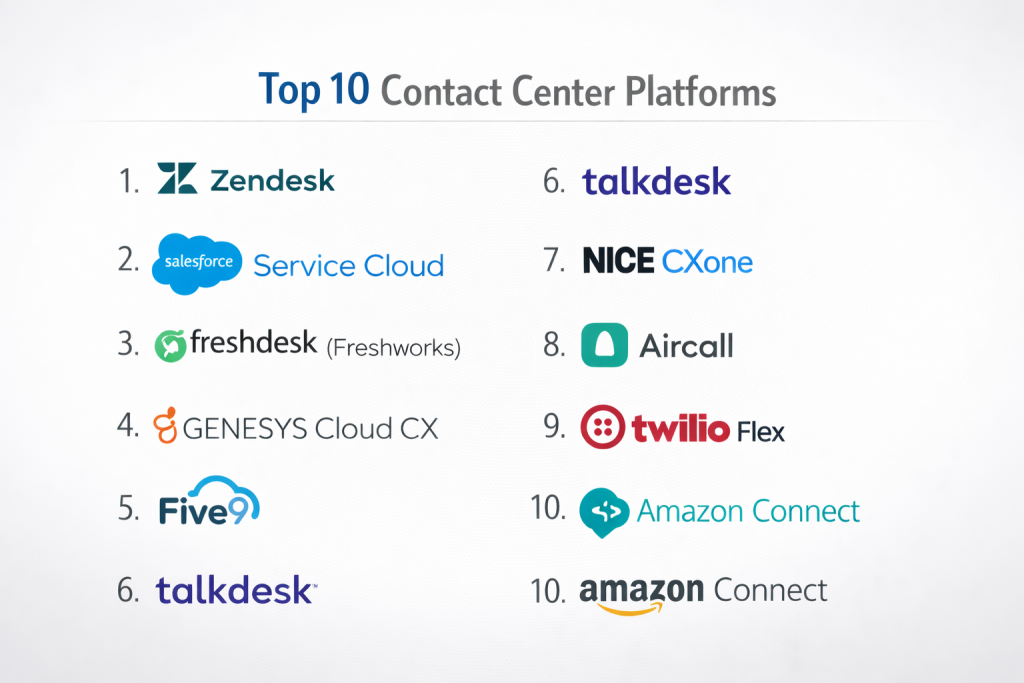
Top 10 Contact Center Platforms
#1 — Zendesk
Short description: A widely used contact center platform that combines customer support, ticketing, and omnichannel communication into one system. It helps businesses manage customer interactions efficiently across multiple channels. The platform offers automation, analytics, and integrations for scaling support operations. It is suitable for SMBs to large enterprises.
Key Features
- Omnichannel support (voice, chat, email)
- Ticketing system
- AI chatbots
- Workflow automation
- Analytics and reporting
- Knowledge base integration
Pros
- Easy to use
- Strong ecosystem
Cons
- Pricing can increase with scale
- Customization complexity
Platforms / Deployment
Web / Desktop / Mobile
Cloud
Security & Compliance
SSO, encryption, GDPR (varies)
Integrations & Ecosystem
Extensive integrations with CRM and business tools.
- Salesforce
- Slack
- Shopify
- APIs
Support & Community
Strong documentation and large global community.
#2 — Salesforce Service Cloud
Short description: A powerful contact center solution built on the Salesforce platform, offering deep CRM integration and advanced automation. It enables businesses to manage customer interactions, cases, and workflows efficiently. The platform supports omnichannel communication and AI-driven insights. It is ideal for enterprise organizations.
Key Features
- Case management
- Omnichannel routing
- AI (Einstein) insights
- Automation workflows
- CRM integration
- Analytics dashboards
Pros
- Deep CRM integration
- Highly customizable
Cons
- Expensive
- Complex implementation
Platforms / Deployment
Web / Mobile
Cloud
Security & Compliance
Enterprise-grade compliance (varies)
Integrations & Ecosystem
Strong integration within Salesforce ecosystem.
- CRM tools
- APIs
- Third-party apps
Support & Community
Extensive enterprise support and ecosystem.
#3 — Freshdesk (Freshworks)
Short description: A cloud-based contact center platform designed for ease of use and scalability. It offers omnichannel support, automation, and analytics to help teams manage customer interactions. The platform is popular among SMBs and growing businesses. It balances functionality and affordability.
Key Features
- Ticketing system
- Omnichannel support
- AI bots
- Automation workflows
- Reporting and analytics
- Self-service portal
Pros
- User-friendly
- Affordable pricing
Cons
- Limited advanced customization
- Scaling limitations
Platforms / Deployment
Web / Mobile
Cloud
Security & Compliance
Varies / N/A
Integrations & Ecosystem
Integrates with business and productivity tools.
- CRM systems
- Collaboration tools
Support & Community
Good SMB-level support and onboarding.
#4 — Genesys Cloud CX
Short description: An enterprise-grade contact center platform offering advanced omnichannel capabilities and AI-driven customer experience tools. It supports large-scale operations with global infrastructure. The platform provides deep analytics and automation features. It is designed for enterprise customer engagement.
Key Features
- Omnichannel communication
- AI-powered routing
- Workforce management
- Analytics dashboards
- Automation tools
- Global infrastructure
Pros
- Highly scalable
- Advanced AI features
Cons
- High cost
- Complex setup
Platforms / Deployment
Web / Desktop / Mobile
Cloud
Security & Compliance
Enterprise-grade compliance (varies)
Integrations & Ecosystem
Strong integration ecosystem with enterprise tools.
- CRM platforms
- APIs
- Analytics tools
Support & Community
Enterprise-level support and resources.
#5 — Five9
Short description: A cloud contact center platform focused on automation, AI, and customer experience optimization. It provides tools for inbound and outbound communication. The platform supports omnichannel engagement and analytics. It is suitable for mid-market and enterprise businesses.
Key Features
- Cloud contact center
- IVR and routing
- AI automation
- Omnichannel support
- Analytics
- Workforce management
Pros
- Strong automation
- Scalable
Cons
- Pricing complexity
- Learning curve
Platforms / Deployment
Web / Desktop
Cloud
Security & Compliance
Varies / N/A
Integrations & Ecosystem
Supports integrations with CRM and enterprise tools.
- Salesforce
- APIs
Support & Community
Good enterprise support; varies by plan.
#6 — Talkdesk
Short description: A modern contact center platform with AI-driven automation and omnichannel capabilities. It helps businesses improve customer experience through intelligent workflows and analytics. The platform is cloud-native and scalable. It is used by mid-market and enterprise organizations.
Key Features
- AI automation
- Omnichannel communication
- Call routing
- Analytics
- Workforce management
- App marketplace
Pros
- Modern interface
- Strong AI features
Cons
- Cost can increase
- Requires setup effort
Platforms / Deployment
Web / Desktop / Mobile
Cloud
Security & Compliance
Varies / N/A
Integrations & Ecosystem
Strong integration ecosystem with APIs and apps.
- CRM tools
- Marketplace apps
Support & Community
Good support with onboarding programs.
#7 — NICE CXone
Short description: A comprehensive contact center platform offering AI-driven analytics, workforce optimization, and omnichannel engagement. It supports large-scale customer service operations. The platform focuses on improving agent productivity and customer satisfaction. It is widely used by enterprises.
Key Features
- Omnichannel engagement
- AI analytics
- Workforce optimization
- Automation
- Reporting
- Call recording
Pros
- Advanced analytics
- Enterprise-ready
Cons
- Complex implementation
- Expensive
Platforms / Deployment
Web / Desktop
Cloud
Security & Compliance
Enterprise-grade compliance (varies)
Integrations & Ecosystem
Integrates with enterprise tools and APIs.
- CRM platforms
- Analytics tools
Support & Community
Strong enterprise support ecosystem.
#8 — Aircall
Short description: A cloud-based contact center solution designed for sales and support teams. It focuses on voice communication with strong integrations and workflow automation. The platform is easy to use and deploy. It is popular among SaaS companies.
Key Features
- VoIP calling
- Call routing
- CRM integrations
- Analytics
- Call recording
- Team collaboration
Pros
- Easy to use
- Strong integrations
Cons
- Limited omnichannel features
- Pricing can be high
Platforms / Deployment
Web / Desktop / Mobile
Cloud
Security & Compliance
Varies / N/A
Integrations & Ecosystem
Strong CRM and helpdesk integrations.
- Salesforce
- HubSpot
- Zendesk
Support & Community
Good support for SaaS teams.
#9 — Twilio Flex
Short description: A highly customizable contact center platform built for developers, offering programmable communication capabilities. It allows businesses to build tailored workflows and customer experiences. The platform is API-first and flexible. It is ideal for companies needing custom solutions.
Key Features
- Programmable contact center
- Omnichannel communication
- APIs and SDKs
- Custom workflows
- Analytics
- Automation
Pros
- Highly flexible
- Developer-friendly
Cons
- Requires technical expertise
- Higher implementation effort
Platforms / Deployment
Web
Cloud
Security & Compliance
Varies / N/A
Integrations & Ecosystem
Extensive API ecosystem for custom integrations.
- Custom apps
- CRM integrations
Support & Community
Strong developer community and resources.
#10 — Amazon Connect
Short description: A cloud-based contact center platform offering scalable and pay-as-you-go pricing. It integrates with AWS services for advanced analytics and AI capabilities. The platform supports omnichannel communication and automation. It is suitable for enterprises and cloud-native businesses.
Key Features
- Cloud contact center
- IVR and routing
- AI integration
- Omnichannel support
- Analytics
- Pay-as-you-go pricing
Pros
- Scalable
- Flexible pricing
Cons
- Requires AWS knowledge
- Setup complexity
Platforms / Deployment
Web
Cloud
Security & Compliance
Varies / N/A
Integrations & Ecosystem
Deep integration with cloud and AI services.
- AWS services
- APIs
Support & Community
Strong cloud support ecosystem.
Comparison Table (Top 10)
| Tool Name | Best For | Platform(s) Supported | Deployment | Standout Feature | Public Rating |
|---|---|---|---|---|---|
| Zendesk | SMB/Enterprise | Web/Mobile | Cloud | Ease of use | N/A |
| Salesforce Service Cloud | Enterprise | Web/Mobile | Cloud | CRM integration | N/A |
| Freshdesk | SMB | Web/Mobile | Cloud | Affordability | N/A |
| Genesys Cloud CX | Enterprise | All platforms | Cloud | AI routing | N/A |
| Five9 | Mid-market | Web/Desktop | Cloud | Automation | N/A |
| Talkdesk | Mid-market | All platforms | Cloud | AI features | N/A |
| NICE CXone | Enterprise | Web/Desktop | Cloud | Analytics | N/A |
| Aircall | SMB | All platforms | Cloud | Integrations | N/A |
| Twilio Flex | Developers | Web | Cloud | Customization | N/A |
| Amazon Connect | Enterprise | Web | Cloud | AWS integration | N/A |
Evaluation & Scoring of Contact Center Platforms
| Tool Name | Core (25%) | Ease (15%) | Integrations (15%) | Security (10%) | Performance (10%) | Support (10%) | Value (15%) | Weighted Total (0–10) |
|---|---|---|---|---|---|---|---|---|
| Zendesk | 8 | 9 | 9 | 7 | 8 | 8 | 8 | 8.3 |
| Salesforce Service Cloud | 9 | 6 | 10 | 9 | 8 | 8 | 7 | 8.5 |
| Freshdesk | 7 | 9 | 7 | 6 | 7 | 8 | 9 | 7.8 |
| Genesys Cloud CX | 9 | 6 | 8 | 9 | 9 | 8 | 7 | 8.4 |
| Five9 | 8 | 7 | 7 | 7 | 8 | 7 | 7 | 7.6 |
| Talkdesk | 8 | 8 | 8 | 7 | 8 | 7 | 7 | 7.9 |
| NICE CXone | 9 | 6 | 8 | 9 | 9 | 8 | 7 | 8.4 |
| Aircall | 7 | 8 | 9 | 6 | 8 | 7 | 7 | 7.7 |
| Twilio Flex | 9 | 5 | 10 | 7 | 8 | 7 | 7 | 8.0 |
| Amazon Connect | 8 | 6 | 9 | 8 | 9 | 7 | 8 | 8.1 |
Interpretation:
These scores provide a comparative view of tools based on key criteria. Higher scores indicate balanced performance, but the best choice depends on your specific business needs, technical capabilities, and budget.
Which Contact Center Platform Is Right for You?
Solo / Freelancer
Aircall or Freshdesk for simplicity and ease of use.
SMB
Freshdesk or Zendesk for affordability and scalability.
Mid-Market
Talkdesk or Five9 for balanced features and growth.
Enterprise
Genesys, NICE CXone, or Salesforce Service Cloud for advanced capabilities.
Budget vs Premium
- Budget: Freshdesk, Aircall
- Premium: Genesys, NICE CXone
Feature Depth vs Ease of Use
- Advanced: Salesforce, Genesys
- Easy: Freshdesk, Zendesk
Integrations & Scalability
- Strong integrations: Salesforce, Twilio
- Scalable: Amazon Connect
Security & Compliance Needs
- High compliance: Salesforce, NICE CXone
- Moderate: Others vary
Frequently Asked Questions (FAQs)
1. What is a contact center platform?
It is a system that manages customer interactions across multiple communication channels.
2. How is it different from a call center?
Contact centers support multiple channels, while call centers focus on voice.
3. Are these platforms cloud-based?
Most modern platforms are cloud-native.
4. Can they integrate with CRM tools?
Yes, integration with CRM systems is a key feature.
5. Do they support AI?
Many platforms offer AI for automation and analytics.
6. How scalable are they?
Highly scalable for growing businesses.
7. What industries use them?
Retail, SaaS, healthcare, finance, and more.
8. Are they secure?
Most provide security features, but levels vary.
9. How long does implementation take?
From days to weeks depending on complexity.
10. Are there alternatives?
Basic helpdesk tools or communication platforms.
Conclusion
Contact Center Platforms have become essential for delivering modern customer experiences, enabling businesses to manage interactions across multiple channels efficiently. Enterprise solutions like Genesys Cloud CX and NICE CXone provide advanced AI and scalability, while tools like Freshdesk and Zendesk offer user-friendly options for growing teams. Developer-focused platforms such as Twilio Flex provide unmatched flexibility for custom workflows. The right platform depends on your operational scale, technical expertise, and customer engagement strategy. To make the best choice, shortlist a few platforms, test them in real scenarios, and ensure they align with your business goals and customer experience expectations.
