Introduction
API Gateways are tools that sit between clients and backend services to manage, route, secure, and monitor API traffic. They act as a centralized entry point for applications, mobile apps, web platforms, and partner systems accessing backend services. Instead of exposing multiple services directly, organizations use an API gateway to simplify management and improve control.
As businesses move toward microservices, cloud-native architectures, and distributed systems, API gateways have become critical infrastructure. They help enforce security policies, reduce latency, manage traffic spikes, and improve developer experience. Modern API gateways also support AI-based monitoring, rate limiting, observability integrations, and multi-cloud deployments.
Common use cases include:
- Routing traffic to microservices
- Securing public APIs
- Rate limiting and throttling
- Load balancing API requests
- Authentication and authorization
- Centralized logging and analytics
What buyers should evaluate:
- Performance under heavy traffic
- Security controls
- Ease of configuration
- Kubernetes and cloud support
- Monitoring and analytics
- Scalability
- Pricing model
- Community and vendor support
Best for: SaaS companies, enterprises, fintech, ecommerce, healthcare, and engineering teams managing APIs at scale.
Not ideal for: Small internal projects with minimal API traffic where lightweight reverse proxies may be enough.
Key Trends in API Gateways
- AI-powered anomaly detection
- Stronger zero-trust security models
- Kubernetes-native gateway adoption
- GraphQL and gRPC support growth
- Usage-based pricing expansion
- Edge deployments increasing
- Deeper observability integrations
- Multi-cloud traffic management
- Policy-as-code adoption
- Better developer self-service tooling
How We Selected These Tools (Methodology)
- Market adoption and brand trust
- Performance reputation
- Security capabilities
- Ease of deployment and operations
- Cloud-native readiness
- Feature depth
- Ecosystem integrations
- Community and documentation quality
- Suitability for SMB to enterprise use cases
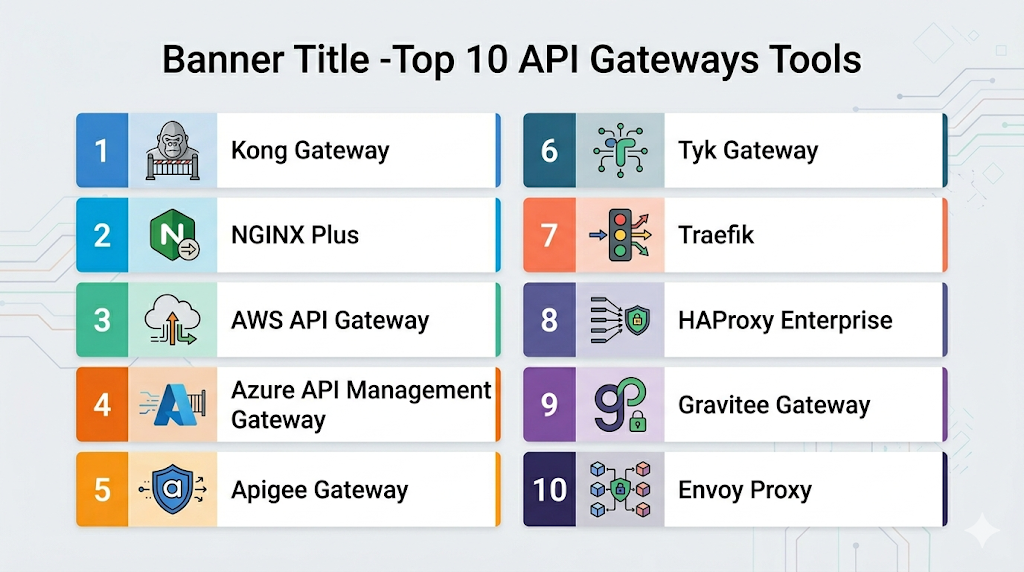
Top 10 API Gateways Tools
#1 — Kong Gateway
Short description: One of the most widely used modern API gateways built for performance, extensibility, and cloud-native environments.
Key Features
- High-performance proxy engine
- Plugin architecture
- Authentication controls
- Rate limiting
- Load balancing
- Kubernetes support
Pros
- Strong scalability
- Large plugin ecosystem
- Good enterprise readiness
Cons
- Advanced setup may require expertise
- Premium features in paid tiers
Platforms / Deployment
Cloud / Self-hosted / Hybrid
Security & Compliance
RBAC, TLS, SSO support, logging. Other certifications vary.
Integrations & Ecosystem
Strong integrations for modern DevOps stacks.
- Kubernetes
- CI/CD tools
- Identity providers
- Observability tools
Support & Community
Large open-source community with enterprise support plans.
#2 — NGINX Plus
Short description: Commercial API gateway and load balancer built on the widely trusted NGINX platform.
Key Features
- Reverse proxy engine
- Load balancing
- Security controls
- Traffic routing
- Health checks
- High availability support
Pros
- Excellent performance
- Trusted enterprise brand
- Flexible deployments
Cons
- Commercial licensing cost
- Advanced API management requires add-ons
Platforms / Deployment
Cloud / Self-hosted / Hybrid
Security & Compliance
TLS, access control, logging, WAF integrations.
Integrations & Ecosystem
Strong infrastructure compatibility.
- Containers
- Kubernetes
- Monitoring tools
- CI/CD pipelines
Support & Community
Strong documentation and enterprise support.
#3 — AWS API Gateway
Short description: Managed API gateway service ideal for teams already operating inside AWS environments.
Key Features
- Managed REST and HTTP APIs
- Usage plans
- Rate limiting
- IAM security
- Serverless integrations
- Monitoring tools
Pros
- Fully managed service
- Strong AWS integrations
- Good elastic scalability
Cons
- Best for AWS-centric teams
- Pricing can rise with traffic volume
Platforms / Deployment
Cloud
Security & Compliance
IAM, encryption, logging, access policies.
Integrations & Ecosystem
Excellent AWS-native ecosystem support.
- Lambda
- CloudWatch
- Cognito
- Databases
Support & Community
Broad documentation and large user base.
#4 — Azure API Management Gateway
Short description: Microsoft-managed gateway layer with enterprise-grade policy controls and Azure integration.
Key Features
- Gateway policies
- Authentication controls
- Rate limiting
- Monitoring tools
- Hybrid gateways
- Developer portal support
Pros
- Great for Microsoft environments
- Strong identity integrations
- Good governance controls
Cons
- Strongest value in Azure ecosystem
- Pricing tiers can be complex
Platforms / Deployment
Cloud / Hybrid
Security & Compliance
Azure identity, RBAC, encryption, audit features.
Integrations & Ecosystem
Native Microsoft ecosystem fit.
- Azure services
- DevOps pipelines
- Identity systems
- Analytics tools
Support & Community
Strong enterprise support and docs.
#5 — Apigee Gateway
Short description: Enterprise API gateway layer within the broader Apigee platform, known for governance and analytics.
Key Features
- Traffic management
- Security policies
- Analytics
- Monetization support
- Hybrid deployment
- Lifecycle tooling
Pros
- Strong enterprise controls
- Mature platform
- Excellent analytics
Cons
- Premium pricing
- Complex for smaller teams
Platforms / Deployment
Cloud / Hybrid
Security & Compliance
SSO, RBAC, encryption, policy controls.
Integrations & Ecosystem
Enterprise integration strength.
- Identity providers
- Monitoring platforms
- Cloud services
- CI/CD tools
Support & Community
Enterprise-grade vendor support.
#6 — Tyk Gateway
Short description: Flexible API gateway platform known for self-hosted and privacy-friendly deployment options.
Key Features
- Gateway routing
- Developer portal
- Rate limiting
- OAuth support
- Analytics
- Hybrid deployment options
Pros
- Strong self-hosted flexibility
- Good value positioning
Cons
- Smaller ecosystem than market leaders
- Advanced enterprise needs may need premium plans
Platforms / Deployment
Cloud / Self-hosted / Hybrid
Security & Compliance
OAuth, RBAC, encryption support.
Integrations & Ecosystem
Good compatibility with modern infrastructure.
- Kubernetes
- Identity tools
- Logging tools
- CI/CD platforms
Support & Community
Growing community with commercial support.
#7 — Traefik
Short description: Cloud-native gateway and ingress controller popular in containerized environments.
Key Features
- Dynamic routing
- Kubernetes ingress
- Auto discovery
- TLS automation
- Middleware controls
- Observability support
Pros
- Great for container platforms
- Easy dynamic config
- Developer friendly
Cons
- Less enterprise management depth
- Best suited to cloud-native teams
Platforms / Deployment
Cloud / Self-hosted
Security & Compliance
TLS, access controls, logging.
Integrations & Ecosystem
Strong in container ecosystems.
- Docker
- Kubernetes
- Prometheus
- Grafana
Support & Community
Strong technical community.
#8 — HAProxy Enterprise
Short description: High-performance traffic management and gateway platform trusted for reliability.
Key Features
- Advanced load balancing
- Traffic routing
- TLS offloading
- Rate limiting
- High availability
- Performance tuning controls
Pros
- Excellent speed and reliability
- Proven enterprise deployments
Cons
- Less API portal focus
- Configuration can be technical
Platforms / Deployment
Cloud / Self-hosted / Hybrid
Security & Compliance
TLS, access policies, logging.
Integrations & Ecosystem
Infrastructure-friendly ecosystem.
- Containers
- Monitoring tools
- Automation tools
Support & Community
Strong enterprise support.
#9 — Gravitee Gateway
Short description: Modern gateway platform with strong support for APIs and event-driven architectures.
Key Features
- Gateway routing
- Security policies
- Event-native support
- Analytics
- Developer portal
- Multi-environment management
Pros
- Modern architecture support
- Good developer experience
Cons
- Smaller market share
- Some advanced features tier-dependent
Platforms / Deployment
Cloud / Self-hosted / Hybrid
Security & Compliance
RBAC, encryption, policy controls.
Integrations & Ecosystem
Modern infrastructure compatibility.
- Kafka ecosystems
- Kubernetes
- Identity systems
Support & Community
Growing commercial ecosystem.
#10 — Envoy Proxy
Short description: High-performance open-source proxy often used as a gateway in service mesh and cloud-native environments.
Key Features
- L7 traffic routing
- Observability support
- Security policies
- gRPC support
- Service mesh compatibility
- High scalability
Pros
- Excellent performance
- Strong cloud-native adoption
- Flexible architecture
Cons
- More technical to manage directly
- Better suited to advanced teams
Platforms / Deployment
Cloud / Self-hosted
Security & Compliance
TLS, RBAC integrations, logging.
Integrations & Ecosystem
Widely used in modern platforms.
- Kubernetes
- Istio ecosystems
- Monitoring tools
- Service meshes
Support & Community
Very strong open-source community.
Comparison Table (Top 10)
| Tool Name | Best For | Platform(s) Supported | Deployment | Standout Feature | Public Rating |
|---|---|---|---|---|---|
| Kong Gateway | Cloud-native teams | Multi-platform | Hybrid | Plugin ecosystem | N/A |
| NGINX Plus | High-performance infra | Multi-platform | Hybrid | Proven proxy engine | N/A |
| AWS API Gateway | AWS users | Multi-platform | Cloud | Managed serverless fit | N/A |
| Azure API Management Gateway | Microsoft shops | Multi-platform | Hybrid | Azure integration | N/A |
| Apigee Gateway | Large enterprises | Multi-platform | Hybrid | Analytics depth | N/A |
| Tyk Gateway | Flexible hosting | Multi-platform | Hybrid | Self-hosted options | N/A |
| Traefik | Kubernetes teams | Multi-platform | Cloud/Self-hosted | Dynamic routing | N/A |
| HAProxy Enterprise | High traffic workloads | Multi-platform | Hybrid | Reliability | N/A |
| Gravitee Gateway | Event-driven teams | Multi-platform | Hybrid | Event-native support | N/A |
| Envoy Proxy | Advanced engineering teams | Multi-platform | Self-hosted | Service mesh fit | N/A |
Evaluation & Scoring of API Gateways
| Tool Name | Core (25%) | Ease (15%) | Integrations (15%) | Security (10%) | Performance (10%) | Support (10%) | Value (15%) | Weighted Total |
|---|---|---|---|---|---|---|---|---|
| Kong Gateway | 9 | 8 | 9 | 8 | 9 | 8 | 8 | 8.5 |
| NGINX Plus | 9 | 7 | 8 | 8 | 10 | 8 | 7 | 8.2 |
| AWS API Gateway | 8 | 8 | 8 | 9 | 9 | 8 | 8 | 8.2 |
| Azure API Management Gateway | 8 | 8 | 8 | 9 | 8 | 8 | 7 | 8.0 |
| Apigee Gateway | 9 | 7 | 8 | 9 | 8 | 9 | 6 | 8.0 |
| Tyk Gateway | 8 | 7 | 7 | 8 | 8 | 7 | 8 | 7.7 |
| Traefik | 8 | 8 | 7 | 7 | 8 | 7 | 9 | 7.9 |
| HAProxy Enterprise | 8 | 6 | 7 | 8 | 10 | 8 | 7 | 7.8 |
| Gravitee Gateway | 8 | 7 | 7 | 8 | 8 | 7 | 8 | 7.7 |
| Envoy Proxy | 9 | 6 | 8 | 8 | 9 | 7 | 8 | 8.0 |
These scores are comparative rather than absolute. Higher scores indicate stronger balance across features, usability, integrations, security, and value. Some buyers may prioritize raw performance, while others care more about managed simplicity. Use the table to shortlist based on your priorities.
Which API Gateway Is Right for You?
Solo / Freelancer
Choose AWS API Gateway or Traefik for lower operational overhead and easier startup usage.
SMB
Kong Gateway, Tyk Gateway, and Traefik offer strong value with room to grow.
Mid-Market
Kong Gateway, Azure API Management Gateway, and NGINX Plus are balanced choices.
Enterprise
Apigee Gateway, Kong Gateway, NGINX Plus, and Azure API Management Gateway fit complex environments.
Budget vs Premium
- Budget-friendly: Traefik, Tyk Gateway, Envoy Proxy
- Premium: Apigee Gateway, NGINX Plus
Feature Depth vs Ease of Use
- Deep features: Kong Gateway, Apigee Gateway
- Ease of use: AWS API Gateway, Azure API Management Gateway
Integrations & Scalability
- Best integrations: AWS, Azure, Kong
- Best scale: NGINX Plus, Envoy Proxy, Kong
Security & Compliance Needs
- High-control environments: Apigee, Azure, NGINX
- Modern secure deployments: Kong, AWS, Envoy
Frequently Asked Questions (FAQs)
1. What is an API Gateway?
It is a central layer that receives API requests, routes traffic, applies security policies, and returns responses from backend services.
2. Do I need an API Gateway for microservices?
In many cases yes, because it simplifies routing, security, observability, and client access.
3. What is the difference between API Gateway and load balancer?
A load balancer distributes traffic, while an API gateway adds authentication, rate limiting, policies, and API-specific controls.
4. Are managed API gateways worth it?
They are often worth it for teams wanting less infrastructure management and faster deployment.
5. Can API gateways improve security?
Yes, they centralize authentication, throttling, encryption enforcement, and access logging.
6. What common mistake do buyers make?
Choosing only on price and ignoring scalability, observability, or team skill requirements.
7. Are open-source gateways reliable?
Many are highly reliable when properly configured and supported internally.
8. Can I migrate from one gateway to another?
Yes, but policies, integrations, and routing rules may require careful rework.
9. Which gateway is best for Kubernetes?
Kong Gateway, Traefik, and Envoy Proxy are common choices.
10. What is the best gateway overall?
There is no universal winner. The best option depends on cloud strategy, budget, scale, and operational maturity.
Conclusion
API Gateways are now a core layer of modern application architecture, helping teams secure APIs, control traffic, and scale services efficiently. The best choice depends on whether you prioritize managed simplicity, enterprise governance, raw performance, or cloud-native flexibility. Tools like Kong Gateway and NGINX Plus excel in high-performance environments, while AWS and Azure suit cloud-first teams. Open-source options like Envoy Proxy and Traefik are strong for technical organizations seeking flexibility. Instead of selecting a tool based only on popularity, shortlist two or three options, test real workloads, validate integrations, and confirm long-term operational fit before making a final decision.
