Introduction
Content Delivery Networks (CDNs) are distributed networks of servers that deliver web content—such as images, videos, scripts, and APIs—from locations closest to users. By caching and serving content from edge locations worldwide, CDNs significantly reduce latency, improve website performance, and enhance user experience.
In today’s fast-paced digital environment, where speed, reliability, and security are critical, CDNs have become essential for websites, SaaS platforms, streaming services, and mobile applications. They not only accelerate content delivery but also provide additional features like DDoS protection, edge computing, and load balancing.
Common use cases include:
- Website performance optimization
- Video streaming and media delivery
- API acceleration
- E-commerce and SaaS applications
- Security and DDoS protection
What buyers should evaluate:
- Global network coverage and edge locations
- Performance and latency
- Caching capabilities
- Security features (DDoS protection, WAF)
- Integration with cloud platforms
- Scalability and reliability
- Pricing model (usage-based vs fixed)
- Developer tools and APIs
Best for: Websites, SaaS companies, media platforms, and enterprises needing fast and secure global content delivery.
Not ideal for: Small static sites with minimal traffic or local-only audiences.
Key Trends in Content Delivery Networks (CDN)
- Edge computing and serverless functions at the edge
- AI-driven traffic routing and optimization
- Integration with security platforms (WAF, Zero Trust)
- Multi-CDN strategies for redundancy
- Real-time analytics and performance monitoring
- API acceleration and dynamic content delivery
- Video streaming optimization
- IPv6 and HTTP/3 adoption
- Privacy-focused data handling
- Integration with cloud-native architectures
How We Selected These Tools (Methodology)
- Evaluated global presence and network infrastructure
- Assessed performance and latency metrics
- Compared caching and optimization features
- Reviewed security capabilities
- Considered integration with cloud ecosystems
- Analyzed scalability and reliability
- Checked developer tools and APIs
- Included both enterprise and SMB-friendly platforms
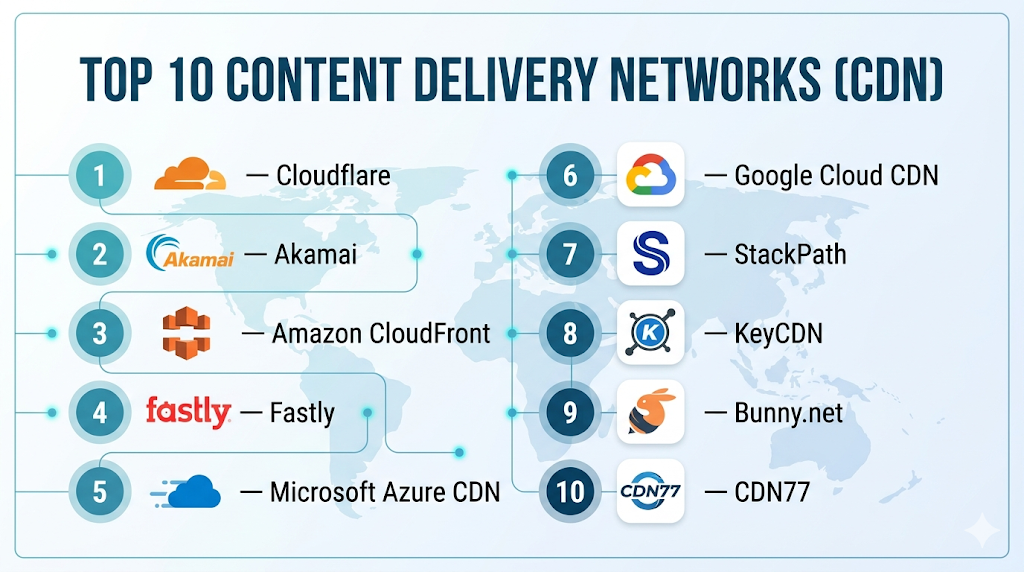
Top 10 Content Delivery Networks (CDN)
#1 — Cloudflare
Short description: Popular CDN offering performance, security, and edge computing features.
Key Features
- Global CDN network
- DDoS protection
- Web Application Firewall (WAF)
- Edge computing (Workers)
- DNS services
- SSL/TLS encryption
- Caching optimization
Pros
- Strong security features
- Easy to set up
Cons
- Advanced features require paid plans
- Limited customization at lower tiers
Platforms / Deployment
Cloud
Security & Compliance
SSL/TLS, WAF, DDoS protection, RBAC (certifications not publicly stated)
Integrations & Ecosystem
Broad integrations with cloud and web services.
- APIs
- DNS integration
- Edge functions
Support & Community
Large community and strong documentation.
#2 — Akamai
Short description: Enterprise-grade CDN with one of the largest global networks.
Key Features
- Massive global edge network
- Advanced caching
- DDoS protection
- Media delivery
- API acceleration
- Edge computing
- Security services
Pros
- Industry-leading performance
- Enterprise reliability
Cons
- Expensive
- Complex setup
Platforms / Deployment
Cloud
Security & Compliance
Enterprise-grade controls (details not publicly stated)
Integrations & Ecosystem
Enterprise ecosystem.
- APIs
- Security tools
- Media platforms
Support & Community
Premium enterprise support.
#3 — Amazon CloudFront
Short description: AWS CDN integrated with Amazon cloud ecosystem.
Key Features
- Global edge locations
- Integration with AWS services
- Real-time metrics
- Security features
- Caching controls
- API delivery
- Edge computing (Lambda@Edge)
Pros
- Deep AWS integration
- Scalable
Cons
- Complex pricing
- Requires AWS knowledge
Platforms / Deployment
Cloud
Security & Compliance
AWS security framework (details not publicly stated)
Integrations & Ecosystem
AWS ecosystem integrations.
- S3
- EC2
- APIs
Support & Community
Strong AWS support.
#4 — Fastly
Short description: High-performance CDN focused on real-time content delivery and edge computing.
Key Features
- Edge cloud platform
- Real-time caching
- Instant purging
- API-first architecture
- Security features
- Analytics
- Edge compute
Pros
- Fast performance
- Developer-friendly
Cons
- Pricing complexity
- Requires technical expertise
Platforms / Deployment
Cloud
Security & Compliance
Basic enterprise controls (details not publicly stated)
Integrations & Ecosystem
Developer-focused integrations.
- APIs
- Edge services
Support & Community
Strong developer support.
#5 — Microsoft Azure CDN
Short description: CDN service integrated with Microsoft Azure cloud platform.
Key Features
- Global network
- Integration with Azure services
- Caching rules
- Security features
- Analytics
- API acceleration
- Multi-CDN options
Pros
- Azure integration
- Scalable
Cons
- Limited outside Azure
- Setup complexity
Platforms / Deployment
Cloud
Security & Compliance
Azure security framework
Integrations & Ecosystem
Azure ecosystem integrations.
- APIs
- Cloud services
Support & Community
Strong Microsoft support.
#6 — Google Cloud CDN
Short description: CDN built into Google Cloud Platform for high-speed delivery.
Key Features
- Global edge network
- Load balancing integration
- Real-time analytics
- Security features
- Caching controls
- HTTP/3 support
- API delivery
Pros
- High performance
- Google infrastructure
Cons
- Limited outside GCP
- Requires cloud expertise
Platforms / Deployment
Cloud
Security & Compliance
Google security framework
Integrations & Ecosystem
GCP ecosystem integrations.
- APIs
- Cloud services
Support & Community
Strong enterprise support.
#7 — StackPath
Short description: CDN focused on performance, security, and edge computing.
Key Features
- Global CDN
- Edge computing
- DDoS protection
- WAF
- Analytics
- API support
- Real-time monitoring
Pros
- Balanced performance and cost
- Security features
Cons
- Smaller network
- Limited enterprise features
Platforms / Deployment
Cloud
Security & Compliance
WAF, DDoS protection (others not publicly stated)
Integrations & Ecosystem
Moderate integrations.
- APIs
- Cloud tools
Support & Community
Good support.
#8 — KeyCDN
Short description: Affordable CDN focused on simplicity and performance.
Key Features
- Global network
- Real-time analytics
- HTTP/2 support
- Instant purging
- API access
- Secure token authentication
- Low-latency delivery
Pros
- Cost-effective
- Easy to use
Cons
- Limited advanced features
- Smaller ecosystem
Platforms / Deployment
Cloud
Security & Compliance
Basic controls (not publicly stated)
Integrations & Ecosystem
Simple integrations.
- APIs
- CMS tools
Support & Community
Good documentation.
#9 — Bunny.net
Short description: High-performance and affordable CDN with developer-friendly features.
Key Features
- Global edge network
- Edge storage
- Video streaming
- Instant purging
- Security features
- Analytics
- API access
Pros
- Affordable pricing
- Fast performance
Cons
- Smaller brand recognition
- Limited enterprise features
Platforms / Deployment
Cloud
Security & Compliance
Basic controls (not publicly stated)
Integrations & Ecosystem
Developer-focused integrations.
- APIs
- Storage services
Support & Community
Growing community.
#10 — CDN77
Short description: CDN platform focused on media delivery and performance optimization.
Key Features
- Global CDN network
- Video streaming optimization
- Real-time analytics
- Security features
- API integration
- Instant purging
- Multi-CDN support
Pros
- Strong media delivery
- Good performance
Cons
- Limited ecosystem
- Pricing tiers
Platforms / Deployment
Cloud
Security & Compliance
Basic controls (not publicly stated)
Integrations & Ecosystem
Moderate integrations.
- APIs
- Media platforms
Support & Community
Good support.
Comparison Table (Top 10)
| Tool Name | Best For | Platform(s) Supported | Deployment | Standout Feature | Public Rating |
|---|---|---|---|---|---|
| Cloudflare | All users | Web | Cloud | Security + CDN combo | N/A |
| Akamai | Enterprise | Web | Cloud | Massive global network | N/A |
| Amazon CloudFront | AWS users | Web | Cloud | AWS integration | N/A |
| Fastly | Developers | Web | Cloud | Real-time edge delivery | N/A |
| Azure CDN | Azure users | Web | Cloud | Microsoft integration | N/A |
| Google Cloud CDN | GCP users | Web | Cloud | Google infrastructure | N/A |
| StackPath | SMB | Web | Cloud | Security + performance | N/A |
| KeyCDN | Budget users | Web | Cloud | Cost-effective | N/A |
| Bunny.net | Developers/SMB | Web | Cloud | Affordable performance | N/A |
| CDN77 | Media delivery | Web | Cloud | Video optimization | N/A |
Evaluation & Scoring of Content Delivery Networks (CDN)
| Tool Name | Core (25%) | Ease (15%) | Integrations (15%) | Security (10%) | Performance (10%) | Support (10%) | Value (15%) | Weighted Total |
|---|---|---|---|---|---|---|---|---|
| Cloudflare | 9 | 9 | 9 | 9 | 9 | 8 | 9 | 9.0 |
| Akamai | 10 | 6 | 9 | 10 | 10 | 9 | 6 | 8.9 |
| Amazon CloudFront | 9 | 7 | 10 | 9 | 9 | 8 | 7 | 8.7 |
| Fastly | 9 | 7 | 9 | 8 | 10 | 8 | 7 | 8.6 |
| Azure CDN | 8 | 7 | 9 | 9 | 9 | 8 | 7 | 8.3 |
| Google Cloud CDN | 8 | 7 | 9 | 9 | 9 | 8 | 7 | 8.3 |
| StackPath | 7 | 8 | 7 | 8 | 8 | 7 | 8 | 7.7 |
| KeyCDN | 7 | 9 | 6 | 7 | 8 | 7 | 9 | 7.8 |
| Bunny.net | 8 | 9 | 7 | 7 | 9 | 7 | 9 | 8.1 |
| CDN77 | 8 | 8 | 7 | 7 | 9 | 7 | 8 | 8.0 |
Interpretation:
Scores reflect comparative strengths across performance, security, and value. Enterprise CDNs excel in performance and security, while smaller providers offer better affordability and ease of use.
Which CDN Is Right for You?
Solo / Freelancer
- Best: KeyCDN, Bunny.net
- Affordable and simple
SMB
- Best: Cloudflare, StackPath
- Balance of cost and features
Mid-Market
- Best: Fastly, Amazon CloudFront
- Performance and scalability
Enterprise
- Best: Akamai, Cloudflare, Azure CDN
- Global scale and security
Budget vs Premium
- Budget: KeyCDN, Bunny.net
- Premium: Akamai, Fastly
Feature Depth vs Ease of Use
- Feature-heavy: Akamai, Fastly
- Easy-to-use: Cloudflare, KeyCDN
Integrations & Scalability
- Strong: AWS, Azure, Google
- Moderate: KeyCDN
Security & Compliance Needs
- Enterprise-grade: Cloudflare, Akamai
- Basic: KeyCDN, Bunny.net
Frequently Asked Questions (FAQs)
What is a CDN?
A CDN is a network of servers that delivers content faster by serving it from locations closer to users.
Why is a CDN important?
It improves website speed, performance, and security.
Do CDNs improve SEO?
Yes, faster websites generally rank better in search engines.
Can CDNs handle dynamic content?
Yes, modern CDNs support dynamic and API content.
Are CDNs secure?
Most CDNs include security features like DDoS protection and WAF.
Do I need a CDN for a small website?
Not always, but it can still improve performance.
What is edge computing in CDNs?
It allows code execution closer to users for faster processing.
How much does a CDN cost?
Pricing varies from free tiers to enterprise pricing.
Can CDNs integrate with cloud platforms?
Yes, most CDNs integrate with AWS, Azure, and GCP.
What is the future of CDNs?
Edge computing, AI optimization, and enhanced security.
Conclusion
Content Delivery Networks have become a foundational layer of modern internet infrastructure, ensuring fast, reliable, and secure content delivery across the globe. From enterprise-grade platforms like Akamai and Cloudflare to cost-effective solutions like Bunny.net and KeyCDN, organizations have a wide range of options depending on their scale and requirements. While large enterprises benefit from advanced security and global reach, smaller businesses can achieve significant performance gains with simpler and more affordable CDNs. The best approach is to evaluate your traffic patterns, geographic audience, and security needs, then test a few CDN providers to ensure optimal performance and integration with your existing systems before making a final decision.
