Introduction
Podcast hosting platforms are specialized services that store, distribute, and manage podcast audio files. Instead of uploading episodes directly to apps like Spotify or Apple Podcasts, creators use these platforms to host content, generate RSS feeds, and distribute episodes across multiple listening pla, podcast hosting has evolved beyond simple storage. Modern platforms now include AI-powered editing, analytics, monetization tools, and audience engagement features, making them critical infrastructure for creators, brands, and media companies.
Real-world use cases:
- Independent creators launching and growing podcasts
- Businesses using podcasts for content marketing
- Media companies managing multiple shows
- Educators distributing audio-based learning
- Influencers monetizing audio content
What buyers should evaluate:
- Ease of use and onboarding
- Distribution reach (Spotify, Apple Podcasts, etc.)
- Analytics depth and accuracy
- Monetization capabilities
- Storage and bandwidth limits
- Editing and production tools
- Integration with marketing tools
- Pricing structure and scalability
- Security and access control
Best for: Creators, marketers, media teams, and businesses of all sizes looking to publish, grow, and monetize podcasts.
Not ideal for: Users who only need basic audio storage or internal file sharing—general cloud storage or CMS platforms may be sufficient in those cases.
Key Trends in Podcast Hosting Platforms
- AI-assisted production: Automated editing, noise reduction, and transcription are becoming standard.
- Built-in monetization: Subscriptions, dynamic ad insertion, and sponsorship marketplaces are integrated into platforms.
- Video podcast support: Growing demand for video-first podcasts across platforms like YouTube.
- Advanced analytics: Listener behavior tracking, retention graphs, and demographic insights are improving.
- Cross-platform distribution automation: One-click publishing across dozens of directories.
- Audience engagement tools: Comments, polls, and listener interaction features are emerging.
- Integration-first ecosystems: Seamless connections with marketing, CRM, and social tools.
- Scalable pricing models: Usage-based and tiered plans tailored for creators and enterprises.
- Privacy and compliance awareness: GDPR-focused analytics and data handling practices.
- Mobile-first workflows: Full podcast management from mobile apps is increasingly common.
How We Selected These Tools (Methodology)
- Evaluated market adoption and brand recognition
- Assessed feature completeness and innovation
- Considered ease of use for beginners and professionals
- Reviewed performance and reliability signals
- Analyzed integration ecosystems and APIs
- Looked at monetization capabilities
- Considered security posture and compliance signals
- Evaluated customer fit across solo creators to enterprises
- Prioritized tools with ongoing development and relevance in 2026
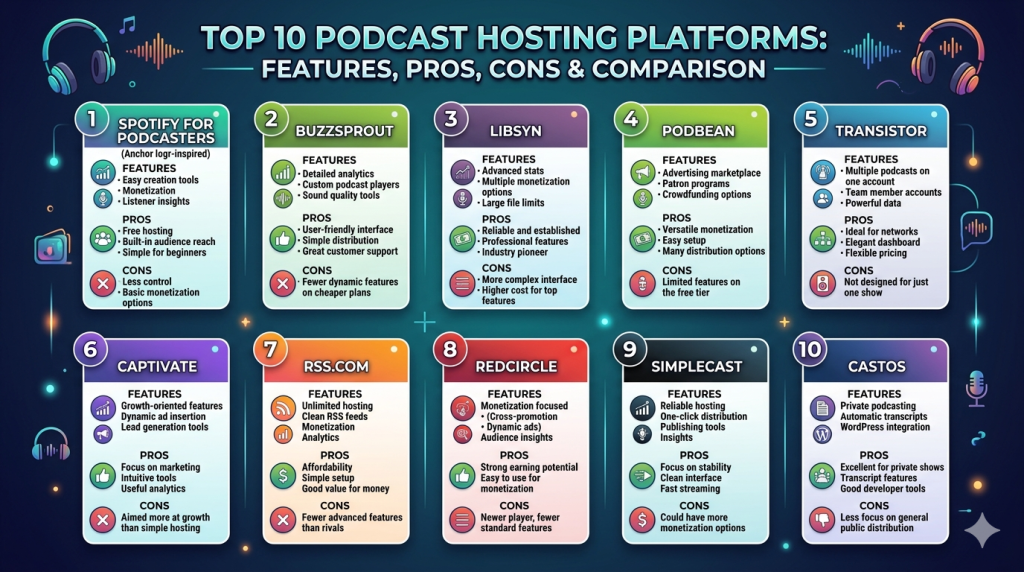
Top 10 Podcast Hosting Platforms Tools
#1 — Spotify for Podcasters (formerly Anchor)
Short description: A free, beginner-friendly podcast hosting platform tightly integrated with Spotify’s ecosystem. Ideal for new creators.
Key Features
- Free hosting and unlimited uploads
- One-click Spotify distribution
- Built-in recording and editing tools
- Monetization via ads and subscriptions
- Listener analytics dashboard
- Mobile app support
- RSS feed generation
Pros
- Completely free to start
- Extremely easy for beginners
Cons
- Limited advanced analytics
- Less control for professional workflows
Platforms / Deployment
Web / iOS / Android
Cloud
Security & Compliance
Basic account security features; Not publicly stated for enterprise compliance.
Integrations & Ecosystem
Strong integration with Spotify ecosystem and distribution channels.
- Spotify
- Apple Podcasts
- Google Podcasts
- RSS-based platforms
Support & Community
Good documentation and large creator community; limited direct support tiers.
#2 — Buzzsprout
Short description: A user-friendly platform focused on simplicity, analytics, and distribution for growing podcasters.
Key Features
- Easy episode uploads and publishing
- Advanced analytics dashboard
- Automatic optimization of audio files
- Monetization marketplace
- Website hosting for podcasts
- Transcription services
- Magic Mastering (audio enhancement)
Pros
- Clean interface and easy setup
- Strong analytics for SMB users
Cons
- Limited storage on lower plans
- Pricing increases with usage
Platforms / Deployment
Web
Cloud
Security & Compliance
Not publicly stated
Integrations & Ecosystem
- Podcast directories
- Affiliate marketing tools
- Transcription services
Support & Community
Strong support and onboarding resources; active community.
#3 — Libsyn
Short description: One of the oldest podcast hosting platforms, known for reliability and scalability.
Key Features
- Reliable media hosting
- Advanced distribution options
- Monetization tools
- Custom mobile apps
- Detailed analytics
- Multiple show management
- Advertising marketplace
Pros
- Highly reliable infrastructure
- Good for scaling multiple shows
Cons
- Outdated interface
- Learning curve for beginners
Platforms / Deployment
Web
Cloud
Security & Compliance
Not publicly stated
Integrations & Ecosystem
- Podcast apps
- Ad networks
- Custom integrations
Support & Community
Established community; support quality varies.
#4 — Podbean
Short description: A full-featured hosting platform offering monetization, live streaming, and podcast apps.
Key Features
- Unlimited hosting plans
- Built-in monetization
- Live streaming capabilities
- Podcast website builder
- Analytics dashboard
- Mobile app support
- Patron support system
Pros
- Strong monetization options
- Versatile feature set
Cons
- UI can feel cluttered
- Advanced features require higher plans
Platforms / Deployment
Web / iOS / Android
Cloud
Security & Compliance
Not publicly stated
Integrations & Ecosystem
- Payment platforms
- Podcast directories
- Live streaming tools
Support & Community
Good support; active user base.
#5 — Transistor
Short description: A modern podcast hosting platform focused on analytics, private podcasts, and team collaboration.
Key Features
- Multiple podcasts under one account
- Private podcast support
- Advanced analytics
- Team collaboration features
- Embeddable players
- Custom domains
- API access
Pros
- Great for teams and businesses
- Clean and modern UI
Cons
- Higher pricing tiers
- Limited built-in editing tools
Platforms / Deployment
Web
Cloud
Security & Compliance
Not publicly stated
Integrations & Ecosystem
- Marketing tools
- Analytics tools
- API for custom workflows
Support & Community
Responsive support; strong documentation.
#6 — Captivate
Short description: A growth-focused podcast hosting platform with strong marketing and analytics features.
Key Features
- Unlimited podcasts and uploads
- Advanced audience analytics
- Call-to-action tools
- Dynamic content insertion
- Marketing integrations
- Podcast websites
- Subscriber growth tools
Pros
- Built for growth and marketing
- Unlimited hosting structure
Cons
- Slight learning curve
- Pricing tiers can be complex
Platforms / Deployment
Web
Cloud
Security & Compliance
Not publicly stated
Integrations & Ecosystem
- Email marketing tools
- Analytics platforms
- Podcast directories
Support & Community
Strong onboarding and support resources.
#7 — RSS.com
Short description: A cost-effective podcast hosting platform with simple pricing and solid distribution features.
Key Features
- Unlimited episodes
- Automated distribution
- Sponsorship opportunities
- Podcast analytics
- Website hosting
- Cross-platform support
Pros
- Affordable pricing
- Simple to use
Cons
- Limited advanced features
- Smaller ecosystem
Platforms / Deployment
Web
Cloud
Security & Compliance
Not publicly stated
Integrations & Ecosystem
- Podcast directories
- Basic marketing tools
Support & Community
Moderate support; growing community.
#8 — RedCircle
Short description: A platform focused on monetization and cross-promotion for podcasters.
Key Features
- Dynamic ad insertion
- Cross-promotion marketplace
- Listener donations
- Subscription support
- Analytics tools
- Collaboration features
Pros
- Strong monetization focus
- Free entry-level plan
Cons
- Less focus on editing tools
- Analytics depth varies
Platforms / Deployment
Web
Cloud
Security & Compliance
Not publicly stated
Integrations & Ecosystem
- Ad marketplaces
- Podcast networks
Support & Community
Good support; active monetization-focused community.
#9 — Simplecast
Short description: A professional podcast hosting platform with strong analytics and distribution features.
Key Features
- Advanced analytics
- Team collaboration
- Distribution management
- Custom players
- API access
- Multi-show support
Pros
- Professional-grade analytics
- Scalable for teams
Cons
- Premium pricing
- Less beginner-friendly
Platforms / Deployment
Web
Cloud
Security & Compliance
Not publicly stated
Integrations & Ecosystem
- Analytics tools
- Marketing platforms
- API integrations
Support & Community
Strong enterprise-level support.
#10 — Castos
Short description: A podcast hosting platform integrated with WordPress and focused on automation and private podcasting.
Key Features
- WordPress integration
- Private podcasting
- Automated transcription
- Video podcast support
- Analytics dashboard
- Unlimited storage
Pros
- Excellent for WordPress users
- Automation features
Cons
- Limited outside WordPress ecosystem
- UI could be improved
Platforms / Deployment
Web
Cloud
Security & Compliance
Not publicly stated
Integrations & Ecosystem
- WordPress
- Marketing tools
- Podcast directories
Support & Community
Good support; niche community.
Comparison Table (Top 10)
| Tool Name | Best For | Platform(s) Supported | Deployment | Standout Feature | Public Rating |
|---|---|---|---|---|---|
| Spotify for Podcasters | Beginners | Web, iOS, Android | Cloud | Free hosting | N/A |
| Buzzsprout | SMB creators | Web | Cloud | Magic Mastering | N/A |
| Libsyn | Scaling podcasts | Web | Cloud | Reliability | N/A |
| Podbean | Monetization | Web, iOS, Android | Cloud | Live streaming | N/A |
| Transistor | Teams | Web | Cloud | Private podcasts | N/A |
| Captivate | Growth-focused users | Web | Cloud | Marketing tools | N/A |
| RSS.com | Budget users | Web | Cloud | Simple pricing | N/A |
| RedCircle | Monetization | Web | Cloud | Cross-promotion | N/A |
| Simplecast | Professionals | Web | Cloud | Advanced analytics | N/A |
| Castos | WordPress users | Web | Cloud | WP integration | N/A |
Evaluation & Scoring of Podcast Hosting Platforms
| Tool Name | Core (25%) | Ease (15%) | Integrations (15%) | Security (10%) | Performance (10%) | Support (10%) | Value (15%) | Weighted Total |
|---|---|---|---|---|---|---|---|---|
| Spotify for Podcasters | 8 | 10 | 7 | 6 | 8 | 7 | 10 | 8.4 |
| Buzzsprout | 8 | 9 | 7 | 6 | 8 | 8 | 7 | 7.9 |
| Libsyn | 9 | 6 | 7 | 6 | 9 | 7 | 7 | 7.8 |
| Podbean | 8 | 8 | 7 | 6 | 8 | 7 | 8 | 7.9 |
| Transistor | 9 | 8 | 8 | 6 | 8 | 8 | 7 | 8.0 |
| Captivate | 9 | 7 | 8 | 6 | 8 | 8 | 7 | 7.9 |
| RSS.com | 7 | 8 | 6 | 6 | 7 | 7 | 9 | 7.6 |
| RedCircle | 8 | 8 | 7 | 6 | 7 | 7 | 8 | 7.7 |
| Simplecast | 9 | 7 | 8 | 6 | 9 | 8 | 6 | 7.9 |
| Castos | 8 | 7 | 7 | 6 | 8 | 7 | 8 | 7.7 |
How to interpret scores:
- Scores are relative comparisons, not absolute benchmarks.
- A higher score reflects better balance across features, usability, and value.
- Differences within 0.2–0.4 are often minor in real-world usage.
- Choose based on fit for your use case, not just total score.
Which Podcast Hosting Platforms Tool Is Right for You?
Solo / Freelancer
- Best choices: Spotify for Podcasters, Buzzsprout, RSS.com
- Focus on ease of use, low cost, and simple publishing workflows.
SMB
- Best choices: Buzzsprout, Podbean, Captivate
- Look for analytics, monetization, and marketing integrations.
Mid-Market
- Best choices: Transistor, Simplecast
- Prioritize team collaboration, scalability, and analytics depth.
Enterprise
- Best choices: Simplecast, Libsyn
- Focus on reliability, multi-show management, and integrations.
Budget vs Premium
- Budget: Spotify for Podcasters, RSS.com
- Premium: Simplecast, Transistor
Feature Depth vs Ease of Use
- Easy: Spotify for Podcasters, Buzzsprout
- Feature-rich: Captivate, Simplecast
Integrations & Scalability
- Strong ecosystems: Transistor, Simplecast
- Basic integrations: RSS.com
Security & Compliance Needs
- Most tools: Basic security
- Enterprise-grade compliance: Not publicly stated across most platforms
Frequently Asked Questions (FAQs)
What is a podcast hosting platform?
A service that stores audio files and distributes them to podcast directories via RSS feeds.
Do I need hosting to start a podcast?
Yes, unless you use platforms that bundle hosting and distribution together.
Are free podcast hosting platforms good?
They work well for beginners but may lack advanced features.
How do podcast platforms make money?
Through subscriptions, ads, and monetization tools.
Can I switch hosting platforms later?
Yes, via RSS feed redirection, though it requires careful setup.
What is dynamic ad insertion?
A feature that allows ads to be inserted into episodes dynamically.
Do these platforms support video podcasts?
Some platforms like Podbean and Castos support video.
How important are analytics?
Very important for growth, monetization, and audience understanding.
Are podcast platforms secure?
Basic security is standard, but enterprise compliance is often not publicly stated.
What’s the biggest mistake beginners make?
Choosing a platform without considering future scalability.
Conclusion
Podcast hosting platforms have become full-stack content ecosystems, offering far more than just storage. From AI-powered production to monetization and analytics, the right tool can significantly impact your podcast’s growth and sustainability.
There’s no single “best” platform—your choice depends on your goals, budget, and technical needs. Beginners may prefer simplicity, while teams and businesses need scalability and integrations.
